
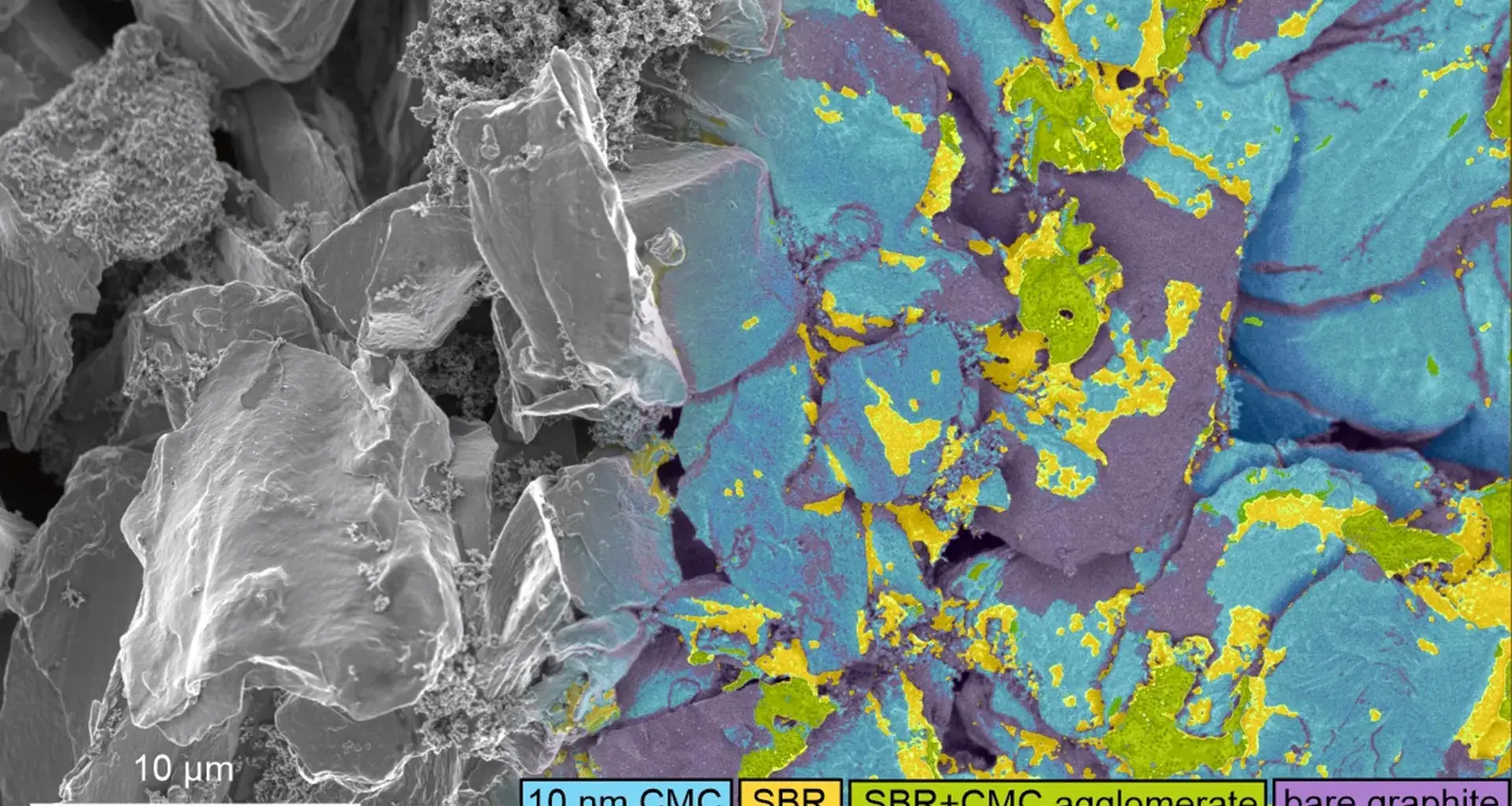
A team at the University of Oxford has created an advanced technique that makes it possible to clearly see a vital component inside lithium-ion battery electrodes that scientists have struggled to track. The findings, published on February 17 in Nature Communications, could make battery manufacturing more efficient and help improve both charging speed and the overall lifespan of Li-ion batteries.
The research zeroed in on polymer binders used in the negative electrodes of lithium-ion batteries (anodes). These binders act like a glue that holds the electrode materials together. Even though they account for less than 5% of the electrode’s total weight, they strongly influence mechanical strength, electrical and ionic conductivity, and how long a battery can operate through repeated charge cycles.
Because binders are present in such small amounts and lack clear visual signatures, scientists have had difficulty determining exactly where they are located within the electrode. This has limited efforts to fine tune battery performance, since the way binders are distributed directly affects conductivity, structural stability, and long term durability.
Patent Pending Staining Technique Reveals Hidden Structure
To overcome this obstacle, the researchers designed a patent-pending staining approach that attaches traceable silver and bromine markers to widely used cellulose- and latex-based binders in graphite- and silicon-based anodes. Once labeled, the binders can be detected because they emit characteristic X-rays (measured with energy-dispersive X-ray spectroscopy) or reflect high-energy electrons from the sample surface (measured with energy-selective backscattered electron imaging).
When viewed under an electron microscope, these signals provide detailed maps of where specific elements are located and what the electrode surface looks like. This allows scientists to analyze binder distribution with far greater precision than before.
Lead author Dr. Stanislaw Zankowski (Department of Materials, University of Oxford) said: “This staining technique opens up an entirely new toolbox for understanding how modern binders behave during electrode manufacturing. For the first time, we can accurately see the distribution of these binders not only generally (i.e., their thickness throughout the electrode), but also locally, as nanoscale binder layers and clusters, and correlate them with anode performance.”
The method works with standard graphite electrodes as well as advanced materials such as silicon or SiOx, making it relevant for both current lithium-ion batteries and next-generation designs.
Faster Charging and Longer Battery Life
By applying the new imaging tool, the team discovered that even subtle shifts in binder distribution can significantly change how efficiently a battery charges and how long it lasts. In testing, adjustments to slurry mixing and drying steps reduced the internal ionic resistance of experimental electrodes by as much as 40% — a major barrier to fast charging.
The researchers also captured detailed images of extremely thin layers of carboxymethyl cellulose (CMC) binder that coat graphite particles. The technique enabled clear detection of CMC layers just 10 nm thick and visualized structures spanning four orders of magnitude within a single image. The images revealed that what begins as a uniform CMC coating can break apart into uneven, patchy fragments during electrode processing, which may weaken battery performance and stability.
Co-author Professor Patrick Grant (Department of Materials, University of Oxford) said: “This multidisciplinary effort-spanning chemistry, electron microscopy, electrochemical testing, and modelling- has resulted in an innovative imaging approach that will help us to understand key surface processes that affect battery longevity and performance. This will drive forward advancements across a wide range of battery applications.”
The work was supported by the Faraday Institution’s Nextrode project and has already drawn significant interest from industry, including major battery producers and electric vehicle manufacturers.