
Every day at work, Louise Duffy carefully sets up her phone to film and upload videos of day-to-day life in a busy chipper. The Instagram and TikTok clips are watched by thousands of people across Ireland, with the backlit menus and shiny silver counter of Rio’s Fish and Chips in Castletroy, Co Limerick, now a familiar sight for the ever-growing number of viewers.
Duffy has been manager and supervisor of Rio’s since it reopened in August 2024 under new ownership, the previous iteration having closed during the pandemic. The business struggled with retaining customers in the first few months after it opened, until Duffy learned from a friend how social media could be harnessed to change a business’s fortunes.
“I am a personal friend of Lee Reeves, the boxer [who has more than 60,000 TikTok followers],” says Duffy. “I asked him would he come over and do a little promotional video for Rio’s for me, as a friend, and to be honest in it. So he came in and did a food review in December 2024. When he did the food review, we were inundated with business. People got a true sense of who we were at that time. It was like we relaunched Rio’s through Lee.”
After this experience, Duffy started posting about Rio’s on social media herself. Last October, she started daily posts, with her content ranging from showcasing new and creative menu items or banter with other staff, to interactions with customers.
Duffy wanted to see if regular social media posts could help the chipper to attract more customers in a challenging market. The idea worked and she links it directly with an increase in customers.
“We’ve gone up nearly 40 per cent in sales since I started posting on social media every day,” she says. “With the volume of customers coming through the door, there’s five of us behind the counter now, it’s that busy. It went from three staff a night, to five a night, and we could do with six a night at this stage.
“[Posting on social media] has been absolutely fantastic for business, and I don’t think we would thrive without it.”
Duffy has also found that posting on social media led to higher standards, as customers naturally expect the food from Rio’s to look the same as it does on social media.
“What I put out in the videos is obviously the best food I can put out, so those standards have to be maintained for customers too. It’s a lot of pressure, and it’s a lot of extra work, but it makes a massive difference.”
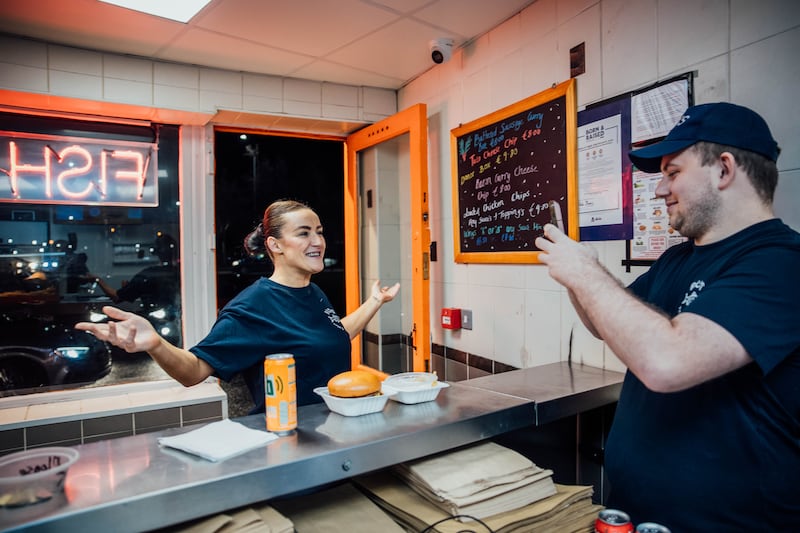 Rio’s manager Louise Duffy making a social media video with staff member Lee McAllister. Photograph: Brian Arthur
 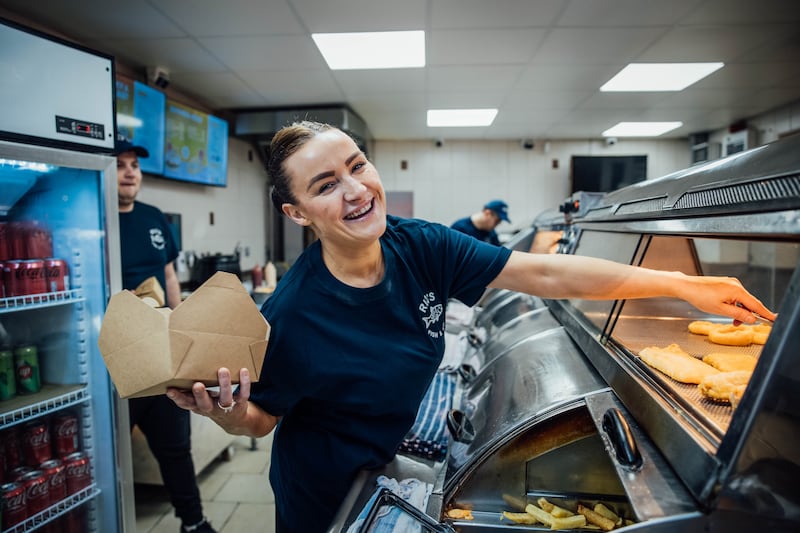 Louise Duffy at work in Rio’s. Photograph: Brian Arthur
Duffy’s use of social media and turning viewers into customers is just one way of innovating as chippers fight for their share of the food market.
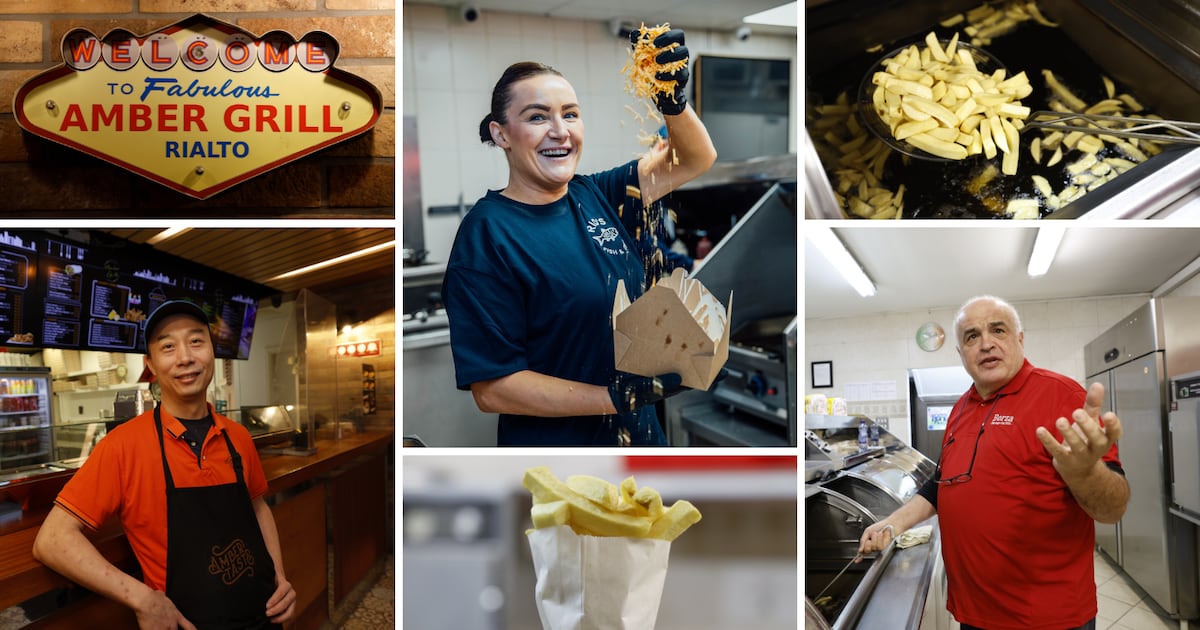
In Rialto, Dublin, customers of Amber Grill can choose from a standard chipper menu and a fully vegan chipper menu. The owner, Jay Chen, decided to add the vegan menu after he picked up on growing demand. He also saw it as a way for his chipper to stand out in a crowded market.
“I’ve been a chef for many years, and I knew that many people in Ireland were vegan and vegetarian,” says Chen. “And after we took over Amber Grill in 2022, some local customers came in and asked us if we did vegan food. After that, we decided to add a vegan menu.
“Our sales went up a lot after we put in the vegan menu; about 25 per cent of our sales are from it now. We didn’t think it would be that popular when we started it, but quite a lot of people had asked for it. Our Beyond Meat burger is the most popular item on our vegan menu – we sell about 100 of them a week.”
As someone with considerable experience in the food industry, Chen has seen how the Irish palate has changed, even in the last decade alone, and how the basic fish and chips package is no longer the biggest seller in chippers.
“Fish isn’t as popular as it used to be in chippers,” he says. “Ten years ago, I worked in another chipper, and we’d do loads of fish, but now the most popular item on our menu is burger and chips.”
Proof that the fast-food market has changed comes in the closure of a number of outlets within the last couple of years, including Jackie Lennox’s in Cork and Munchies in Bayside, Dublin.
The reasons for the closures are many. Jackie Lennox’s cited difficulty recruiting staff and high levels of paperwork, the owners of Munchies were retiring, while the Restaurants Association of Ireland (RAI) says conditions continue to be difficult for chippers in 2026.
“Many chippers and traditional fish and chip shops fall within the remit of the Restaurants Association of Ireland,” a spokesperson for the RAI said. “A number of our members operate in the takeaway and fast-casual sector, including long-established, family-run chippers that play an important role in towns and villages across the country.
“We have seen evidence of closures over the last two years, particularly among smaller family businesses. These closures are often linked to rising costs and falling margins.
“Conditions for chip shop operators, like all food businesses, are challenging. The sector has been hit by rising input costs, increasing labour costs, higher energy bills, insurance and the impact of the 13.5 per cent VAT rate, which will thankfully return to 9 per cent in July 2026. Many operators are finding the cost of doing business extremely difficult, with margins being eroded entirely.”
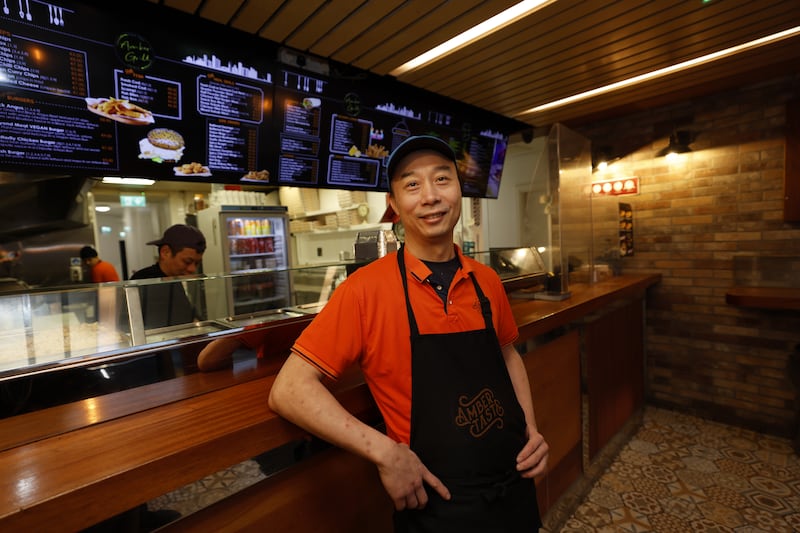 Jay Chen, who took over the Amber Grill in Rialto, Dublin, in 2022. Photograph: Nick Bradshaw
 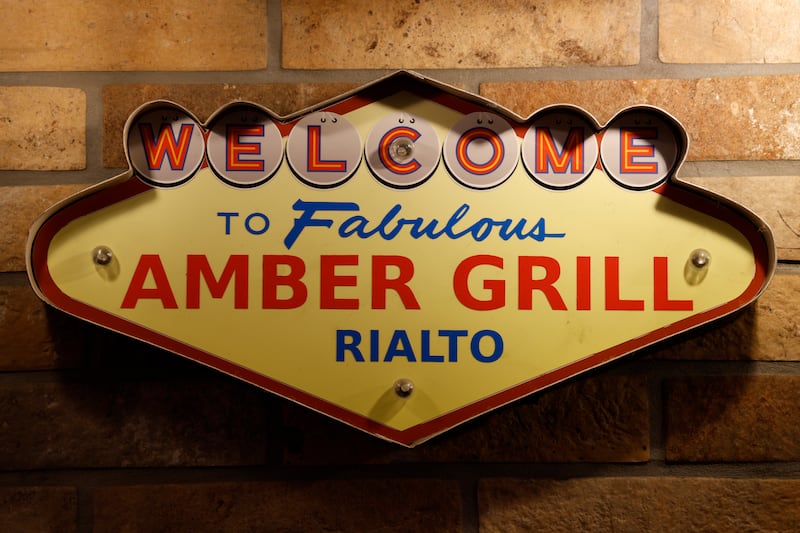 The Amber Grill in Rialto serves a vegan menu. Photograph: Nick Bradshaw
Back in Rialto, Chen has observed a reluctance within the next generation of people whose parents run chippers to take over.
“A lot of the other chippers are run by Italian families, and the owners are getting older, and their children don’t want to carry on the business,” he says.
“Running a takeaway is hard work, I think most people would rather work in an office. My partner and I work more than 50 hours a week running Amber Grill.”
Amber Grill, was run by an Italian family for many decades before Chen bought it, and he is proud to carry on the Italian tradition.
“Before we took it over, it was run by an Italian family,” he says. “Their son would still help out in the shop some weekends after we took over, but he had another job that was full time.
“When we took over Amber Grill, we wanted to follow in the footsteps of the family who ran it before us. We didn’t want to change much. And we knew it was in a good location, so we wanted to keep it going.”
Also proud to carry on the tradition of chippers is Teresa Borza Di Nardi, who owns Borza in Tallaght village, Dublin. Her parents established the chipper in 1972, after previously establishing chippers in the Churchtown and Parnell Street areas of Dublin.
“I think the reason we’ve lasted so long in Tallaght is because Borza’s has been family-run by the same family for decades,” says Borza Di Nardi. “And you’ll never go into Borza and find only staff – there’s always a member of the family here.
“That’s a thing that came from my mam and dad. We have very loyal staff, but they felt it was important to always have someone from the family in the shop.
“And my mam always said, ‘Never serve something you wouldn’t eat yourself’.”
Borza Di Nardi has clear memories of coming home from school as a child and helping out in the family business. While her own children have gone on to work in other industries, she says her nephews will probably carry on the business in the future. However, she is concerned that traditional Italian chippers might disappear from Irish towns and cities.
“I think in 15 or 20 years’ time, there’ll be very few Italian families running chippers, but I hope I’m wrong,” she says. “I’d hate to see them go, but the overall costs are so high.
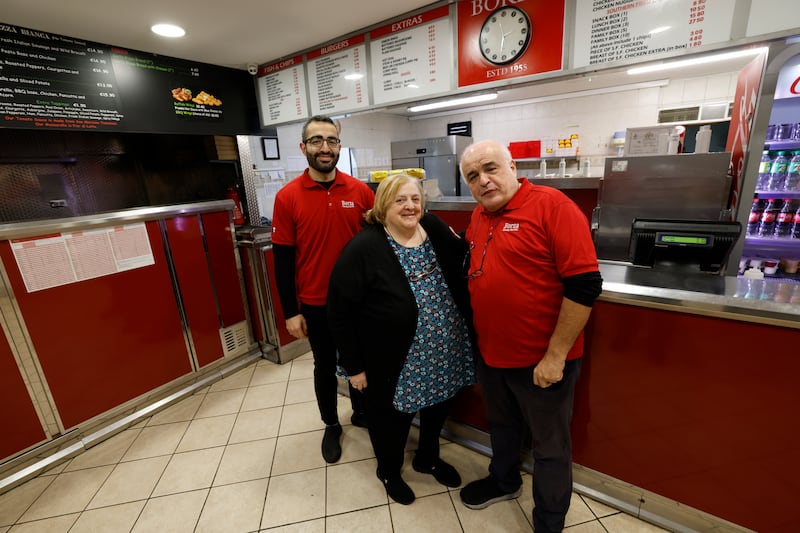 Alberto Borza, Teresa Borza Di Nardi and Loreto Borza in family-run Borza’s in Tallaght, Dublin. Photograph: Nick Bradshaw
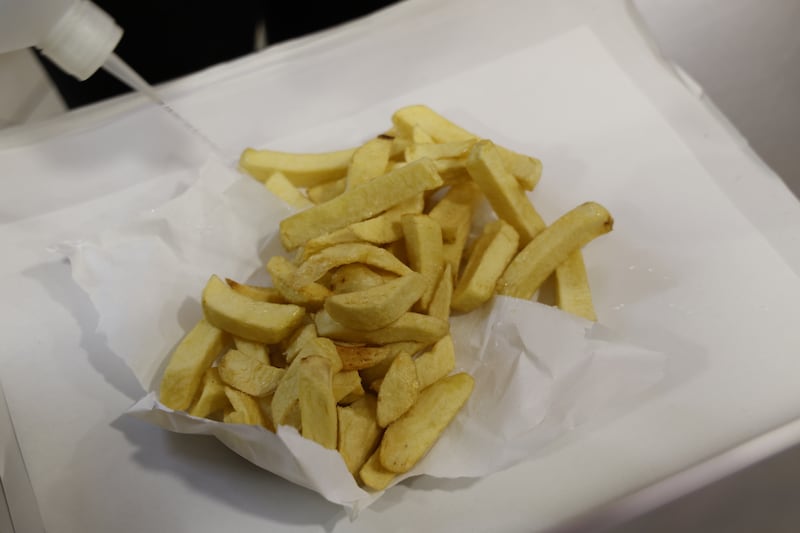 Chips ready for a customer at Borza’s. Photograph: Nick Bradshaw
“I have cousins who run chippers, and four or five of them are selling their chippers. They want out of the business. I think it’s quite sad to be honest.
“My mam and dad worked so hard to build the business. They worked very hard and very long hours all their lives, and they worked hard for every penny they earned. I think it’s very sad that we could be coming to an end of an era and a family tradition.
“But working here isn’t just a job for me and my family, it’s our life. We’ve never really considered it a job; it’s just something we were born into.”
In Castletroy, Duffy from Rio’s is confident that chippers will remain within the fabric of Irish life.
[ Best places for fish and chips in IrelandOpens in new window ]
“I’m positive about the future of chippers,” she says. “But you have to move with the times; you can’t stay back in the past. If you’re willing to move with the times and put in the extra bit of graft, you’re going to get the results for it. If you’re not going to do that, and your quality’s lacking, people aren’t going to keep coming to you.”