
What was once known as Billy Williams’s cabbage patch is now one of the globe’s most intimidating rugby venues. After Eden Park in Auckland and Ellis Park in Johannesburg, Twickenham ranks as one of the rugby world’s most difficult stadiums for away teams to navigate.
Each venue has its own greeting rituals.
In Auckland, crowds of Kiwis all gave us the middle finger. Charming.
Driving into Ellis Park, the windows of our team buses were pelted with hundreds of fleshy oranges.
We later found out that the oranges were injected with vodka and after the locals had sucked the combination dry, the drained fruit then became a projectile.
We chalked that up as a win for environmental recycling.
Entering Twickenham is a totally different experience. “Twickers” is a place where the long-dead persona of Britannia is resurrected from its cryonic state for a few brief hours at every home match.
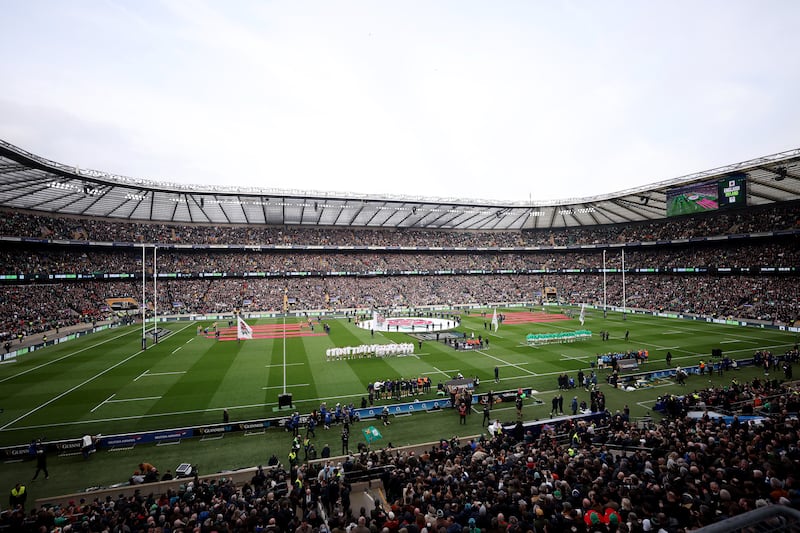 The England and Ireland squads prepare to meet at their Six Nations match in Twickenham on March 9th, 2024. Photograph: Catherine Ivill/Getty Images
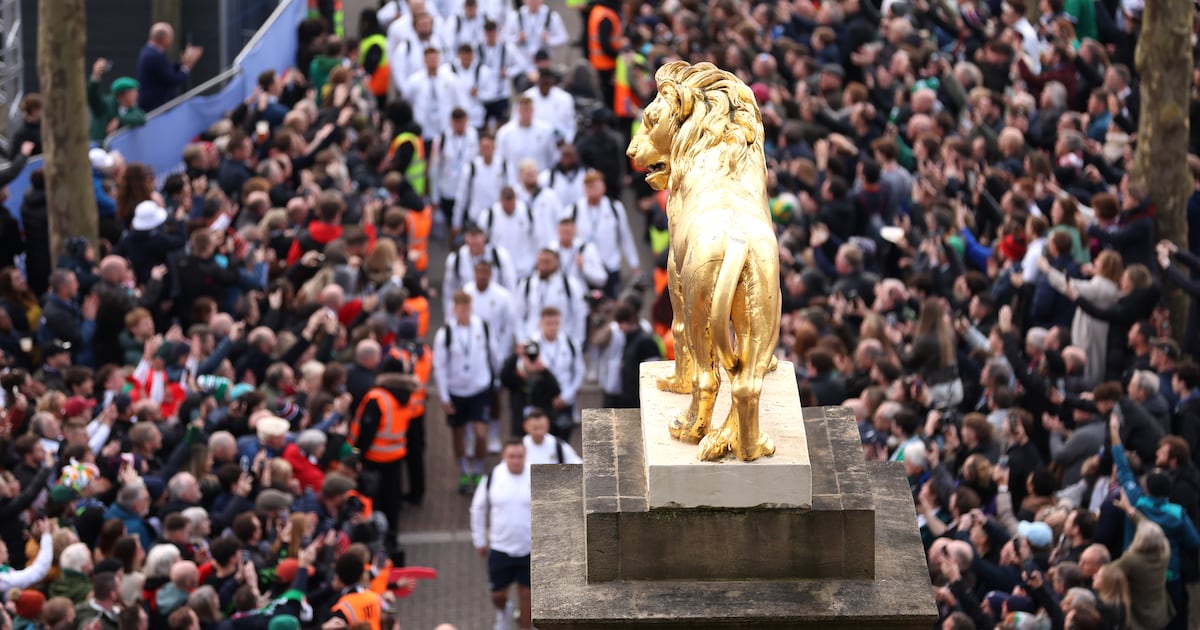
The golden lion statue that graces the entrance should provide the hint that you are entering a theatre. The theme of the pantomime is that the Empire still lives and everyone – including the Celtic visitors – is encouraged to play their part.
The guests are never the villains. That would be far too impolite.
Like the scene from Monty Python’s The Life of Brian, where those who are condemned to be crucified are met by the urbanely polite Michael Palin, who kindly asks each person, “Crucifixion? This way please …”
The visiting team are greeted with looks of sympathy that a cancer patient might encounter when they turn up for their first round of chemotherapy. “Poor devils,” they mumble.
Michael Palin’s avatar hurries you along. “Away, change room? Just on the right. There’s a good lad.”
Awaiting in the dressing room is a large pot of hot tea and a generous plate of creamy biscuits.
The psychological war is in full swing.
During your team warm-up, the crowd begin their renditions of the Empire’s hymns. William Blake’s Jerusalem is sung. Recalling the possibility of Jesus walking on England’s green fields. The theological and historical impossibility is irrelevant because we are now neck deep in Twickers theatrics.
As Swing Low, Sweet Chariot explodes from the stands, Twickenham is fighting to get inside the head of every player.
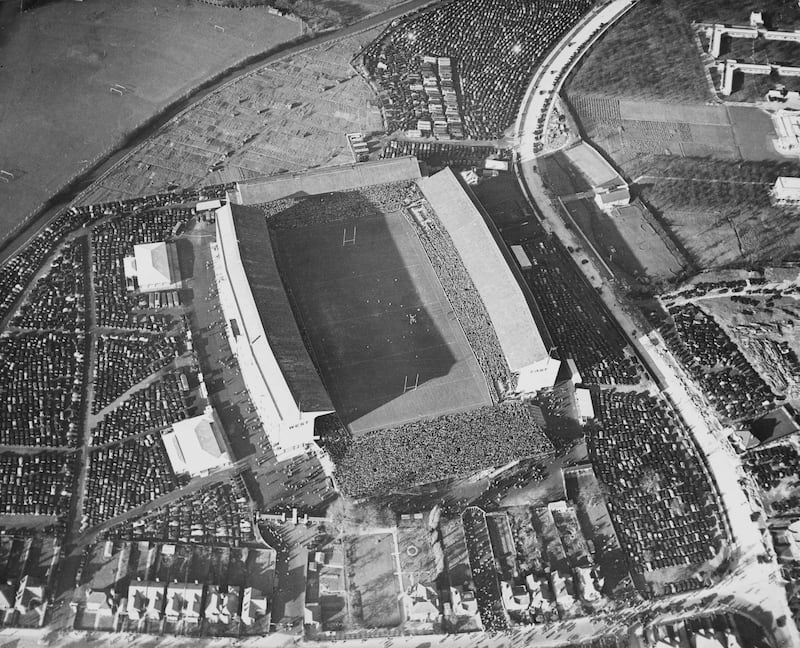 Aerial view of Twickenham Stadium in southwest London in 1939. Photograph: Central Press/Hulton Archive/Getty Images
Part of Rome’s majesty was aimed at intimidating foreign ambassadors. Saying, “Don’t mess with us.” The cabbage patch thrives on the same concept.
At this point, for the visiting players there are only two possible outcomes.
For the mentally weak, the golden lion, the hymns, the trappings of empire, the overtly polite implied superiority will subliminally distract the individual, telling them that today is not their day.
The mentally strong will react in the opposite direction. They will find the clarity to see through the facade and create their own internal energy. Manipulating their environment to produce the fuel that empowers them to access the full range of their rugby competencies.
[ Ireland must keep guard raised against wounded beast at TwickenhamOpens in new window ]
Inside Twickenham, you either become intimidated or you compartmentalise the situation down to the fact that you are playing a team whose emblem is a rose, on an old veggie garden, and if you hit the players inside those white jerseys hard enough and often enough, those pristine shirts will begin to turn red.
For thousands of years, empires have only understood a message when it is delivered with brutal physicality. I know that sounds very Neanderthal, but to beat England at any sport, across every epoch, requires physical domination.
The Scots proved that last weekend.
The extreme physicality of Test match rugby demands that those who play to win must bring a high level of emotion to their performance.
If a team’s emotion is too high, players lose control and give away penalties. If it is too low, as was the case with Ireland in Paris two weeks ago, then the opposition will bash you up.
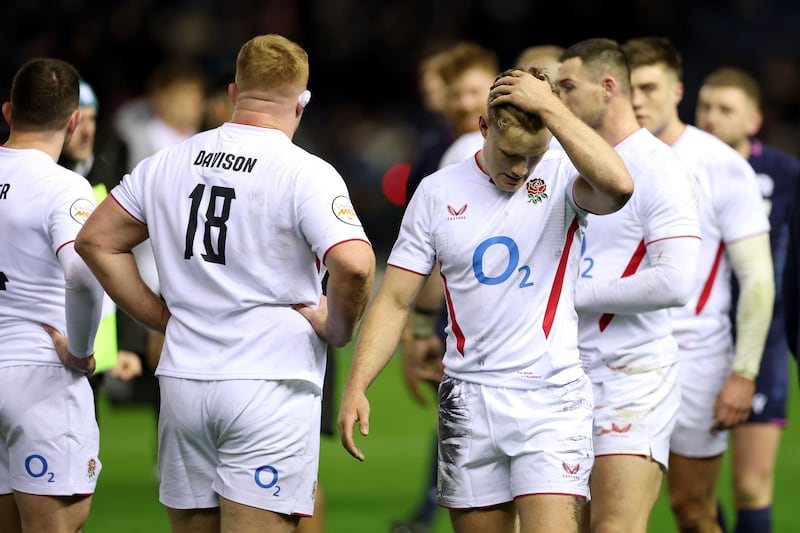 England’s Fin Smith dejected following defeat to Scotland at Murrayfield in their Six Nations match on February 14th. Photo by Stu Forster/Getty Images)
If we think back to the opening half of Ireland’s victorious second Test in South Africa in 2024, the emotional pitch of the men in green was high and controlled. They physically dominated the world champions and imposed the Irish game plan on the match.
In the opening two rounds of this year’s Championship, the teams that have started the matches with the highest levels of mental arousal and emotional energy have dominated. France smashed Ireland in the opening 20 minutes and the Scots did the same to England at Murrayfield.
[ Which version of Ireland will turn up at Twickenham?Opens in new window ]
We know that every elite athlete is responsible for what words and images they allow to enter their mind. So every international rugby player should have deleted their social media accounts. If you listen to what people in the grandstands are saying, very soon you will be joining them in watching and not playing.
If players listen to the sewage spewed on to social media by weak cowards who would not last five minutes in the white-hot intensity of Test match rugby, then they are responsible for undermining their own self-confidence.
I can understand the pressure that the uneducated criticism of Sam Prendergast and Jack Crowley has generated. I also respect how their coach, Andy Farrell, wants to protect these young men. On every level, it is wrong that these young Irish athletes are feeling harassed by such pathetic individuals.
However, there is one guaranteed way to stop it.
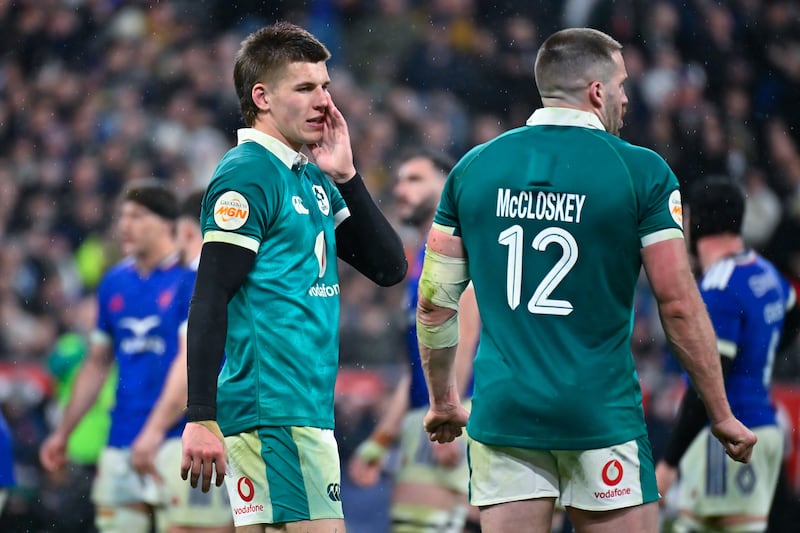 Ireland’s Sam Prendergast and Stuart McCloskey during the Six Nations 2026 match between France and Ireland at Stade de France on February 5th. Photograph: Federico Pestellini/Eurasia Sport Images/Getty Images
Sam, Jack and every other developing elite athlete should buy an old flip phone that takes only calls and texts from people they allow to have their number and put their iPhone in a box in the garage. They will then join the many generations of rugby players who have gone before them who often say that they are grateful that iPhones were not around in their day. However, the motivation from the old blokes mostly surrounds what was happening post game in the pubs.
Getting off social media is now another compulsory decision in the discipline required by elite sportspeople.
There is no doubt that England will respond to the humiliation dished out to them in Edinburgh. So every Irish player must bring buckets more aggression to Twickenham than they have in the opening two Six Nations matches and strike early to put England under scoreboard pressure. If they do, then the cracks the Scots exposed at Murrayfield can be exploited by Ireland.
If Ireland turn up in the same mental state they did in Paris, a wounded England at home will be far too strong and the Empire will strike back.