
Toronto artist Sibyl Goldstein died in 2012 and left behind about 1,000 paintings and drawings.Henry Chan Jr./Supplied
Visual artists sometimes joke that they own the world’s largest collection of their own work. The studio – if they are lucky enough to have one – or the basement of their house is stuffed with art. Maybe there’s a storage locker, too. What is to become of it after they are gone? Unless they are so commercially successful that a dealer has always snapped up their production and institutions want their archives, their hoard has little monetary value but requires expensive storage. Yet for their heirs to throw it all away feels like trashing a legacy.
Facing this conundrum, the family of Toronto artist Sybil Goldstein agreed to an unusual plan: Koffler Arts proposed an exhibition that would offer the art free to anyone who expressed interest.
“It would be great to make her work accessible and celebrated as opposed to tidied away in basements,” said Koffler general director Matthew Jocelyn, who cooked up the scheme to simply give Goldstein’s paintings to private individuals or public galleries. “The principle from the beginning is not we’re sacrificing something, but we’re celebrating something. That was essential, that this had to be a joyful process of allowing her work to be seen. A lot of this work has never been shown.”
The Koffler Gallery is offering free artwork by Goldstein, including her 2011-12 series Toronto Is (at left).Henry Chan Jr./Supplied
Goldstein, who died suddenly from thrombosis in 2012 aged 57, was active on the Toronto art scene for 30 years, part of a dynamic movement that reacted against the minimalist and abstract styles of the 1970s to re-establish figuration in art. In 1981, she was a founding member of ChromaZone, an artists’ collective that organized large group shows and performances in Canada and Europe before disbanding in 1986. Goldstein was also an instructor at Sheridan College and painted the ceiling of the Cameron House, the music venue on Toronto’s Queen Street West.
“She just produced art non-stop. She was one of those forces of nature that galvanized the community around her, militant in a constructive way,” Jocelyn said.
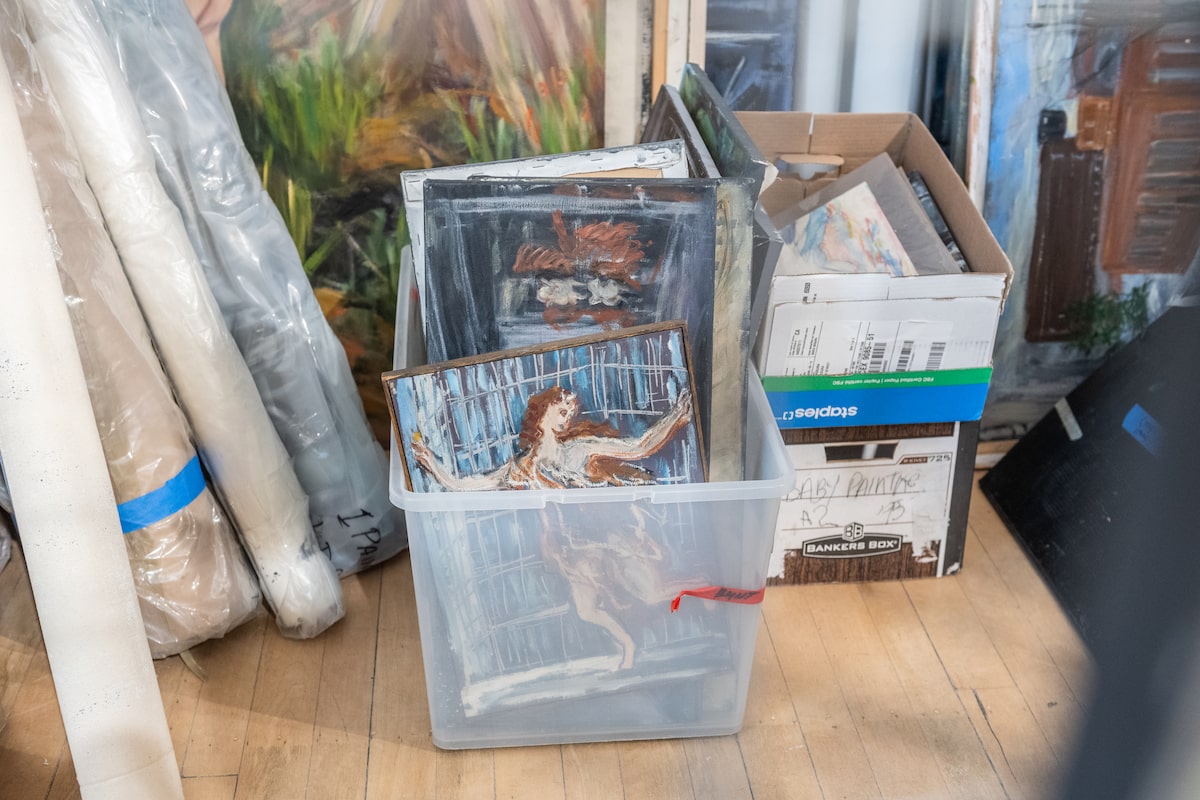
At her death, she left about 1,000 paintings and drawings – landscapes and Toronto street scenes, sometimes featuring mythical or angelic figures. They include Toronto Is, a series about city life executed in oil stick and pastel on black paper, which she had just completed in 2012. Goldstein’s ex-husband, Lorne Fromer, who was storing some of the art, her son, Jacob Fromer, and her friend Herb Tookey, a former owner of the Cameron House, were left with the problem of what to do with it all.
Members of the ChromaZone artist collective, from left, Rae Johnson, Oliver Girling, Goldstein and Andy Fabo in 1986.Courtesy Joslyn Rogers/Supplied
They approached Koffler seeking to donate the whole collection, but it is not a collecting institution and has no storage space. A few months later, Jocelyn heard about the recent example of artist Patrick Chamberlain, who was retiring to Canada after years living in Chicago and chose to give away his art rather than move it from one storage locker to another.
Jocelyn proposed a Goldstein exhibition during which visitors could sign up to take an artwork when the show came down. Priority would be given to public institutions, but if a gallery didn’t speak up, a work would go to any good home.
It then fell to Koffler adjunct curator David Liss and artist Andy Fabo, another founding member of ChromaZone, to go through the 1,000 works and separate legacy works from those that could be discarded. Liss documented 384 works and curated a show from that, creating a studio effect in the Koffler’s new light-filled secondary gallery space at Youngplace on Shaw Street, dubbed Koffler301.
Nature meets culture in Sylvia Safdie’s art
Visual artist Carole Sabiston was known for her huge, elaborate fabric creations
Since the exhibition opened in January, 360 works have been claimed. Three Ontario galleries – McMaster Museum of Art in Hamilton, Art Gallery of Northumberland and Temiskaming Art Gallery – have expressed an interest in particular works, while the National Gallery of Canada has been window-shopping. Jocelyn had contacted about 150 public galleries and still hopes the Toronto Is series, which Tookey wants kept as one piece, might find an institutional home. Another 200 or so works are not displayed but left in a portfolio and can be taken away on the spot.
“In no way are we trying to promote discount art,” Jocelyn said. “How do we make this 100-per-cent respectful and 100-per-cent honouring the legacy, but recognizing the quandary: It costs a lot of money to store art.”
Jocelyn is not offering the exhibition as a model to follow but hopes it will shine some light on the issues surrounding artistic legacy and succession planning: “It’s a great opportunity for us to initiate a more public conversation about something that is not talked about enough, a kind of grey zone and an uncomfortable zone for a lot of people.”
Sybil Goldstein: Urban Myths continues to March 1 at Koffler301 in Youngplace, 180 Shaw St.