
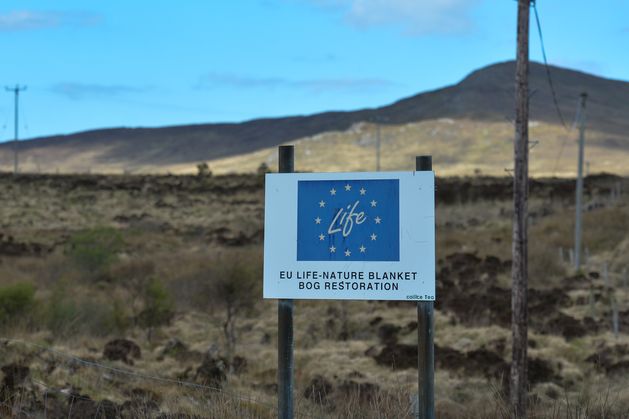
Political will, funding and a strong plan for public land will all help ensure meaningful progress on restoring our degraded ecosystems, according to environmentalist Fintan Kelly
At the end of last year, the Government published The Status of EU Protected Habitats and Species in Ireland, 2025: Summary Report, known as the Article 17. Published every six years, it provides an update on the conservation status of 59 habitats and 60 species in Ireland protected under the EU Habitats Directive.
According to this report, 90pc of Ireland’s protected habitats are in ‘unfavourable’ conservation status, while 51pc are showing deteriorating trends.
Following the European Council’s adoption of the Nature Restoration Law in 2024, each EU member state must produce their own Nature Restoration Plan to show how they will achieve the targets it sets out. At present, an Independent Advisory Committee on Nature Restoration has been established here, with the task of making recommendations to the Minister of State for Nature, Heritage and Biodiversity on what should be included in the national plan.
The IEN is a network of 40 environmental non-government organisations that advocates for positive ecological policy changes. Each of its member organisations – including Friends of the Earth, the Irish Whale and Dolphin Group, and the Irish Wildlife Trust – are involved in the well-being and protection of nature.
Kelly says that three elements are required if Ireland is to make meaningful progress on restoring degraded ecosystems – particularly peatlands, native forests and other areas with the most potential to capture carbon and reduce the impact of natural disasters.

Fintan Kelly, senior land use officer with the Irish Environmental Network
1. Strong political leadership
Kelly says that to date, one of the major obstacles to Ireland developing a cohesive nature restoration strategy has been an official “siloed” approach, with different Government departments playing sometimes conflicting roles in developing the national plan. Currently, the Department of Housing, Local Government and Heritage has ownership of Ireland’s proposed Nature Restoration Plan, while the Department of Public Expenditure and Department of Finance holds the purse strings.
“Unless you have strong political leadership to drive change in all of the relevant sectors and departments, it’s very difficult to develop a clear strategy,” he explains. “The State says they’re going to adopt an all-of-government approach, which on the face of it is a good thing. In practice, what we are seeing is a lot of confusion and bureaucratic barriers, with each department incentivised by different things. An all-of-government approach towards tackling the biodiversity crisis is needed, but ideally, this would involve clear, determined leadership from the Department of the Taoiseach, all the way down the chain.”
2. Secure funding
“If you’re restoring a house, you need to know exactly what budget you’re working with, so you can see what’s possible,” Kelly says. “The same principle applies here.
“We really need dedicated, ring-fenced, long-term finance in order to make the Nature Restoration Plan a reality. We should have seen that in last year’s National Development Plan – and at a bare minimum, I would have expected that the Infrastructure, Climate and Nature Fund would have received a large allocation for nature restoration. There hasn’t been any concrete action on funding, so IEN is strongly advocating for that to be put in place. Ireland has legal obligations to meet in this regard.”
3. A strong plan for public land
“Ireland has a lot of privately owned land, including small family farms,” Kelly says, “and plenty of individual farmers are doing their best to help nature on their land. But if we want to really drive Irish nature restoration at the scale that is needed, we need to do that through publicly owned land. This would mean much stronger, more ambitious planning by the state bodies who manage key areas like forests and peatlands. Effectively, the Irish people own that land.
“We often hear a narrative that pits humans against nature – arguing that nature restoration is very difficult, very controversial. But in our experience, from the many communities around Ireland we have engaged with, that’s not true at all. Obviously, people want to see nature restoration done in a way that supports and empowers their communities, but the idea of restoring nature as a whole is broadly popular. Our message is: Ireland can’t achieve transformational change by continuing to do what we have always done in the past.”