

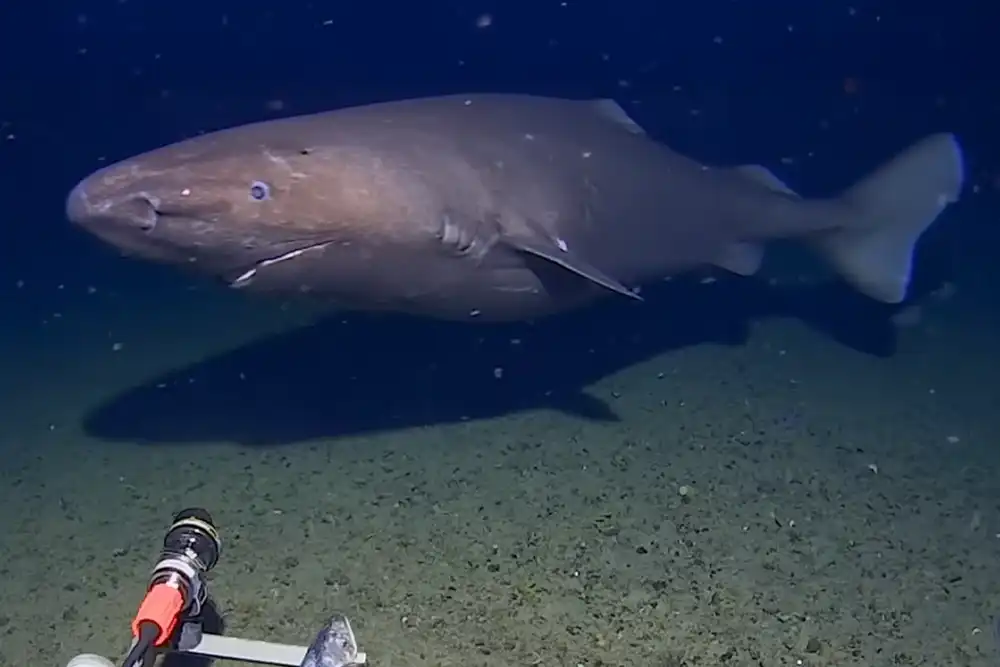
 Still from Minderoo-UWA deep sea camera footage (Image: Minderoo-UWA Deep-Sea Research Centre/YouTube)
By DIVE Staff
Researchers from the Minderoo-UWA Deep-Sea Research Centre have captured what appears to be the first confirmed footage of a shark in Antarctic waters.
The sighting was made at a depth of approximately 490 metres (1,608ft) by a baited deep-sea camera in a January 2025 expedition to the South Shetland Islands off the Antarctic Peninsula.
Although the exact species has not been confirmed, the shark is believed to be a member of the sleeper shark family, most likely a Southern sleeper shark (Somniosus antarcticus).
Sleeper sharks, Somniosidae, are a group of deep-water sharks that have adapted to survive in cold environments, characterised by their slow movements, small fins and a diet that includes fish, cephalopods and carrion.
The most well-known species in the family is the Greenland shark, Somniosus microcephalus, which is found in Arctic and North Atlantic waters and is known for extreme longevity, with one individual estimated to be almost 400 years old.
Dr Jessica Kolbusz, who identified the shark in the footage, said the sighting was unexpected. ‘It was surprising since this is the first footage obtained of a Somniosidae or any elasmobranch in situ in the Southern Ocean,’ she told ABC News.
While Southern sleeper sharks have been recorded in subantarctic regions of the Southern Ocean, such as South Georgia, Macquarie Island and Southern Chile, there have been no confirmed reports of the sharks in Antarctic waters prior to last year’s sighting.
Most sharks are ectothermic – cold-blooded – and found in warmer waters, although a handful of species, such as great whites, mako sharks and porbeagles, are ‘regionally endothermic’, meaning they can keep parts of their bodies warm by generating heat while swimming, and are able to survive in colder waters.
Water temperatures around the Antarctic can drop to as low as -2°C (28°F), which makes it difficult for most species to survive without specialist adaptations.
The Antarctic sleeper shark was spotted in the water temperatures of about 1.27°C (34°F), although specimens of its Greenland shark cousins have been recorded in below-freezing conditions, an adaptation believed to be the result of high concentrations of trimethylamine N-oxide (TMAO) and urea in their muscles, compounds which act as a natural antifreeze.
Dr Alan Jamieson, founding director of the Minderoo-UWA research centre, said the team had not anticipated encountering sharks during the deployment.
‘We went down there not expecting to see sharks because there’s a general rule of thumb that you don’t get sharks in Antarctica,’ he said. ‘And it’s not even a little one either. It’s a hunk of a shark. These things are tanks.’
The shark observed by the remote camera is estimated to be 3-4 metres long. While the exact species cannot be confirmed from the video observations alone, environmental DNA samples collected during the expedition may help with identification once analysed.
The footage was obtained during a broader deep-sea research expedition using baited camera landers to survey benthic and mid-water ecosystems around the Antarctic Peninsula.
Large areas of the Southern Ocean, particularly the deep waters below the continental shelf, remain poorly documented, with limited long-term observational data compared with other ocean basins.
To learn more about the Minderoo-UWA Deep-Sea Research Centre’s work, follow the team on Facebook @UWAOceansInstitute, X @MinderooUWA and Instagram @deepseauwa, subscribe on YouTube @deepseauwa, or visit the centre’s website.
Related articles