
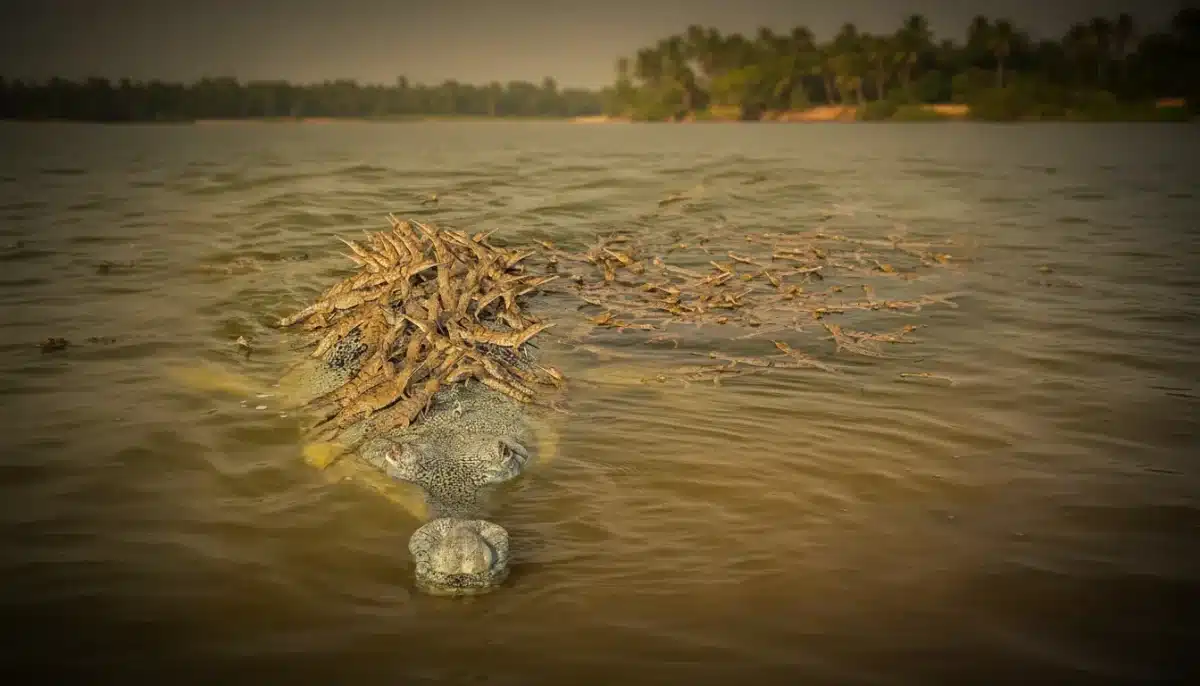
If you think you’ve seen every wildlife photo under the sun, think again. Picture this: a huge crocodile floating down a sacred river, carrying a hundred (!) baby crocs on his back. No, you’re not dreaming—this enchanting scene actually happened, brilliantly captured by photographer Dhritiman Mukherjee. Nature never fails to surprise, and sometimes it’s downright magical.
An Enchanting Snapshot in the Wild
Deep within a wildlife sanctuary near the storied Ganges River—a waterway revered in India and teeming with life—Mukherjee spent weeks patiently blending into the environment. His goal? To catch a shot worthy of a legend. And he did not disappoint. His patience was rewarded with an extraordinary image: a massive male gharial (a critically endangered crocodile species) gliding through the water with his impressive brood along for the ride. Forget riding shotgun—these little ones had VIP seats on dad’s back.
This eye-catching moment isn’t just about cuteness overload (although it delivers); it shines a light on the precarious situation of the gharial. With only about 650 adult gharials left in the wild, every baby matters.
The Science Behind the Sight
Gharials set themselves apart from other crocs with their striking looks and oddball behaviors. Their long, skinny snouts and wickedly sharp teeth mean they simply can’t carry their babies in their mouths, like other crocodile relatives do. Instead, these gentle giants have innovated: dad becomes the family ferry, giving his hatchlings a safe ride above the swirling river.
Patrick Campbell, senior reptile curator at the Natural History Museum, explains: “These creatures, which can grow over four meters long and weigh up to 900 kilograms (around 2,000 pounds), face numerous challenges due to habitat degradation.”
The sight of a male gharial shuttling his young might seem exotic, but for this species, it’s a savvy survival tactic. Those fragile babies get a fighting chance against river currents and lurking dangers, all from the safest vantage point the wild has to offer—a parent’s back.
From Riverbank to World Stage
Mukherjee’s shot goes far beyond documenting a rare event; it pulses with the vitality of the animal kingdom and the strength of familial bonds. His respectful, unobtrusive approach let us peek into an astonishingly intimate moment in the wild—without ever intruding.
Recognition followed quickly. The image was shortlisted for Wildlife Photographer of the Year and snagged a top spot among a hundred winners in a competition organized by London’s Natural History Museum, which tells you just how impactful this moment is among experts and audiences alike.
A Personal Reflection—and a Local Angle
As someone who’s spent years weaving together stories from every corner of the internet, the story behind this photo hits me right in the feels. It’s a sharp reminder of nature’s delicate balance and the astonishing resilience and flexibility of animals. Here in Austin, Texas, where creativity and community spirit fuel efforts to protect our wild spaces, tales of species adapting for survival really resonate. They remind every one of us of the part we play in safeguarding our planet’s future.
The photograph stands as a testament to the resilience of nature and the quiet heroism of fatherhood in the wild. Moments like this invite us all to slow down and marvel at the complexity and beauty swirling just beneath the surface of daily life. Amid the rush and noise, they’re the images that make us stop, look—and care just a little bit more.
Sarah Jensen is a 30-year-old American web content writer based in Austin, Texas. Her background in entertainment, technology, and logic games gives her writing an infectious enthusiasm—one she loves to share with readers as curious and passionate as she is.