
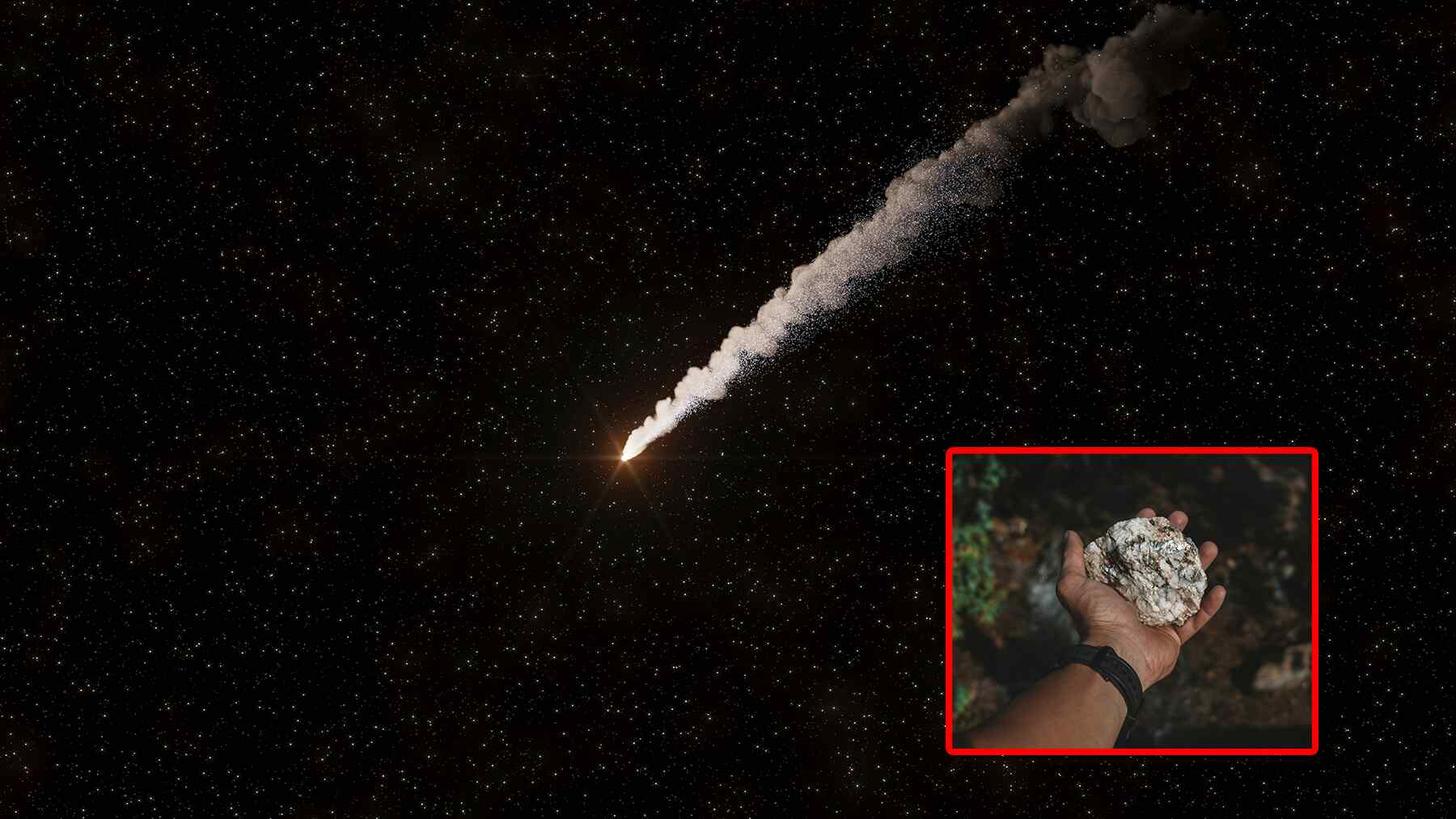
You probably look up and see stars.
Maybe a satellite drifting quietly across the night sky.
But above you, thousands of defunct objects are circling Earth at thousands of miles per hour.
And eventually, many of them come back down.
The concern isn’t what has already fallen.
It’s what’s next.
With launches increasing, experts warn that re-entering debris could become more frequent — and parts of the United States sit directly under common descent paths.
Up there, there aren’t just stars. There’s also a lot of junk
Above your head there isn’t just stars and planets…
There’s a growing junkyard of human-made debris whizzing around Earth at blistering speeds.
Our planet’s orbit now hosts tens of thousands of tracked objects bigger than a softball, including old satellites, spent rocket stages, and fragments from collisions. On top of that, there are millions more smaller pieces — shards the size of bolts and flecks of paint — all hurtling around the planet.
Just to put that in perspective: the latest data suggests there are roughly 40,000+ objects in orbit that space agencies are tracking, with around 1.2 million pieces larger than a centimeter — all potential hazards for spacecraft and, yes, parts that can survive a fiery reentry.
And that’s not including the countless microscopic fragments even harder to track.
So when astronomers warn about “rising risk” from fragments falling back to Earth, it’s not sci-fi — it’s clutter we ourselves have created up there.
The problem isn’t how many satellites have fallen. It’s how many will fall
It’s tempting to think that once a satellite falls, the “danger” is over.
But that’s exactly the wrong way to look at it.
The news isn’t about how many pieces have already come down — it’s about how many more will over time as orbital traffic skyrockets and thousands of new spacecraft are launched.
Experts warn that with megaconstellations continuing to grow, the collective risk of uncontrolled re-entries is increasing, and even materials that burn up on re-entry aren’t guaranteed to completely disappear before reaching the surface.
Astronomers and space agencies have made it clear: the current safety rules were written when only a few satellites were in orbit. Now, with tens of thousands planned or already there, that old math no longer holds — and fragments returning to Earth could become a more frequent part of everyday life.
There is a measurable risk — not an immediate alarm bell, but a real probability that re-entering debris could affect aircraft, property, or even people on the ground if trends continue.
And that’s why scientists aren’t just tracking past fall-backs anymore — they’re watching what’s about to come down next.
Astronomers point to the states with the highest risk
This isn’t a Hollywood scenario.
Space agencies already know bits of satellites and rockets eventually fall back to Earth as their orbits decay — and not all of it burns up completely. With thousands of defunct satellites and rocket parts circling the planet, the likelihood of surviving fragments reaching the ground is quietly rising.
Recent research warns there’s a 40 % cumulative risk that debris from megaconstellations could cause ground casualties if it survives atmospheric reentry.
So where are they most likely to land?
Statistically, debris can fall anywhere between about 52 º N and 52 º S latitude, an enormous swath that includes much of the United States.
But because satellites often decay along orbital paths that cross the continental U.S., states like Florida, Texas, Louisiana, and the wider southeastern and central regions are more frequently under potential reentry corridors — especially during certain launch geometries.
And what do authorities say?
Official agencies like NOAA and the FAA have issued alerts pointing out that falling debris is a real operational concern for airspace and aviation. It’s not just about airplanes — the warnings emphasize that satellite fragments can survive the fiery descent and pose risk to both aircraft and the ground below.
Space isn’t as empty as it looks.
What’s orbiting above you isn’t just science and satellites — it’s aging hardware that eventually has to come down. Most of it burns up. Some of it doesn’t.
The risk today isn’t panic-level. But it’s measurable, and it’s growing as launches multiply.
For now, it’s something experts track closely.
But as traffic increases overhead, the question isn’t whether debris falls.
It’s how often — and where.