
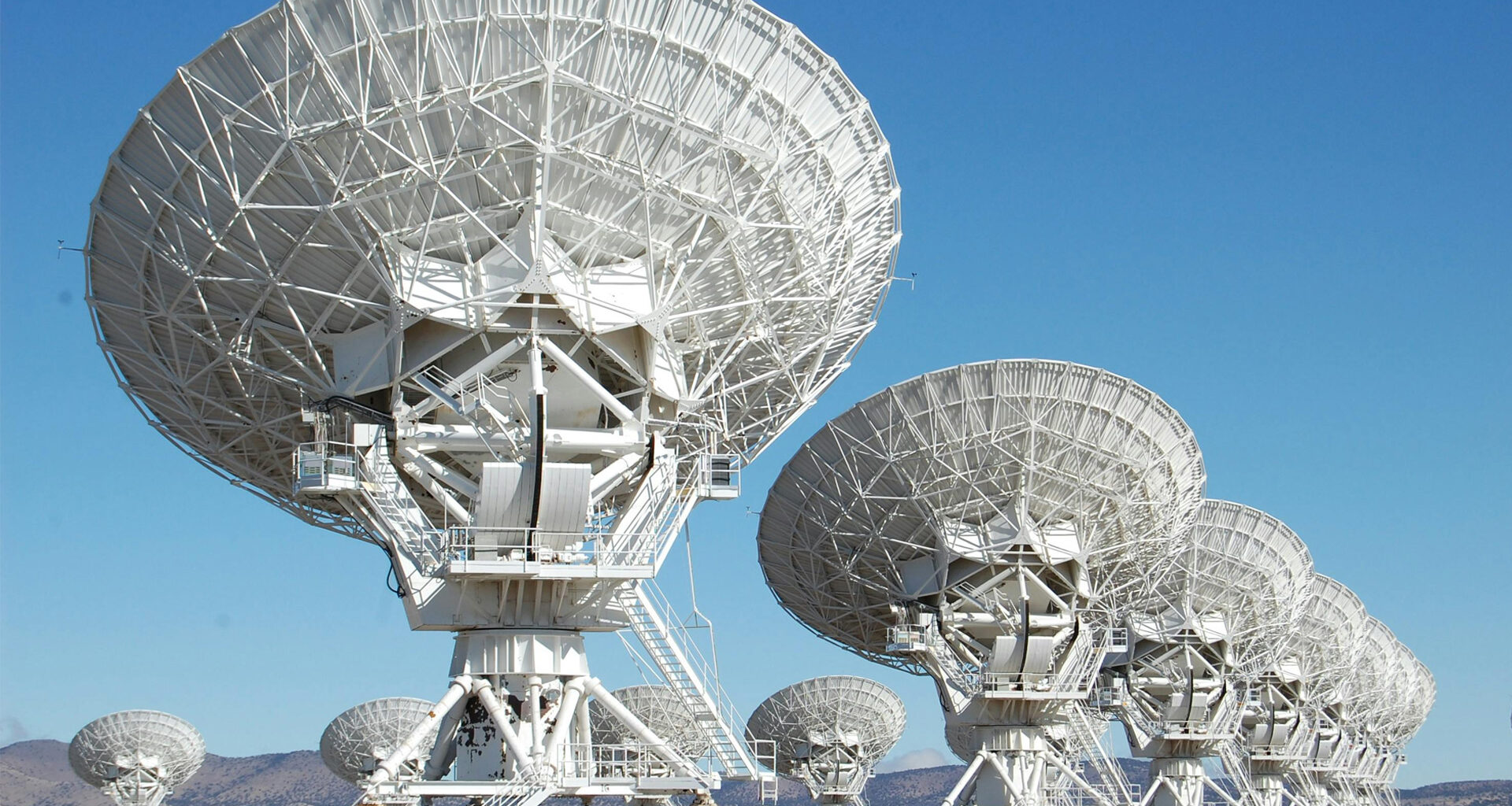
Space rarely gives up its secrets easily. For instance, what looks like a single bright dot may actually be two stars orbiting each other. A flicker may be a distant planet hidden in the overwhelming light of its parent star. So what’s the best way to see such cosmic details
The usual solution has been straightforward — make telescopes bigger. A wider mirror collects more information and reveals finer detail. However, there is a physical and financial limit to how large a single telescope can be built.
So scientists found a workaround. Instead of building one gigantic telescope, they placed smaller telescopes far apart and combined their light. If done correctly, the system behaves like a single telescope as wide as the distance between them. This technique, called long-baseline interferometry, is already used in astronomy.
However, there’s a catch. To combine that light, you have to physically bring it together from faraway telescopes. This may sound simple, but it isn’t because light is fragile.
The useful information is carried in extremely subtle features of the light. As it travels long distances, even small disturbances — like tiny losses or environmental noise — can weaken or distort it. By the time the beams meet, some of the crucial details may already be gone.
Now, a team of researchers from NASA Goddard Space Flight Center, the University of Maryland, and the University of Arizona has proposed a unique solution based on two interesting questions:
What if telescopes didn’t need to bring their light together at all? What if they could combine information using quantum entanglement instead? If their proposal works, astronomers may one day build telescope networks that achieve sharper images than current systems — without sending beams of light through long, vulnerable links
Looking at light from a quantum lens
Instead of treating light simply as waves forming an image, the researchers treat it as a quantum carrier of information. This perspective changes the question from What picture do we see?” to what is the absolute maximum information quantum physics allows us to extract?
Over the past decade, quantum information theory has shown that with smarter measurement strategies, more detail can be extracted from the same light.
One such strategy involves spatial mode sorting. When starlight enters a telescope, it isn’t just a blob. It contains different spatial patterns — different ways the electric field is distributed across space.
“A spatial mode sorter is a device that splits incoming light into these different patterns and sends each one to its own detector. Analyzing these patterns helps telescopes extract more information from faint or tiny objects.” Saikat Guha, one of the study authors and an expert in quantum networking at the University of Arizona, said.
Earlier theoretical work showed that combining spatial mode sorting with long-baseline interferometry could reach the true quantum limit for resolving two stars.
However, after sorting the light at each telescope, the different modes still had to be physically combined using beam splitters. Which brought researchers back to the original problem — transporting fragile light across long distances.
Interference without meeting
What if the combination step could happen without physically bringing the light together? According to the researchers, entanglement can make this possible. This quantum phenomenon creates correlations between two distant systems that are stronger than any classical connection.
If each telescope shares entangled quantum memories, for example, atomic systems storing quantum bits—then joint measurements can be performed across distance.
Using entanglement plus ordinary classical communication, the researchers show that it is possible to mathematically reproduce the same type of joint measurement that beam splitters would perform.
In effect, the telescopes interfere with each other’s data without their light ever meeting. The idea builds on earlier theoretical proposals, which explored remote interference using entanglement.
However, the new framework goes further. Instead of simply copying traditional phase-scanning interferometry in a quantum way, it allows arbitrary joint quantum measurements across a network of telescopes.
This means the system is not limited to old methods — it can, in principle, perform the most information-efficient measurement allowed by quantum mechanics.
“We came up with a way to perform the pairwise combining of the locally sorted starlight at each telescope in an array of beamsplitters, but without any physical beamsplitter, and without ever physically bringing the light from the two telescopes to one location,” Guha added.
Testing the quantum idea
To test the idea, the team performed detailed calculations for realistic astronomical scenarios, such as resolving two closely spaced point sources.
The results suggest that an entanglement-assisted telescope network could outperform both single telescopes and classical long-baseline systems that rely only on classical communication.
More importantly, an important part of this approach, entanglement-assisted phase measurements of weak light, has already been demonstrated experimentally. Researchers at Harvard created remote entanglement between atomic quantum memories using silicon-vacancy centers in diamond, showing that the fundamental physics is achievable.
If this approach becomes practical, it could transform how we observe the universe. “Our approach could have applications in areas spanning from localizing clusters of stars to detecting a change to a known object for space domain awareness, classifying objects from a library, detecting exoplanets, and more,” Guha said.
For now, this work clearly suggests that the next leap in astronomical resolution may not come from building larger mirrors, but from building quantum communication networks.
The study is published in the journal Physical Review Letters.