
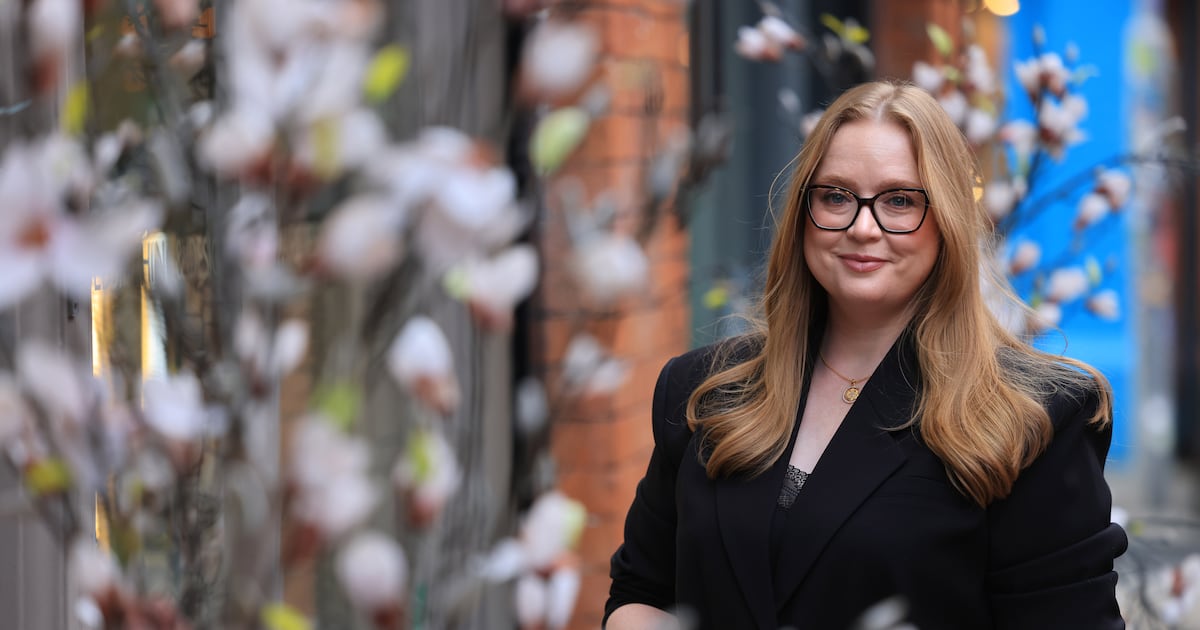
Jen Bray doesn’t strike you as the kind of person to get nervous before an interview. A former political correspondent with The Irish Times and current political editor with The Sunday Times Ireland, Bray has interviewed taoisigh, navigated live primetime television as a guest on The Late Late Show, and anchored podcasts. She has carved out a role in the public eye for most of her working life.
Yet there’s something different about this interview, as Bray herself concedes. She has arrived at this city-centre Dublin hotel – dressed in fashionable black, with wide-framed glasses – to talk not about politics, but about herself: her story, her life, her writing. “I’ve been mentally preparing myself to open up,” she says. “When I was getting so anxious about book publicity, I had to examine: why am I so anxious?”
The fear is coming from a specific place, which we’ll get to shortly. But first there’s the question of her debut novel The Lies Between Us, a marvellously twisty matryoshka doll of a crime story, with shades of Agatha Christie and Liz Nugent in the stylings.
Three warring sisters: former garda Lucy, novelist Susannah, and unhappy middle sister Tara – are meeting for a peacemaking dinner in Dunmore East, where their mother has a holiday home. But when Susannah disappears, and a body of a woman is found on the shore nearby, the family are drawn into a mystery that has its roots in a dark and complicated past.
The book has already won praise from her peers (“Outstanding,” said Jane Casey. “So satisfying,” said Marian Keyes) and scored the ultimate compliment: rights have been sold to publishers in Germany, Poland and the all-important United States, something many Irish novelists would give their eyeteeth for. “It means the book being available to this huge audience,” Bray says, of the deal with Pegasus Books. When her agent rang to tell her, “She was like, ‘You’re getting published in America.’ I was like, ‘What the hell?’”
They say luck is when preparation meets opportunity, and it couldn’t be more true than in Bray’s case. Technically The Lies Between Us is the 37-year-old’s fourth novel; three others reside in her bedside drawer. Growing up in Dublin and Wexford (her family moved close to Gorey when she was starting secondary school), her instincts toward writing were always strong. “I’ve always felt really compelled to write fiction and I remember being a teenager thinking I want to write: I want to be a fiction author but also a journalist. Which one can I get financially independent in quickest? And it was a journalist. I thought I’ll work on the other thing in the background. It just took longer than I thought.”
It took 15 years, many rejection letters and one sympathetic editor – Patricia Deevy at Penguin Sandycove, who heard Bray on The Irish Times’ Inside Politics podcast talking about a novel she was writing, and asked Bray to send her the manuscript. Bray is excited today: this is the beginning of the book promotional trail. But she has qualms too.
As the Irish novelist Kevin Barry once remarked, “when you write fiction, you’re giving yourself away. There has to be something about yourself coming out to make it real and good.” The Lies Between Us is not directly autobiographical, but the character of Lucy has some experiences in common with Bray. Lucy is attacked on the street as a young woman in New York, a crime that changes the course of her life.
When Bray was 21 years old, she was also the victim of an assault on O’Connell Street in Dublin. She had been on a night out with her cousin Sarah and her work colleague Neil. They’d found themselves in McDonald’s at the end of the night. Waiting in the queue Bray realised someone was trying to get into her jacket pocket. When she moved away, the woman – in her late 20s with her boyfriend lingering nearby – threatened her, saying there would be people waiting outside for her.
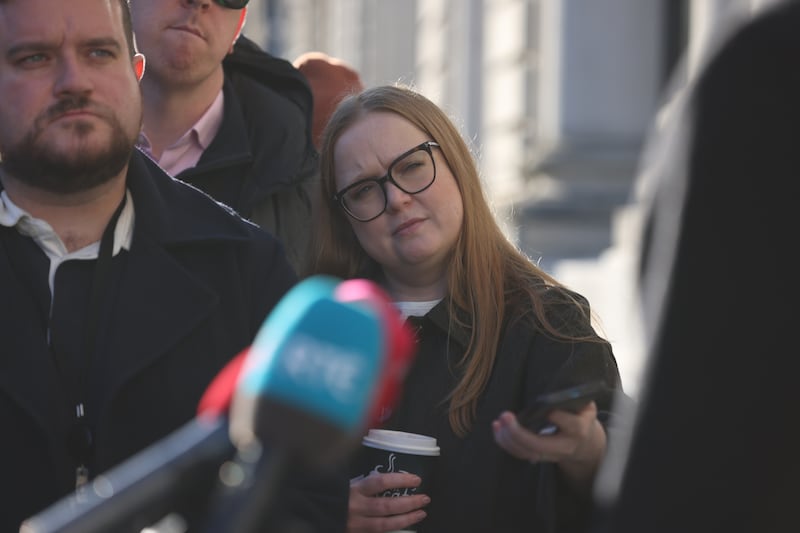 Jen Bray: ‘The hours in political journalism are crazy and the pressure is insane’. Photograph: Bryan O’Brien
When the three friends tried to get into a taxi, Bray was pulled back out by the hair. The woman punched her in the face, then Bray was thrown against a wall by the woman and her boyfriend, and the woman pulled out a rusty Stanley blade. “I felt something cold on my face and when I looked down, it was blood.” While she was on the ground, her attackers started trying to rob her again, feeling in her pockets. “I had a cheap little phone and my apartment keys, and that’s it, and they took that.”
Bray takes off her glasses to trace the white line where the now barely visible scar wends its way beneath her left eye. The woman had taken the blade from the top of her nose, cut beneath her eye and in a semicircle down her cheek. “I had emergency surgery in the Mater,” she says. “The surgeons were amazing. It was really bad. I thought, ‘That’s it. I’m destroyed’.” After five hours of surgery, with six surgeons present, Bray woke with a massive bandage covering half of her face.
Two weeks after the surgery, she returned to her job at The Sunday Tribune to try to find refuge in the newsroom. “I remember feeling bad for my colleagues,” she says. “Like, do you look at her or not look at her? Is looking weird? I went back to work as quickly as I could, even though it terrified me to show my face. And I just kept busy. I threw myself into it.”
She also did a couple of remarkably brave things: she spoke about the attack on The Late Late Show (“I nearly fainted before I went on, I got purple spots in my vision: I don’t remember a single thing that happened on that show”), she wrote about it, and she testified against her attackers, because even though there were many witnesses, forensic evidence and CCTV, the pair still protested their innocence. “I had to testify because they pleaded not guilty, which was one of the worst experiences of my life. I remember being on the stand and thinking, I can’t do this. They were right there.”
Until a few months back, Bray thought she had come through her experiences well – when Ryan Tubridy asked her at the time if she had got counselling, she brushed his query off. “I was like, ‘No, I’m fine’. And for the last decade I have been like, ‘I am fine’, until now. Until book publicity, and now I’m like, ‘Oh, no, I haven’t dealt with this at all’.”
Why does she think she hasn’t dealt with it? “I realised a lot of it is to do with confidence. I guess I’ve convinced myself that I’m really not …” She trails off. “I think for years I just thought I was horrible or disgusting or something. I didn’t realise how bad it affected me or how much confidence it took from me. It stole my confidence. So I’m working on that now.”
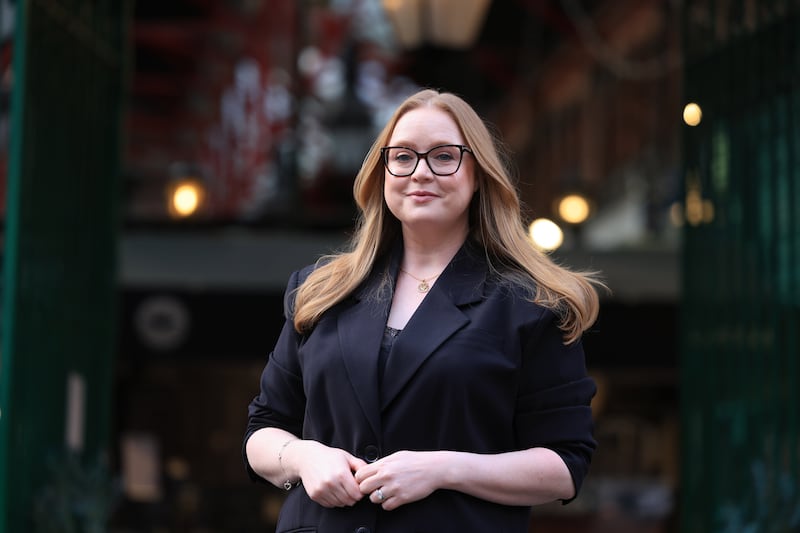 Jen Bray: ‘I think to succeed at getting a book published, you have to be obsessed.’ Photograph: Dara Mac Dónaill
In the novel there’s an emphasis on the fork in the road – the direction a character may take that shapes their life. Bray sometimes thinks about the person she was before the attack, the bright, bubbly 19-year-old who was so determined to get into a career in writing that she kept turning up to the Sunday Tribune office on Baggott Street even after her four-week internship had ended. The editor Nóirín Hegarty, she recalls, told her, “Thanks and best of luck” and Bray responded, “No, I’ll be back here on Tuesday.” She laughs, with a little wistfulness. “I was a bit bratty. I was bolshie. Afterwards it was the total opposite.”
She wonders a lot about who she might have been had the attack not happened. “Would my life have been better? Who would I be?”
It’s tempting to try to find a silver lining in her story – to say it shaped her into the success she now is, but – while I know Bray only through her work (I started at The Irish Times shortly before she left the paper) – that seems patently untrue. She was already unswerving of focus. Her novel is the product of pure grit. “I think to succeed at getting a book published, you have to be obsessed,” she says.
It’s a good trait for a career in journalism too. During Covid, when the book was conceived during bouts of insomnia (“Instead of lying awake and thinking about death, I would lie awake and think about plot points and characters”), Bray was often left exhausted by the demands of the daily job. “The hours in political journalism are crazy and the pressure is insane,” she says.
There must have been times when she contemplated a different existence. I can’t help but note that a number of her old colleagues in political journalism are now working as Government advisers. “I have been offered a job as an adviser three times,” she says. “Each would have been an amazing opportunity on paper. And one in particular I did consider very seriously. But ultimately – and no shame to anyone who does go for it – I can’t marry the fact that I spent so long writing what I hope are critical but fair pieces; to have done that for 11 years, and then one day switch around and go and advise, it jars for me.” She laughs. “I feel like if I was in a meeting, I would want the exclusive. I’d be crying, I need to tell somebody – ideally a couple of hundred thousand readers.”
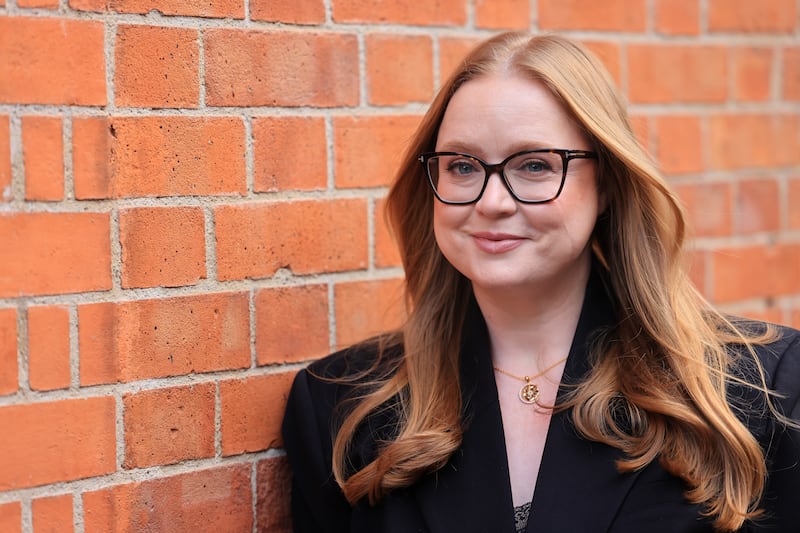 Jen Bray: ‘I have so many ideas, I’m just itching to write them.’ Photograph: Dara Mac Dónaill
Bray’s novel is dedicated to two people: her husband of 10 years Alan Sherry, who is also a journalist, and her younger brother Michael, who died in 2023. “He was 21. It’s changed me completely as a person. It makes you analyse what’s important.” His death taught Bray, she says, that she must take risks because you don’t know what’s coming around the corner. It was a major reason she decided to leave The Irish Times after seven years for her new role. “I remember saying to the Editor everything has changed for me, I am acutely seized with the knowledge that anything can happen and I can’t not make a change because I’m scared.”
You’d wonder if another move – to full-time novelist – isn’t that far off. Bray – more than most – seems like someone who is actively questing for control of her future. She has already written a new novel. And she has big plans. “I am so ambitious. I have so many ideas, I’m just itching to write them,” she says. “I would love to have a book a year and I’m determined to make it happen.”
The Lies Between Us is published by Sandycove on February 26th