
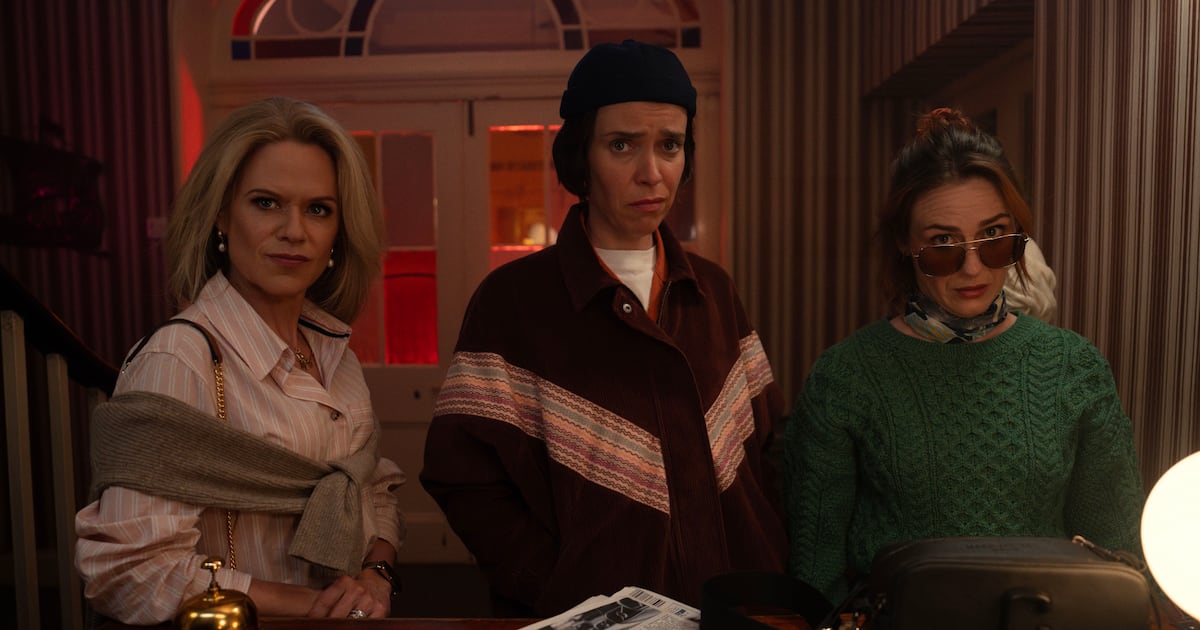
“Do you think the vibe is weird in here?” asks Robyn (Sinéad Keenan) in How to Get to Heaven from Belfast, Lisa McGee’s new Netflix comedy-mystery caper. Weird vibes are now normal in television shows set in Ireland. As Saoirse-Monica Jackson’s character might say, it would be strange if there weren’t any weird vibes, babes.
McGee offers a knowing send-up of weird vibe shows, winking at how Irish-flavoured dramas lay national cliches on thick while simultaneously contriving to fudge their sense of time and place.
[ How to Get to Heaven from Belfast: An underwhelming and tonally disorienting showOpens in new window ]
“Locals” deploy Americanisms such as “twisters” and “motels”, then other characters loudly question why. An apparent villain unleashes a sinister-by-numbers whistle to the tune of Molly Malone. Someone exclaims “Jesus Christ” mid-argument, but it’s because a giant Jesus statue has materialised on the road. “Sure isn’t that how we like to do things?” says a woman disclosing a cover-up – a risibly vague allusion to Irish scandal that will wash over international viewers.
In the ultimate “having your barmbrack and eating it” moment, Dublin manifests as a shamrock-swamped playground for the maniacally drunk, only for the date to be revealed as St Patrick’s Day.
This joke, at once clever and tedious, is the internationalisation of television writ large. It is often necessary to repeat tropes in order to parody them. Still, How to Get to Heaven from Belfast’s overfamiliar milieu remains “Ireland as theme park” and, alas, there has been a surfeit of this stuff of late.
McGee’s high-energy series may be more entertaining than Netflix’s Bodkin and Sky’s Small Town, Big Story combined, but all three shows share DNA. The world they present is populated by “eejits”, folk-horror archetypes and the last nuns in Ireland to wear habits. A decades-old mystery is twinned with the suggestion that nothing should be taken seriously in a place of such whimsy.
In Bodkin, American podcaster Gilbert (Will Forte) demands to see the “small, quaint stuff”. Hamming-it-up locals oblige by talking about fairies 11 minutes in, to the disdain of returning emigrant Dove (Siobhán Cullen). A stand-in for the audience, she complains that Gilbert “thinks Ireland is some kind of Disneyland”. The weird vibes are provided by wolves.
In Small Town, Big Story, returning emigrant Wendy (Christina Hendricks) must contend with eccentric locals while producing a fantasy film called I Am Celt. “F**kin’ Looney Tunes. Every f**kin’ way you look. And why does it not stop raining?” Wendy despairs. The twist is the weird vibes arrive courtesy of aliens. But why is her mother quoting Exodus at her? Is that an Irish thing? It is on TV.
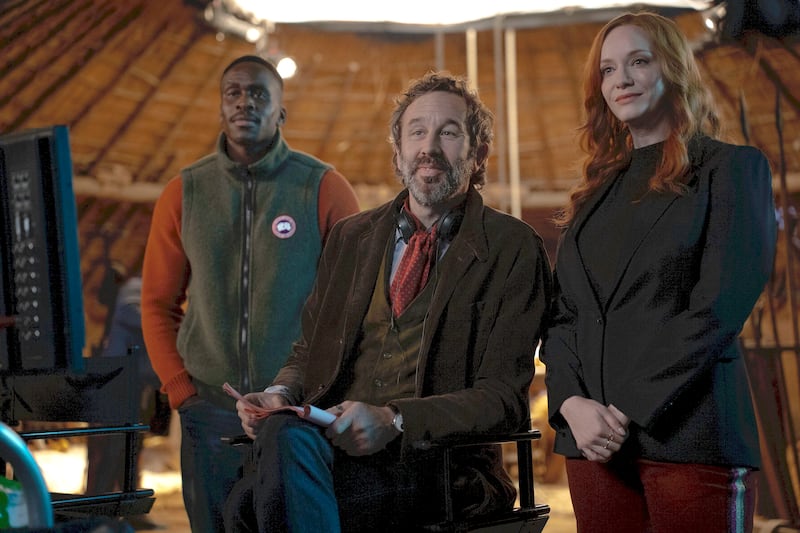 Christina Hendricks plays Wendy Patterson in Chris O’Dowd’s Small Town, Big Story. Photograph: Bernard Walsh/ Small Town Big Story
There’s more than one way to send a series hurtling into a time warp. RTÉ dramas The Walsh Sisters and These Sacred Vows are tonally contained compared to their weird vibe cousins. Both are ostensibly set in the here and now. And yet they come off as period pieces in disguise.
Tenerife-set These Sacred Vows, currently on air, could easily be a Celtic Tiger-era show. It features lots of golf, someone who hasn’t heard of “gaydar” and throwback mentions of “factor” (suncream). Sandra (Justine Mitchell) explains that she hid her pregnancy from her baby’s father, Vincent (Tom Vaughan-Lawlor), because he was training to be a priest – a plot surely more appropriate for an older generation.
[ TV guide: the best new shows to watch, starting tonightOpens in new window ]
“Have I opened a door to the past?” asks Helen (Mairéad Tyers) in The Walsh Sisters, as Anna (Louisa Harland) listens to A Woman’s Heart (1992). A hoary old reference to Fight Club (1999) receives no such framing. Rehab “looks like somewhere Ozzy Osbourne would stay”. Sanctimonious martyr “Mammy Walsh” (Carrie Crowley) bemoans “the outpouring of cheap ugly flowers” when Princess Diana died as if she’s been ruminating on how awful these were since 1997.
“Mammy Walsh” is not the only middle-aged woman on Irish television to be saddled with attitudes that seem, at best, out of time. I can barely speak about Sheryl (Sophie Thompson), the alcohol-fuelled mother in RTÉ-backed comedy SisterS, who lives in TV’s stock “Irish home” – one laden with religious iconography – while implying her daughter should be grateful not to have been hit by her ex.
Is it possible to make a modern show where the characters are Irish, but not stereotypes and not inordinately self-conscious about their accident of birth? Of course. Such a series doesn’t even need to be painfully contemporary to convince.
Obituary, Ray Lawlor’s macabre comedy for RTÉ and Hulu, is set in the fictional “bog-standard backwater” of Kilraven, where we’re told “there’s a ton of weird stuff going on”. But the similarity to weird-vibes shows ends there. It just gets on with it.
Elvira (Siobhán Cullen), an obituarist driven to murder by poor rates of pay, is a fiendishly smart psychopath pursued by adversaries who are steely, not stupid. Kilraven might be “like a funfair in winter”, but there are no clowns here. No one wanders in from another timeline – instead, it feels timeless.
This shouldn’t be so unusual.