
First he asked Ireland, the nation, to take a long hard look at itself. Then Andy Farrell homed in on the rugby team once known as the best in the business.
“Are we Irish?” he questioned angrily in response to putrid social media abuse directed at his players post-Italy game; the belittling of his fly-halves, the racist insults towards Edwin Edogbo.
A week on it was not the trolls and keyboard warriors in his crosshairs but those charged with wearing the green against England. Are we still Ireland? was, in essence, what he wanted to know.
Ireland had not been Ireland all season. Autumn saw them swatted aside by the All Blacks and scrummed into the dirt by the Springboks. Winter brought no reprieve. France ripped them apart, Italy should have had a maiden win in Dublin.
Recent struggles
The memory of back-to-back Six Nations titles, of sitting number one in the world rankings, had dimmed to the point of being almost forgotten.
“What concerns me,” Irish legend Brian O’Driscoll said in France, “is that now there is a vulnerability to this team. Other sides will be looking at us and think, ‘Do you know what, this is nothing like the Irish team that was at the World Cup in Paris two years ago.’”
A country unrecognisable on the pitch and one in danger of becoming so off it given the damage done by the trolls to the image of the welcoming land Ireland rightly prides itself on being.
That certainly was a perception ahead of Twickenham and Farrell was not about to sit on his hands and just hope for better. “We have to be honest with each other and say it as it is,” he said.
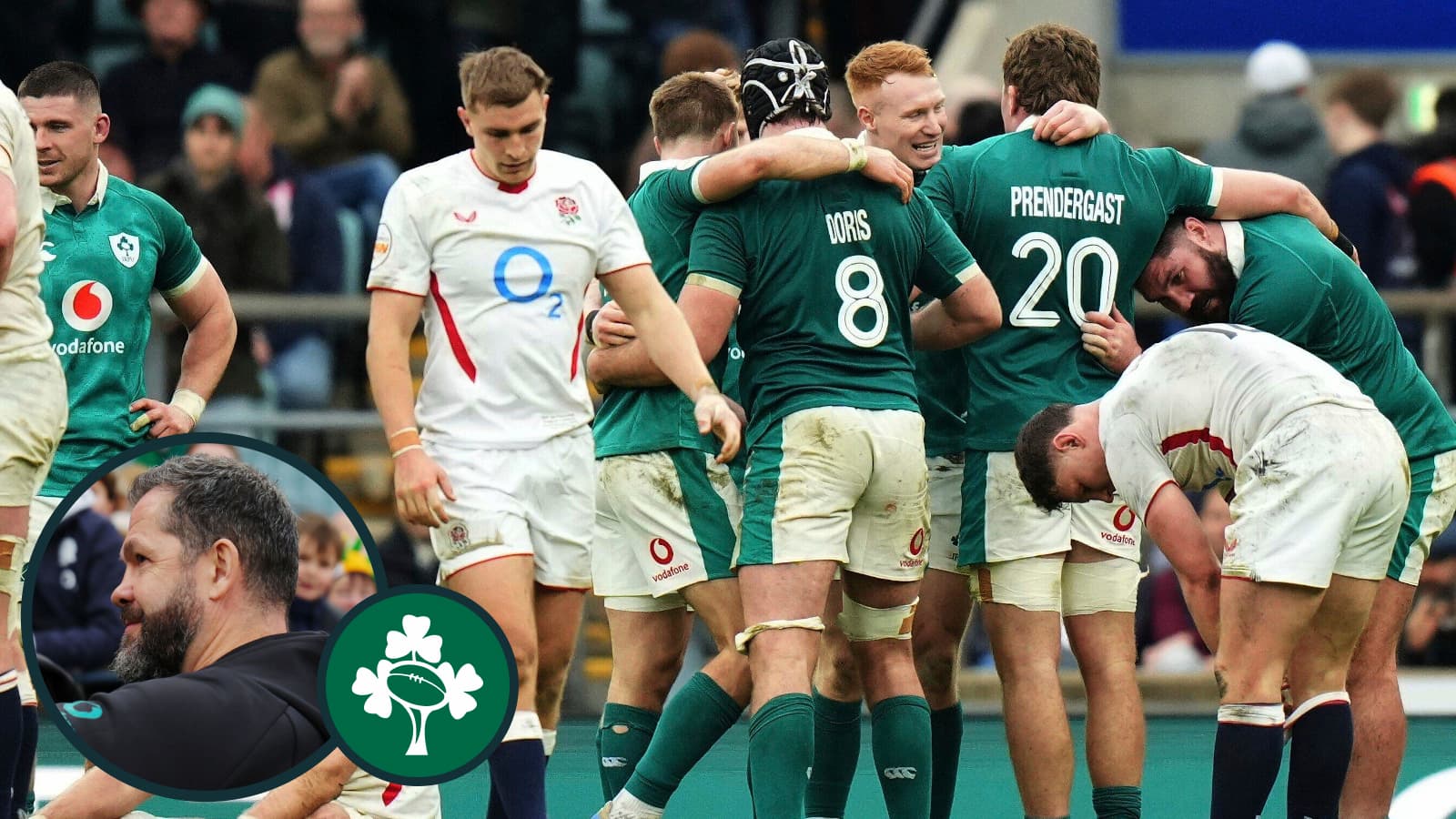
What followed was one of Ireland’s great performances, a record win for the nation at Allianz Stadium, a five-try hammering so complete it left England broken.
Players previously out of sorts and low in confidence, men condemned in the court of public opinion as past their best, tore apart opponents beaten only once in a year.
A group Farrell accused of lacking intent against France turned up with a ton of the stuff; Jamison Gibson-Park, Tadhg Beirne and Josh van der Flier, players he dropped for Italy, bounced back with statement performances.
Gibson-Park dominated the game with a speed of thought and deed England could not live with. The scrum-half scored the first try with a tap and go which caught Steve Borthwick’s team cold and was unfortunate to have a second chalked off soon after.
When he put Rob Baloucoune over on 27 minutes Ireland led 15-0 and it was already clear England were cooked. Later tries by Tommy O’Brien, Dan Sheehan and Jamie Osborne, merely gilded the lily.
“I’m unbelievably proud of the lads,” said Farrell. “Ecstatic for the players mainly and for the fans who turned out in their thousands. I felt all week we were going to do that.
“It must be nice to be Irish today.”
Those last eight words neatly placed a bookend on a difficult period for the Irish. They spoke of unification; of component parts, players and public, coming back together.
In that respect, Saturday in south west London felt bigger than a single win to rekindle Ireland’s title hopes, with home games against Wales and Scotland to come in the first two weeks of March.
It was an occasion to rejuvenate the Irish programme, to renew belief in what may be possible even though the squad is ageing and 20 months to the World Cup seems a long time for some of the group.
In marked contrast here were 80 minutes of rugby which took England back to square one. If defeat by Scotland sounded alarm bells, this one had fans evacuating the building long before the final whistle.
Farrell effectively threw down the gauntlet to his 30-somethings to prove they were the men not only for this week but the big show in Australia, and got a mighty response.
The reaction Borthwick got from challenging his players to prove Murrayfield was a one-off, a blip after 12 consecutive wins, was feeble by comparison.
England defended like they had never played together. They kicked like they had never tried it before, which seasoned observers will tell you is far from the truth.
Their emotional intensity was non-existent. They missed 28 tackles, lost the collisions, were beaten at the breakdown. They conceded 24 turnovers, made twice as many handling errors, twice kicked out on the full.
There was not a single redeeming quality to mark the occasion of Maro Itoje’s 100th cap. Freddie Steward and Luke Cowan-Dickie were hooked before half-time. There could have been others.
Abiding image
A week after playing half an hour with 14 men, England gave up two more to the sin bin. Challenged to out-energise Ireland and make amends for Edinburgh in the aerial contest they were left for dead in both.
England go next to Rome. They have never lost to Italy. What price them extending that record after this debacle?
The abiding image of the day, other than white shirted supporters streaming through the exits with the game still going and Fields of Athenry ringing round the stadium, was of Marcus Smith intercepting a pass six minutes from time and breaking clear.
Want more from Planet Rugby? Add us as a preferred source on Google to your favourites list for world-class coverage you can trust.
“Smith must score,” said the commentator, only for the words to catch in his throat as 33-year old Stuart McCloskey ran him down with a desire England failed to match all afternoon.
In the coaching box Farrell jumped to his feet and punched the air. “It’s about doing the things you promised each other you were going to do,” beamed the boss.
“You talk about the nation and getting the Irish people behind us. Hopefully that brought both the people here and at home a bit of joy. We definitely enjoyed it.”
READ MORE: Brian O’Driscoll ‘flummoxed’ by Ireland’s incredible victory over ‘vulnerable’ England