
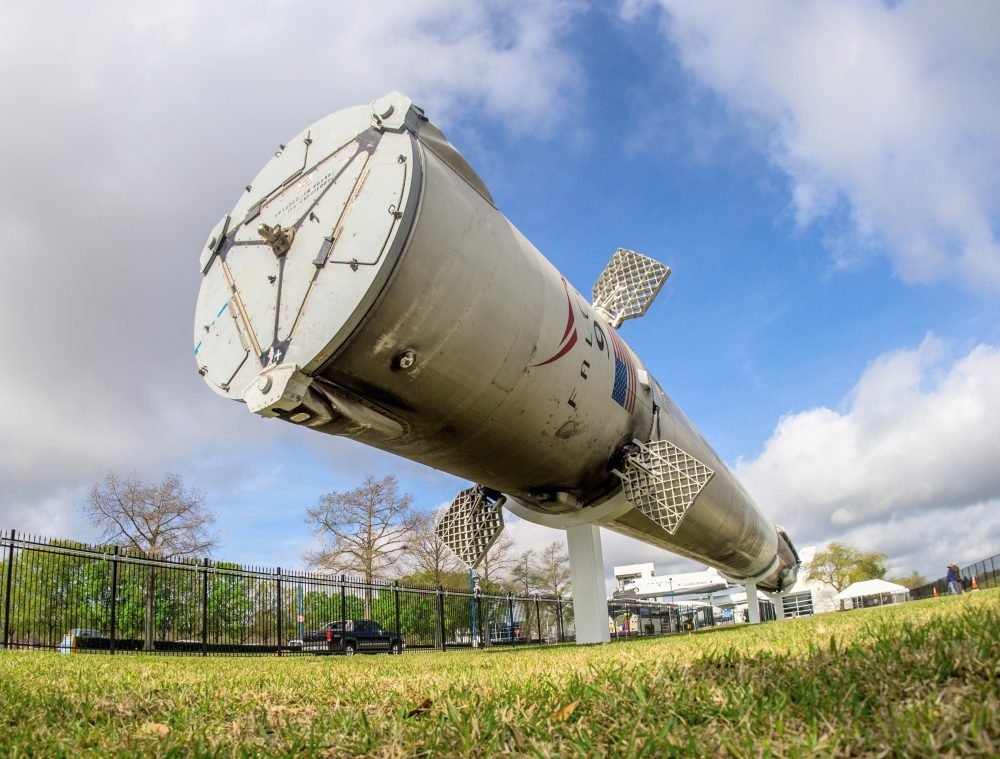
Scientists have documented a tenfold surge of lithium atoms in the upper atmosphere and have traced it directly to the uncontrolled re-entry of a Falcon 9 rocket stage.
The finding establishes that burning space hardware can leave a measurable chemical imprint nearly 60 miles above Earth, expanding concerns about what rising launch traffic deposits overhead.
Lithium spike detected

Just after midnight UTC on February 20, 2025, a narrow layer of lithium appeared high above northern Germany where only trace amounts normally exist.
At the Leibniz Institute of Atmospheric Physics (IAP), Dr. Robin Wing recorded the sudden spike and linked it to debris from a Falcon 9 stage that had fallen back to Earth hours earlier.
The plume lingered between about 58 and 60 miles in altitude for less than half an hour before fading from view, yet its concentration rose to ten times the usual background.
That brief signal marked the first direct detection of upper-atmospheric pollution from space debris re-entry and set the stage for tracing how such material travels after the fireball disappears.
Rocket re-entry left its mark
Backtracking the air over northern Germany led the team to a narrow corridor over the Atlantic, west of Ireland.
Wind models let them run thousands of paths, showing the plume could have drifted about 1,000 miles in roughly 20 hours.
Along that track, an uncontrolled Falcon 9 stage re-entered and burned over Europe, and debris turned up near Poznan in Poland.
That match made chance less likely and showed how re-entries can leave a chemical fingerprint even after the fireball fades.
Lithium hardly shows up at these heights in nature, so a new cloud stands out fast.
Inside rockets, engineers use lithium in batteries and mix it into some aluminum parts, and heat can turn it into vapor.
In the Falcon 9 stage, the team estimated about 66 pounds of lithium in metal walls that started shedding during re-entry.
That single material choice made lithium a tracer for human-made debris, even when other metals blend into natural background.
To see lithium that high, Wing used IAP lidar, a laser system that measures air by reflected light.
Each pulse tuned to lithium’s color made atoms glow, and sensors counted the returning light to map the plume by height.
Dark winter skies helped, since daylight can drown the faint signal, and the instrument also tracked how the layer moved.
Only atoms that still matched lithium’s light could show up, so some of the released material stayed invisible to this approach.
Natural atmospheric causes ruled out
Natural metal layers can appear when the ionosphere, an electrically charged region above weather, rearranges atoms and ions.
Radar and radio soundings near the lidar site showed no strong charged layer beforehand, and local magnetic activity stayed quiet.
Without that natural setup, the team treated the lithium surge as fallout from the earlier re-entry, not a routine blip.
Ruling out nature matters because future plumes will need the same filter before anyone can talk seriously about long-term impacts.
Rocket re-entry releases metals
During re-entry, ablation, material boiling off during extreme heating, releases metals as atoms that can spread on winds.
As the plume sank, oxygen and other gases could bind with lithium, turning it into compounds that no longer reflect the laser.
Because those reactions happen quickly, the clean lithium signal likely captured only a slice of what the stage actually released.
That limitation pushes scientists toward chemistry models and more observations, not a single instrument, when counting re-entry pollution.
Lower down, the stratosphere, a stable layer roughly 7 to 31 miles up, can collect re-entry byproducts.
High-altitude aircraft found about ten percent of large sulfuric-acid particles carrying metals in ratios consistent with spacecraft alloys.
A 2024 model found that re-entry aluminum oxide particles could stay aloft for 714 days, long enough to spread widely.
Those signs suggest the lithium plume was not an odd one-off, but a preview of material that can linger.
Rising rocket launches
Rocket launches more than doubled between 2015 and 2023, so more hardware now falls back through the upper atmosphere.
Fast-growing satellite fleets shorten replacement cycles, and operators often let old units decay until gravity pulls them into a fiery return.
“Continued growth in satellite launches and re-entries may lead to cumulative effects, with implications for long-term atmospheric composition and climate interactions,” wrote Dr. Wing.
Keeping track of what burns up, and what it turns into, will matter more as launch schedules keep tightening.
Scientists call for wider monitoring
More stations, including IAP, could watch for metal clouds after re-entries, turning rare catches into a running record.
Adding new targets beyond lithium would help, since different spacecraft materials release different metals that react and travel differently.
Better tracking could also push engineers to design stages for cleaner breakups, not just safer fragments on the ground.
Until that happens, each new observation will offer only a partial inventory, and most of the chemistry will remain hidden.
A single lithium plume traced to one rocket stage revealed how space traffic can deposit measurable pollution far above everyday weather.
As launches and re-entries accelerate, expanded monitoring and cleaner re-entry designs could help limit what drifts into lower layers.
The study is published in the journal Communications Earth & Environment.
—–
Like what you read? Subscribe to our newsletter for engaging articles, exclusive content, and the latest updates.
Check us out on EarthSnap, a free app brought to you by Eric Ralls and Earth.com.
—–