
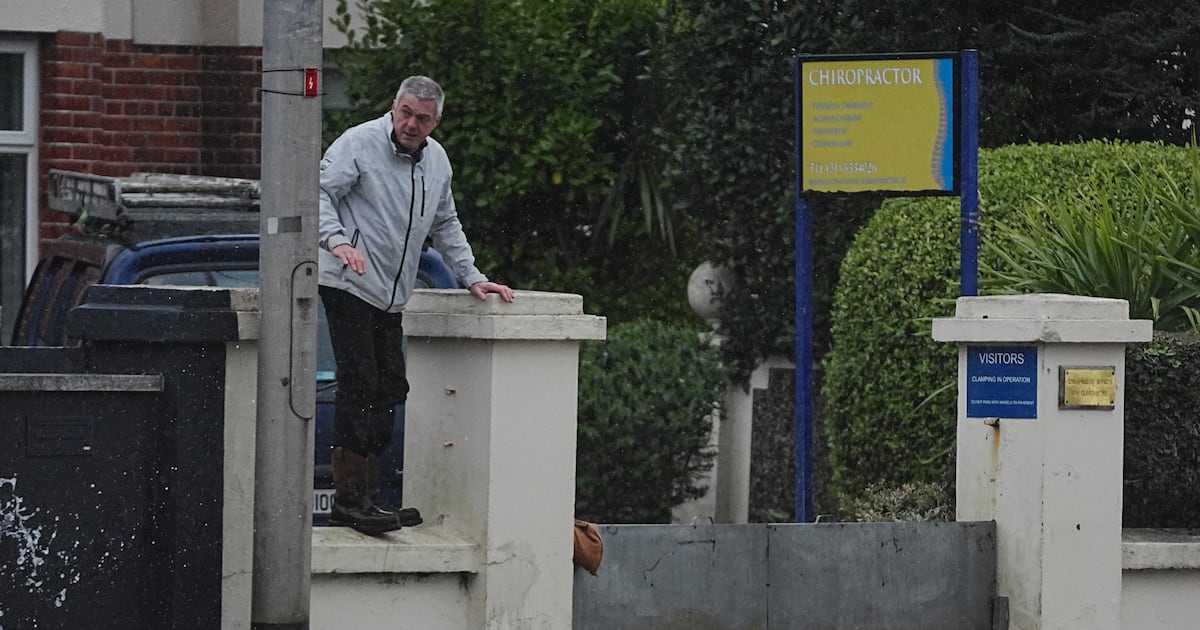
The image of a man standing on a garden wall on the Clontarf Road in north Dublin, his hand raised to the waves surging towards him, which appeared on the front of The Irish Times the day after the February 5th floods, brings to mind the much-misunderstood tale of King Canute.
Canute was not, as is often thought, suffering from the hubristic belief that he could turn back the tide. On the contrary, in vainly commanding the sea not to soak him, the 11th century Viking king was demonstrating the limits of his power in the face of an irresistible force.
The man on the wall in his not-long-enough wellies, Garrett Connolly, was also not suffering from a delusion that he could turn back tides. He was waving at passing buses.
“That was me standing on the wall trying to get the buses to slow down. There was one wave they sent over the flood gate and I could have surfed on it. I was furious.”
From around 1pm on Thursday, February 5th, Connolly had watched as the waves crested the sea wall, and gradually but inexorably made their way towards his chiropractic clinic on the coast road.
 Buses make their way along Clontarf Road, Dublin, during flooding on February 5. Photograph: Brian Lawless/PA
“At about 2.15pm I was saying, ‘The high water is now past, that should be the worst of it’, and actually I was wrong. It continued to wash over the wall, over the grass. Then the small wall between the footpath and the bicycle track, at the roadside, that was breached. That’s only about a foot high – it was like a lovely little waterfall coming over that – and very quickly the road started to fill.
“That’s when I deployed the floodgate and, credit to Dublin City Council, the guys were out here in force in their bright yellow jackets distributing sandbags.”
Connolly’s efforts and those of the council workers, who rapidly stacked sandbags across the front driveways of houses along the Clontarf Road, did keep the flood waters from entering properties this time.
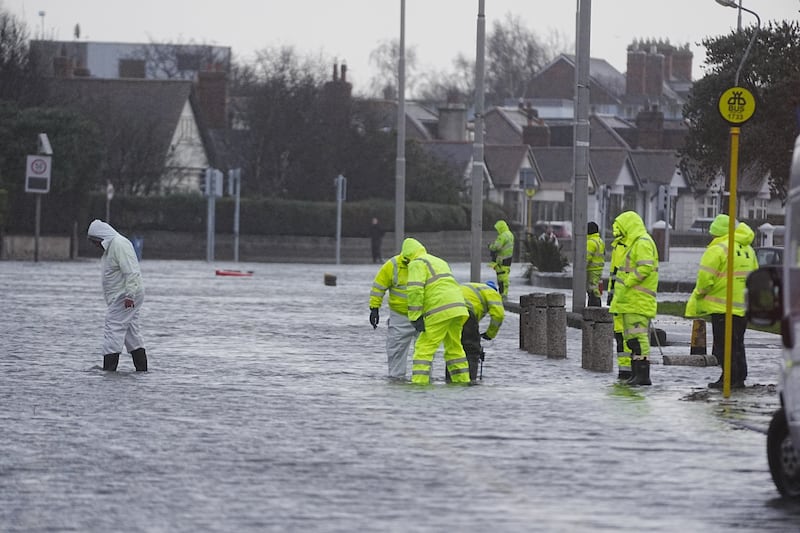 Dublin City Council workers respond to flooding in Clontarf on February 5. Photograph: Brian Lawless/PA
A couple of decades ago, residents and businesses weren’t so lucky.
“I’m here about 20 years, but a couple of years before I came they were inundated here in 2004. They were ankle deep and more at the time, and the business closed briefly because there had to be some reconstruction,” Connolly says. “I’ve seen it lapping at the front door. I’ve never seen it in the building.”
The 2004 floods came just two years after an “extreme tidal event” hit Dublin Bay. In both years, house and businesses along the Clontarf Road were flooded.
These floods were considered particularly significant because up to that point it hadn’t been appreciated that Clontarf was at particular risk from sea flooding, the last significant tidal flood event having occurred in 1922.
After the 2002 and 2004 floods, the council began designing defences and in 2007 submitted an application to An Bord Pleanála. In 2008 permission was granted – a turnaround time which many communities waiting more than a decade for flood alleviation schemes would consider remarkable.
Substantial local opposition to the project emerged in 2011, however, the year before construction was due to start. The defences involved a combination of earth mounds (or berms) and walls up to 2.75m (9ft) in height along the promenade.
Locals did not object at the planning stage, with many in 2011 saying they hadn’t realised how tall the “eyesore” embankments would be.
[ ‘Everything is gone underwater’: Clontarf Baths owner says amenity has been ‘destroyed’ ]
The council offered to reduce their height to 2.17m (7ft), the lowest height permitted by the planning board, but this also met with resistance locally and the council shelved the scheme.
In 2013, a working group involving residents, businesses, councillors and council engineers was established to try to find a way through the morass.
The following year agreement was reached, in principle, on a dual wall defence, involving the existing sea wall and a new wall near the roadside, replacing the “little waterfall” wall. The promenade in between would be used to contain and absorb flood waters.
Consultants were engaged and in 2018 produced the designs for the two-wall solution, with the new roadside wall reaching heights of 1.6m tall (5ft 3in) in places. This, the council said, could be submitted to the board by the following year.
However, opposition to the heights continued and in 2020 the council decided on a solution involving demountable barriers anywhere the defences would exceed 1.2m.
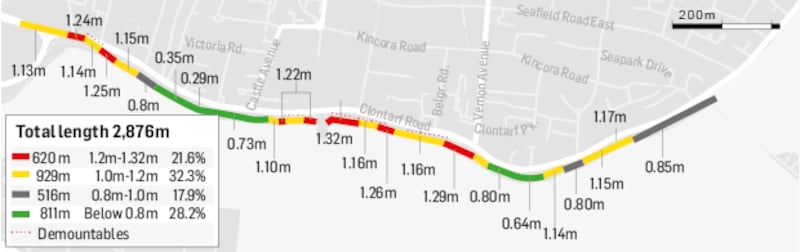 Dublin City Council’s 2020 flood defence plan for Clontarf
Little progress has been made since, and the heights issue is not resolved. The council last month said it would engage new consultants by the end of this year, but it would be 2033 before the defences were in place “if all goes well”.
In the meantime, the Uisce Éireann watermains replacement project, intended to be progressed in tandem with the flood defences, has begun in recent days further up the coast road in Raheny.
Work will next year move to Clontarf and into the promenade, which will have to be excavated, before being dug up again if and when the defences are built.
Deirdre Nichol, of the Clontarf Residents Association, and Eilish O’Brien, a community representative, are both members of the working group and say their concerns with the flood defences have been misunderstood.
“We’ve been saying, right from the beginning, we absolutely want the flood defences, but we don’t want to lose the promenade. It doesn’t have to look exactly like it does now, but it has to have that amenity space – amenity space that’s used by the whole city, not just Clontarf,” Nichol says.
The problem, she says, is that passive surveillance from the road would be lost if the wall went ahead at the proposed height, making the promenade unsafe, particularly for women.
“We’ve never rejected the dual-wall solution, it was just the height of the permanent element that we had an issue with, due to safety concerns. A permanent wall of 1.2m and putting demountables on top of that wouldn’t be acceptable.”
O’Brien has been a member of the working group since it was established and said its core principles had not changed.
“In 2013 we wrote a vision in relation to the principles around what needed to be done to make sure you maintained the amenity while also providing for flood defence.
“The four principles are: provide a defence against tidal flooding, preserve the environment, promote the amenity and protect public safety. Nobody is talking about preserving the sea view. That’s not what it’s about.”
O’Brien says these principles could not be adhered to if the earlier schemes had gone ahead.
“Imagine if the berm had gone ahead, a big mound several metres high? It would have destroyed the promenade.”
Connolly says he wasn’t a great fan of the mound plan either, but he would be keen to see the project accelerated.
“The problem is there are people whose properties are not directly threatened who will say no to everything or people who say ‘I don’t want my view inhibited by anything’. There’s probably a couple of those geniuses around.”
Joe McDonagh moved to his house on the seafront with his wife and two small boys in 2000. He was there for the 2002 floods when the waters reached his front step, but didn’t get inside his house. He has considered all sides of the argument and would like the council to get on with developing the defences.
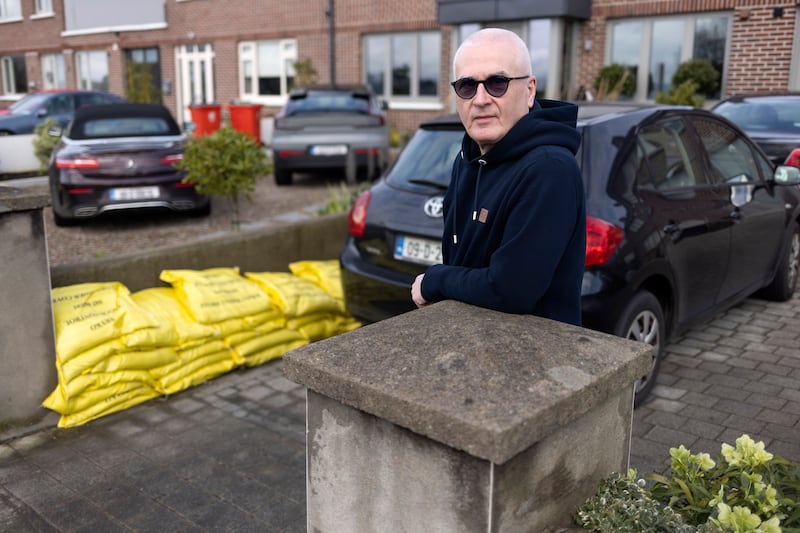 Clontarf Road resident Joe McDonagh with council-issued sandbags for flood protection. Photograph: Chris Maddaloni
“I think that the council should simply take the bull by the horns and get on with it. End of story. I’m all for collaboration, consensus building, ground-up approaches towards development, community engagement, but somebody has to call a spade a spade.”
There is, he says, a tendency locally to resist or defer any development on the seafront.
“The immediate problem is tidal flooding and its consequences and the damage it’s going to do, so it has to be solved. You can’t say, well, we’re not going to solve that because people like to have a particular view on a sunny day when the sea is calm.”
For some, he thinks their investment in the battle over flood defences may have led them to lose sight of the necessity for those defences.
“I think some people love a cause. I’m all for democratising things. I’m all for harnessing and capturing the voice of people on the ground, but if leads to indecision and procrastination, somebody has to make a call.
“We live in a wonderful part in Dublin. To be a wise steward of one’s life, you take steps to deal with a potential threat, and isn’t it better to be feel secure rather than thinking, ‘Oh, I’m missing a lovely view?’.”
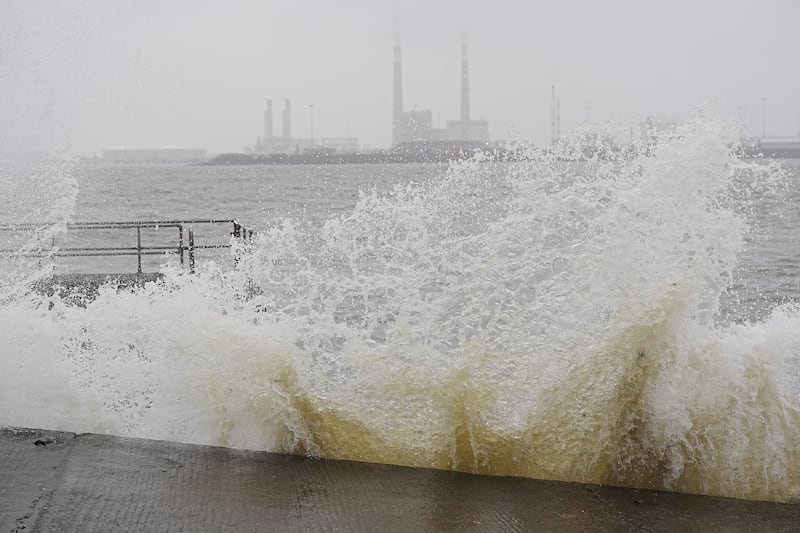 Waves crash against the sea wall in Clontarf earlier this month. Photograph: Brian Lawless/PA
Shamus O’Donnell moved to the seafront just three years ago, aware of the risks of buying a coastal property.
“It’s nice to live by the water, so there’s a certain level of risk that you’re going to take and I think a lot of it is our own responsibility.”
In saying that, he would be in favour of the council’s defences.
“It’s a difficult balancing act to get right. People do enjoy the promenade and don’t want the views obscured. But, given the way the climate’s going, maybe we should all treat these floods as an early warning and take the solution on offer. We’re only looking out over the docks anyway.”