
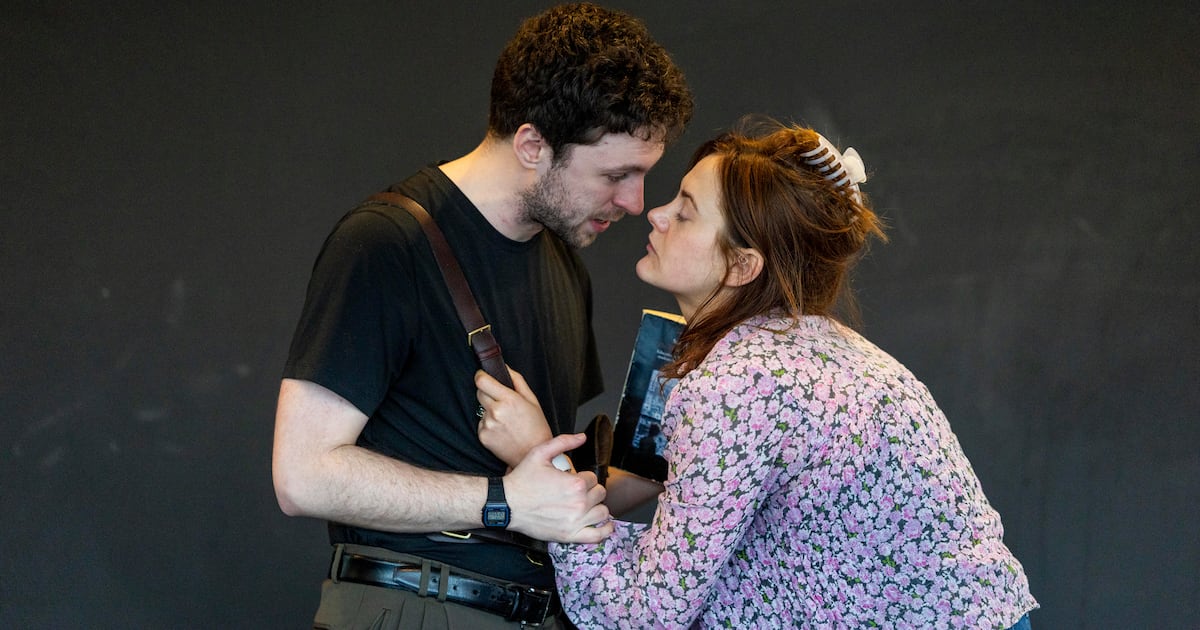
The same week that Seán O’Casey’s The Plough and the Stars opened at the Abbey Theatre in February 1926, the Free State government was setting up a “Committee on Evil Literature”.
Comprising three laymen and two clergy – Catholic and Protestant – it met for a year before concluding that existing obscenity laws were insufficient to deal with the threat from certain books, newspapers and magazines. The results included a Censorship of Publications Act, under which many authors would be banned.
Decades later, in 1958, O’Casey (by then long exiled to England) effectively banned his own work from Ireland for a time after Archbishop John Charles McQuaid objected to his then latest play, The Drums of Father Ned.
But as The Plough and the Stars went into rehearsal just before Christmas 1925, amid much sensitivity about its treatment of the Easter Rising, O’Casey fought for his work line by line in the Abbey itself, sometimes against attempted censorship by the cast.
The actress Eileen Crowe, for example, refused to utter the scripted sentence: “I had never a child that was not born within the boundaries of the Ten Commandments.” FJ McCormick meanwhile took umbrage at a single word: “snotty”.
A bigger problem, everyone agreed, was the bawdy ballad to be sung in the original text by the prostitute Rosie Redmond. That included the lines: “I once had a lover, a tailor, but he could do nothin’ for me,/An’ then I fell in with a sailor as strong an’ wild as the sea./We cuddled an’ kissed with devotion, till th’ night from th’ mornin’ had fled;/An’ there, to our joy, a bright bouncin’ boy,/Was dancin’ a jig in th’ bed!”
Michael J Dolan, the actor who played Young Covey, considered its inclusion “impossible”. O’Casey conceded reluctantly that it would “offend thousands”. The song was dropped.
In a letter to the director Lennox Robinson on January 10th, 1926, the author sounded an exasperated note: “The play itself is (in my opinion) a deadly compromise with the actual; it has been further modified by the [Abbey] Directors but I draw the line at a vigilance committee of the actors.”
In a line that would later seem ironic, rejecting comparisons with The Playboy of the Western World, which had caused riots at the same theatre 19 years earlier, he added: “I’m sorry, but I’m not Synge … ”
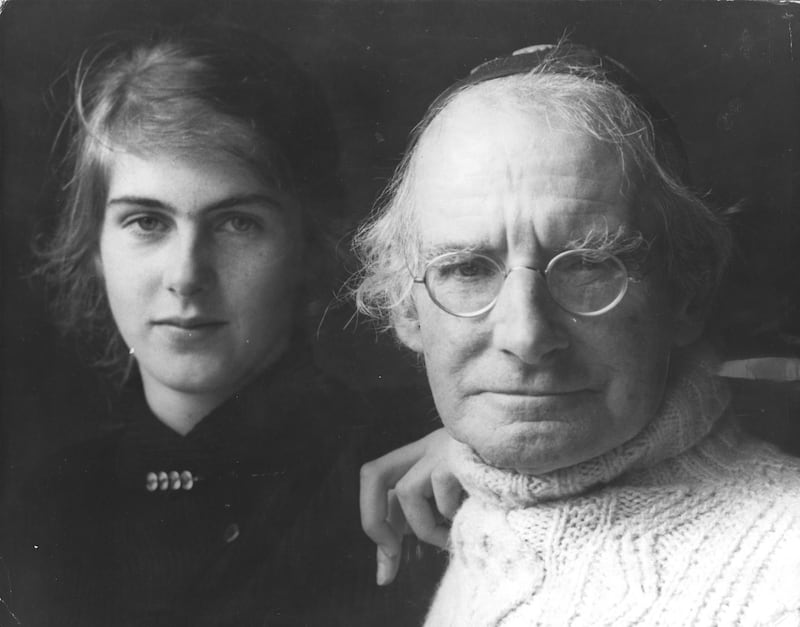 Sean O’Casey (1884-1964), author of The Plough and the Stars, with his daughter Shivaun. Photograph: Hulton-Deutsch Collection/Corbis/Getty
The opening night of The Plough and the Stars, on Monday, February 8th, 1926, was an apparent triumph before a packed attendance including many invited luminaries.
A long queue stretched down Abbey Street, of which – according to Joseph Holloway, a diarist who never missed a premiere in Dublin and attended every night of the Plough’s weeklong run – “not a quarter” were able to get in.
O’Casey’s latest work did not appeal to Holloway’s conservative tastes. Even so, he reported “electricity in the air before and behind the curtain” and concluded: “The first-night audience stamped the play with their approval in no uncertain way.”
The first signs of trouble came on Tuesday when a sister of republican martyr Kevin Barry was among several in the “pit” (the theatre’s standing area) to object loudly at the scene in Act 2 where Irish Volunteers bring the tricolour into a pub.
On Wednesday, Holloway heard “a sort of moaning sound” from the pit during the same scene, in which Redmond (lamenting that the republican meeting outside is bad for her business) also features prominently.
But the big trouble came on Thursday when, after another quiet start, Act 2 took place amid chaotic scenes and a clamour that often drowned out the voices on stage.
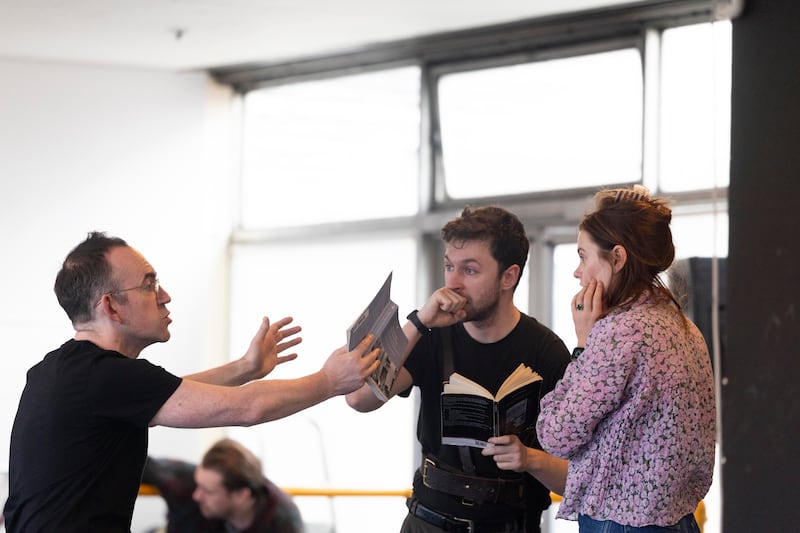 Tom Creed, director of the Abbey Theatre’s latest production of The Plough and the Stars, and actors Eimhin Fitzgerald Doherty and Kate Gilmore. Photograph: Tom Honan
Holloway had not noticed the brewing storm until, during the first interval, he heard Tipperary IRA veteran Dan Breen telling someone that the audience included several widows and mothers of the 1916 dead, among them “Mrs Pearse, Mrs Tom Clarke, [and] Mrs Sheehy Skeffington”.
The calls of “Author!” that followed opening night now gave way to shouts of “O’Casey out!” Chairs were thrown. Women who climbed on stage were ejected with “uncommon roughness” by actors. Barry Fitzgerald, a future Hollywood star playing Fluther Good, punched a male protester into the wings.
After securing a temporary silence, FJ McCormick appealed to the crowd to respect the difference between cast and play. But when Yeats made his famous “You have disgraced yourselves again” speech from the stage, it was barely audible.
He later took the trouble of visiting The Irish Times offices to make sure they had all the details and in the Abbey’s green room afterwards, congratulated the cast on their part in an epochal occasion. As the cynical Holloway put it, Yeats was “in his element”.
Friday’s show went ahead in a “detective-lined theatre”, where there was standing room only for police. Saturday’s closing night was briefly threatened when gunmen attempted to kidnap Fitzgerald from a house in Clontarf. But both the matinee and evening shows went ahead as planned, with the cast advised to stay in the theatre in between.
The weeklong run had made headlines and history. It also made a lot of money. Average weekly revenue in the Abbey then was £180. The Plough and the Stars took £434.10. Following the success of Shadow of a Gunman and Juno and the Paycock, it confirmed O’Casey as the box office star of the decade.
When famously rejecting his next work, The Silver Tassie, in 1928, Yeats would express deep regret to the playwright “not merely because of my admiration for your work” but also because, as he admitted, “the Abbey owed its recent prosperity to you”.
In the modern Abbey’s rehearsal studio, last week, the actress playing Mrs Gogan (Kate Stanley Brennan) in the forthcoming centenary production settles her consumptive “daughter” Mollser (Evie May O’Brien) into a chair at the front of their Dublin tenement, saying: “Th’ sun’ll do you all th’ good in th’ world.”
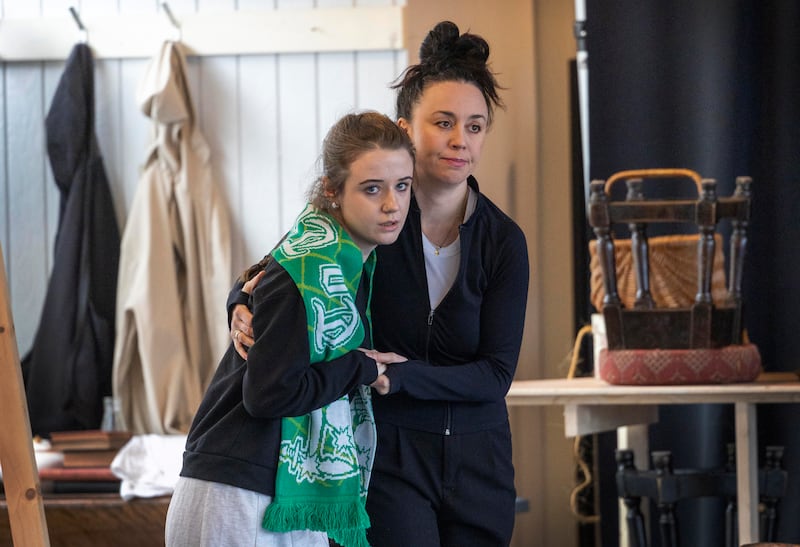 Kate Stanley Brennan as Mrs Gogan (right) and Evie May O’Brien as Mollser in rehearsals at the Abbey. Photo: Tom Honan
Director Tom Creed jokes that everyone will have to imagine the sun, because none of us have seen it for weeks. Sure enough, the glass-walled, top-floor rehearsal room has unbroken views of yet another charcoal sky over Dublin.
On the plus side, it also offers a glimpse of the GPO, focal point of the events described in O’Casey’s drama. Few of the world’s famous plays can be presented so close to the scene of the original action as the Abbey’s Plough and the Stars.
The director is taking the cast through Act III, set early in Easter Week 1916, with fighting under way but the attention of some inner-city Dubliners turning to thoughts of looting shops and pubs. That too upset republicans in 1926.
But as Creed reminds me later, the Abbey has been central to similar events much more recently. On November 23rd, 2023, he was supposed to be overseeing a dress rehearsal for another play from the pantheon, Brendan Behan’s The Quare Fella, until the unfolding riots outside forced the event to be abandoned.
 The Plough and the Stars director Tom Creed. Photograph: Tom Honan
Leaving the theatre that night was “like walking into Act III of The Plough and the Stars”. If not buildings, buses, a Garda car and a tram were on fire outside. And almost inevitably, shops were being looted again.
Since then, in a related event, Creed has seen tricolours fastened to lamp-posts in Dolphin’s Barn – where he lives – and many other parts of Dublin: bringing another theme of O’Casey’s play, the use and misuse of flags, back to life in a new and expected way.
There were stories too the night of the riots about a visiting English tourist caught up in the chaos and trying to find his way back to a hotel: an echo of The Plough and the Stars’s comically posh “Lady from Rathmines”, hopelessly lost in the inner city during the Rising.
Creed’s version of the play will be completely faithful to the original. Indeed, as a Corkman, he’s more conscious than most of the circularity involved in the centenary production: “I pass the portrait of Lennox Robinson [former Abbey manager and director of the 1926 shows, who was also from Cork] every day.”
But even without any efforts on his part, the play’s themes – especially its questioning of purist nationalism – have been updated in ways O’Casey could hardly have foreseen.
Courtesy of the Abbey archive, one of the resources Creed and his cast can draw on in is the original “prompt book”, the director’s copy of the script, with its many handwritten revisions.
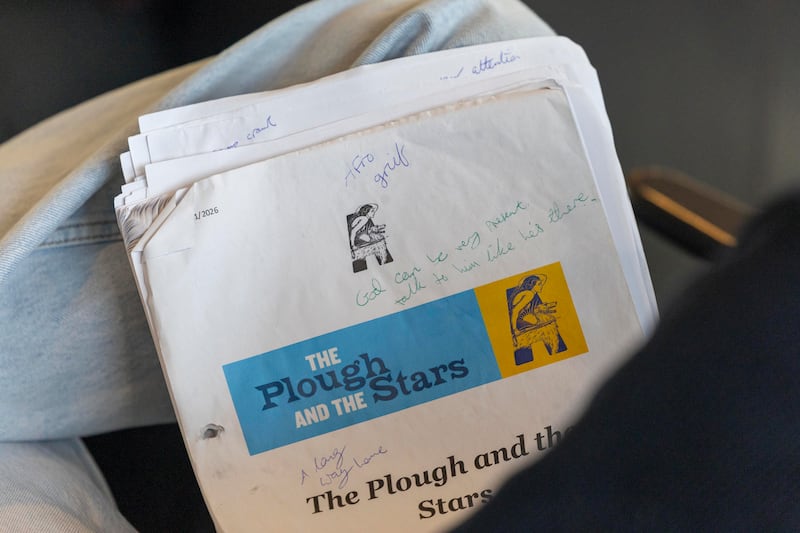 During rehearsal of The Plough and the Stars. The play would mark the high point of the O’Casey’s career. Photograph: Tom Honan
 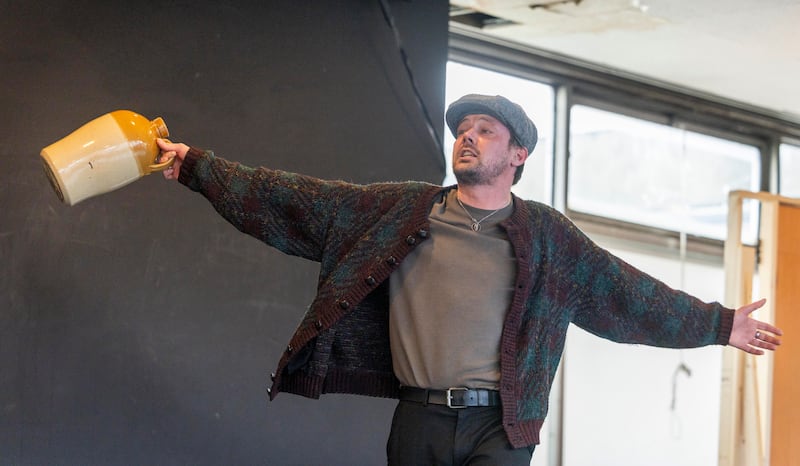 Dan Monaghan (Fluther) during rehearsals at the Abbey. Photo: Tom Honan
Although he won’t be changing O’Casey’s lines, Creed hopes the new production will leave “space” for audience members to bring their own sensibilities to the work, even ones relating to “Gaza, Iran, Minneapolis”.
Having said which, he employs a local metaphor to express the huge sense of responsibility conferred by having to direct this play in its home venue: “It’s the All-Ireland final of theatre.”
By 1926, it was clear that many of the radical ideas that inspired the Easter Rising and War of Independence were being discarded by the pragmatists who inherited the resultant freedom.
The aspirational programme for the First Dáil had been explained away in a withering phrase, as “mostly poetry”. That was by Kevin O’Higgins, who was among WB’s invitees for the opening of The Plough and the Stars. (According to Holloway, he didn’t like it.)
O’Casey’s Troubles trilogy of the mid-1920s – and two other plays, relatively forgotten, in between – were the work of a man disillusioned by the abandonment of the socialist principles for which some of his friends had fought.
His hostility to the Rising may also have been influenced by survivor’s guilt. He had been general secretary of the Irish Citizen Army until resigning in July 1914, just before James Connolly took command.
In any case, The Plough and the Stars earned him the special enmity of other survivors for whom the dead of 1916 were sacred. Foremost among those were mothers, sisters, and widows.
The Irish Times’s approving review of the first production called it “a woman’s play, a drama in which men must fight and women must weep”. But in the riots, women led the fighting too. Over in the news columns on February 12th, 1926, the Times reported of Thursday night: “From start to finish, the whole thing was a women’s row, made and carried on by women.”
After the rioting, the battle continued on the letters pages. Hannah Sheehy Skeffington, whose pacifist husband Francis had been murdered by a British army officer during Easter Week, took to the Irish Independent to complain about the play.
“The [controversy] will, no doubt, help to fill the houses in London with audiences that come to mock at those ‘foolish dead’,” she wrote. “The Ireland that remembers with tear-dimmed eyes all that Easter Week stands for, will not, and cannot, be silent in face of such a challenge.”
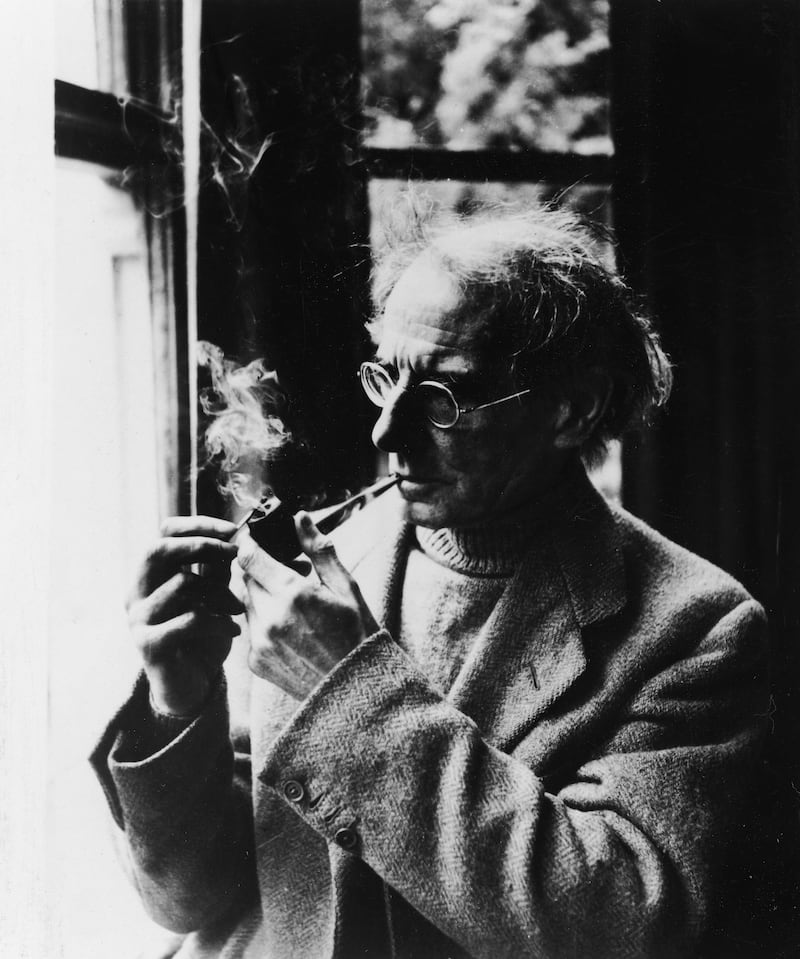 Playwright Sean O’Casey in the early 1950s. Photograph: Hulton Archive/Getty
O’Casey replied in this newspaper, with unveiled contempt: “The heavy-hearted expression by Mrs Sheehy Skeffington about ‘the Ireland that remembers with tear-dimmed eyes all that Easter Week stands for’ makes me sick. Some of the men cannot even get a job. Mrs Skeffington is certainly not dumb, but she appears to be both blind and deaf to all the things that are happening around her … ”
Although he didn’t know it at the time, The Plough and the Stars would mark the high point of the playwright’s career, artistically at least. For Creed, O’Casey’s achievements with the play included helping to show the way forward to Samuel Beckett.
Beckett would later write: ‘Mr O’Casey is a master of knockabout in this very serious and honourable sense – that he discerns the principle of disintegration in even the most complacent solidities.” Creed’s production may underline this when, after the earlier chaos, the stage quietens and empties at the end.
For the nationalist writer and historian, PS O’Hegarty, the Plough’s “matchless second act” – the one that caused the trouble in 1926 – was a masterpiece in itself. O’Casey recycled it from an early, rejected work, The Cooing of Doves. And if its intention was to satirise the Rising, O’Hegarty saw it in a different light.
In his estimation, its juxtaposition of the pub scene with the words of an offstage orator rose above everything else in the play. Although the orator is unnamed, we know him to be Patrick Pearse, and the speech to be similar to the one he delivered at the grave of O’Donovan Rossa.
“It cuts like a trumpet call,” wrote O’Hegarty, “like the sword of the Lord, like a gleam of beauty, right across the squalidity, the maudlinism, the spinelessness, which was Ireland at that time; just as the Rising itself came, suddenly, like an act of heaven. It is a true act, a perfectly beautiful act, true humanly and true historically, and to it I take off my hat.”
Whatever his intentions with The Plough and the Stars, O’Casey (1880–1964) was never to reach such dramatic heights again. He was in his mid-40s by then and the successes of the period 1923-26 had crowned a long apprenticeship of trying to write for the stage.
As a former literary editor of this newspaper, Terence de Vere White, summed up, the trilogy “drew not only on his experience as a dweller in the slums but on the untapped reservoir of the 1916 and [later] fighting in Dublin. He lived where it was and was of the people who made it and who suffered it. He took it in through the pores of his thin skin and involved it into these plays … After that he had no theme.”