
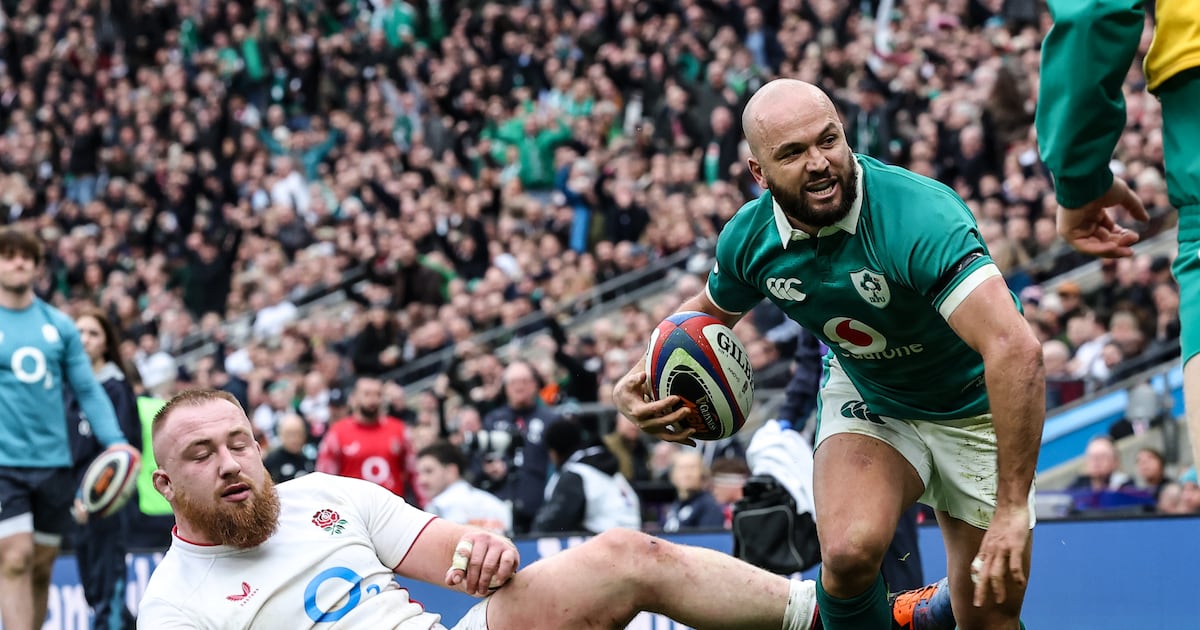
Jamison Gibson-Park could probably outrun the superlatives if he was of a mind. Instead, the quietly spoken Ireland scrumhalf will ignore or shrug them off in much the same way that he did opponents at Twickenham, content to let others lead the eulogies regarding the majesty of his contribution.
There are rare occasions when a player’s performance is so utterly compelling that a match seems to spin on the periphery, a blurred background with just the individual in focus. There were times when that was the case in southwest London. Gibson-Park’s imperious display induced sloppy grins and head shakes, as green-clad onlookers marvelled at the way he orchestrated the game plan and directed his team-mates.
He appeared to play the game in preview mode, aware of opportunities and possibilities, a nanosecond before anyone else on the pitch, a gimlet-eyed predator let loose. And how he feasted, from the moment he sized up England’s distracted defence, took the ball and the tap penalty in one elongated movement.
England tighthead Joe Heyes was powerless in attempting to defend Gibson-Park’s foot speed. A jumping-off point for Ireland’s try-scoring exploits. He wouldn’t be the only one in a white shirt to feel that sense of helplessness in the 70 minutes in which the Ireland scrumhalf presided over his side’s stunning victory, before trotting off to a standing ovation from sections of the travelling support.
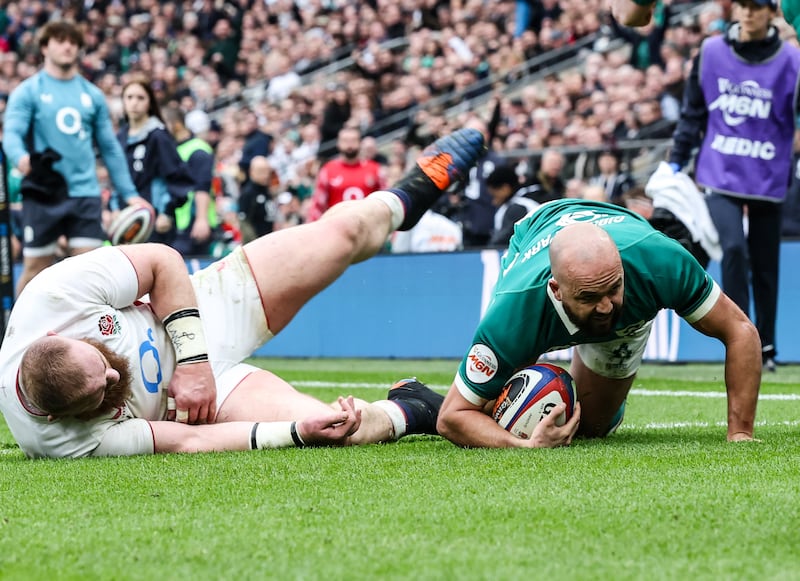 Jamison Gibson-Park scores a try against England. Photograph: Billy Stickland/Inpho
While the applause was in recognition of his rugby prowess, it would also have contained an element of gratitude. Occasions at Twickenham when Irish fans get to kick back and relax long before the final whistle, secure in the knowledge that there will be no nasty surprises or nerve shredding tension to endure regarding the outcome are few.
Players talk about getting into a flow, where the mental and physical, the tactical and technical, function in harmony. The subconscious overrides the thought process and takes over. When Gibson-Park came on as a replacement against Italy the previous weekend in Dublin the tempo of Ireland’s play increased appreciably.
Twickenham was a continuation – steepling box-kicks, chased enthusiastically and effectively by Rob Baloucoune and Tommy O’Brien, or clearances dispatched 40 metres down the touchline with an elegant sweep of his right foot. Simple things are rarely that, but he made them look child’s play; easy-peasy.
At his best Gibson-Park exudes a preternatural calm, never appearing rushed, decisive in his actions. He scans on his way to rucks and whether it’s whipping the ball away or picking up and occupying the fringe defenders, he rarely affords defences the luxury of being able to reload.
Exploring and exploiting space, it’s the speed at which he zips around that denies opponents that second look or chance. It was remarkable the number of times that Gibson-Park found himself at the nub of the action, in attack and defence.
If he wasn’t scoring tries, he was facilitating them. If he wasn’t making tackles or turnovers, he was directing others to do so. Freddie Steward was later followed to the sin bin by Henry Pollock; the player who goaded the England number eight into the indiscretion, Gibson-Park.
He would have crossed for a second try had O’Brien not been harshly penalised for an aerial duel in which Steward lost possession before the players collided. If the England fullback got lucky there, it ran out when he was correctly binned for grabbing at Gibson-Park at a ruck close to the English line.
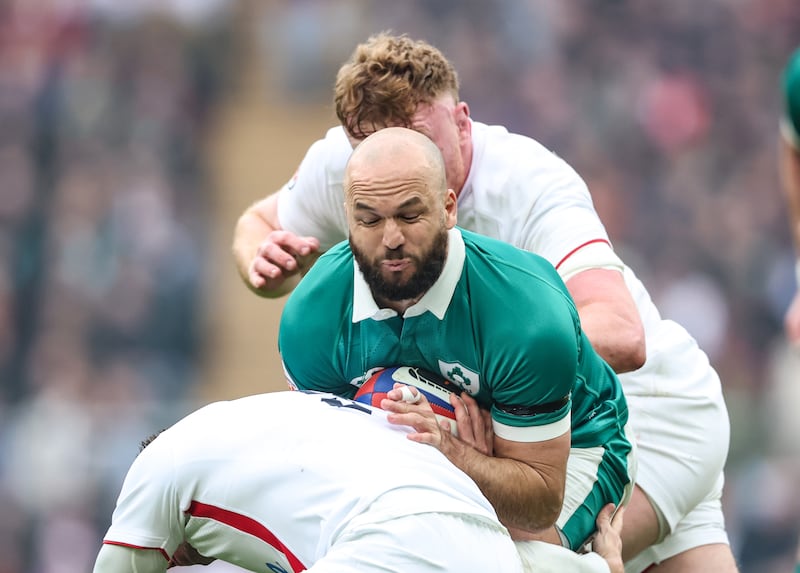 Ireland’s Jamison Gibson-Park is tackled during Saturday’s Six Nations game against Engand. Photograph: Billy Stickland/Inpho
Even in that instant the Ireland scrumhalf showed his quality. He fought off the contact, resisted any temptation for theatrics, hell-bent on getting the ball away and his long, cut-out pass allowed Rob Baloucoune to walk in for a try. Gibson-Park’s match-long brilliance contained a myriad of examples of that decision-making and execution.
There was more too than razzle-dazzle. As England threatened a try late in the first half, the scrumhalf directed O’Brien to stay out on Tommy Freeman and took responsibility for closing the space on the inside. Stuart McCloskey stuck out a big hand and O’Brien gobbled up the ricochet. It was Gibson-Park’s hustle that snuffed out the threat.
On 50 minutes he saved a try, bravely. The only way that Jamie George could eject him from a ruck a couple of metres from the Irish line was with a neck roll. Then, following a ruck turnover, it was his kick and turbo-driven pursuit that, in tandem with Nick Timoney, forced a penalty in the England 22. It was the precursor to Jamie Osborne’s try.
Gibson-Park celebrates his 34th birthday on Monday. He is a gold-standard scrumhalf in global terms and days like Saturday reinforce that assertion, with him happily back to his peerless best after a brief dip in form. His rugby IQ and physical prowess separate him by a distance from those that aspire to be him, in output and effect.
It is up to the others to close the gap. For supporters and team-mates, they’ll hope he has a portrait in the attic to keep him young for as long as possible.