
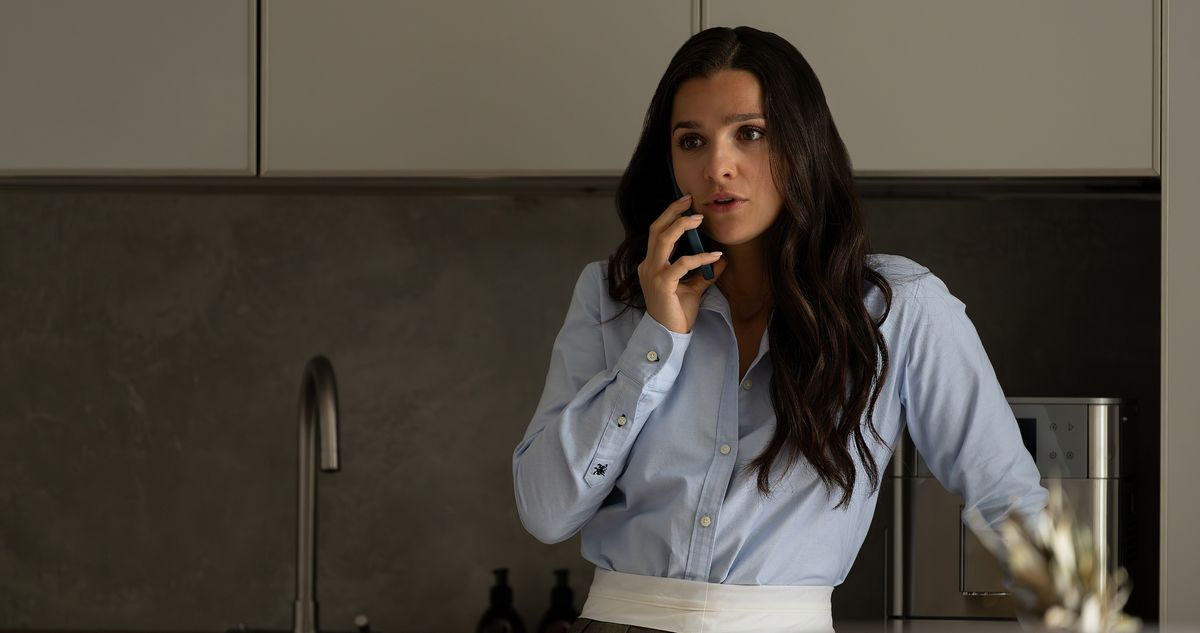
“She’s creating an element of discomfort and vulnerability and a power imbalance that she then is able to control.”
Photo: Simon Ridgway/HBO
Spoilers follow for the Industry season four episode seven, “Points of Emphasis,” which premiered on HBO on Sunday, February 22.
Lady Yasmin Muck is now a muckraker, but she’s not doing it out of the goodness of her heart. The former Pierpoint employee played by Marisa Abela has spent Industry’s fourth season struggling to find her place in her marriage to addict baronet Henry Muck (Kit Harington) while keeping them both afloat in their new jobs at fintech company Tender. She’s a zealous defender of corrupt Tender CEO Whitney Halberstram (Max Minghella) while also an increasingly immoral operator of her own, engineering a threesome for herself and Henry with Whitney’s assistant, Hayley (Kiernan Shipka), and securing a neo-Nazi a column in a newspaper owned by Henry’s uncle, Viscount Alexander Norton (Andrew Havill), to ensure his support of Tender. She’ll do anything to make her coupling with Henry and her career at Tender work, until both blow up in her face in “Dear Henry.” Under suspicion from British media and the finance industry over claims that Tender is a fraud, Whitney gives Henry a letter admitting the depth of the company’s deception — and since Henry is the company’s patsy CEO, he’s going to take the fall. In Sunday’s episode, Yasmin is on the warpath, using Alexander’s media connections to smear Tender, incriminate her husband, and absolve herself. She’s used to being left behind. This time, she’s leaving first.
During her time on Industry, for which she won a BAFTA last year, Abela deftly balanced Yasmin’s wounds from a childhood spent with her sexual-abuser father, her baseline insecurities about her own skills and place in society, and a need for increasing poise as she’s moved into the aristocracy. With her marriage to Henry, Yasmin thought she found the partner she’d been waiting for her whole life; as it collapses, she becomes, as one of Alexander’s editors calls her, “a hard fucking bird” looking out for herself.
“She sees it as an act of self-preservation,” Abela says of Yasmin’s appeal to Alexander to report on Henry’s role in Tender’s downfall. “Yasmin is pretty cut and dry: When she makes a decision, the door has closed. It’s not like she never loved him, but she has to move on.”
What was your initial reaction to Yasmin’s arc for season four? She’s trying to find purpose for Henry and for herself.
I was really excited to explore the idea of Yasmin as a wife putting someone’s needs above her own. We see that in episodes two and three, where Yasmin is trying to play the good wife and lift Henry up out of that hole. This is the most grown-up we see Yasmin, and that’s because there is someone else in her life that matters to her just as much as she does. Since season one, Yasmin’s main objective was to feel useful and needed and necessary. She hopes this will be the role in which that happens. She is suddenly an important function in someone else’s life, and she sees herself being able to succeed and thrive in this role — not just as this man’s wife but as Lady Muck.
At the end of the third season, she seems so ready to join the aristocracy. But at the beginning of season four, she and Henry get into an argument about letting a servant open the curtains instead of Yasmin. There’s a certain degree of knowledge that she’s never going to have because she didn’t grow up in that world.
Yasmin is trying her hardest, even by the clothes she’s wearing and her voice — she’s more posh this season. She’s trying to assimilate as best she can. But she can’t quite see the servants in her home as part of the furniture in the way Henry can. She doesn’t think she’s alone in a room with her husband if there are servants there, whereas the other people in that house are comfortable doing whatever and saying whatever in front of “the help.”
The relationship between Yasmin and Henry is so tumultuous because both of them are trying to figure out what their marriage is. What was your dynamic like?
We have really great chemistry as two people who have been married for longer than Yasmin and Henry have. It’s quite funny, we have almost a rather brotherly-sisterly-like dynamic as people, and that helps as we’re exploring a kind of sexless marriage, a kind of sibling-esque relationship. We leaned into that and the comfortability that he and I have together. I don’t want to say it’s competitive energy, but we push one another in those scenes to get the most juice out of the material.
Watching episode seven, I thought a lot about what Yasmin’s aunt Cordelia says to her about husbands during Henry’s birthday party: “You never give them unconditional love because they will weaponize it. They will fuck all of their fears into us and then kill us.”
Cordelia storms into episode two as a kind of oracle for the rest of the season for Yasmin. Whether she realizes it or not, it makes such an impression on her. The moment Henry turns around at the end of episode two and says, “Maybe we should try for a child,” the look that crosses Yasmin’s face is, Oh no, Cordelia was right. I am never going to have any control over this situation. I’m in quite a fragile, vulnerable position. Essentially, what Cordelia does is push her off-balance, and she’s trying to regain that balance for the rest of the season and doesn’t quite manage it. It’s episode seven when she finally decides that she has to act. At the end of episode six, really, she’s like, I’m out. I’m done with this. I need to start looking after myself again. No one’s going to look after me like I am.
Yasmin puts that mission into motion by meeting with Henry’s uncle Alexander to tell him about Henry’s drug use and infidelity. She’s building a trap door for herself.
That scene was about Yasmin slowly planting seeds in other people’s minds that Henry isn’t a sane, safe, reliable source. It’s the most careful she has to be, but she’s also using Lord Norton as a kind of test, because they have a close relationship. She’s almost asking him for permission in that scene to — I don’t know if I want to say “abandon” Henry — but to start creating her own nest. That’s how I was playing it, like a child pushing their first boundary, testing the limits of what they can get away with. He knows where I’m going with this. If he turns around and says, “Stop that, Yasmin,” maybe she would. But she’s dipping her toes into that water, and he gives her permission in that scene by not arguing back.
Alexander is maybe the only man in Industry who does not sexualize Yasmin. How did you want to play that relationship?
I wanted to see what a nonsexual, non-male-gaze-y relationship with Yasmin looked like. I think allows the audience to see Yasmin in a different light.
When Yasmin talks to other women about their sexual experiences this season, she views them through the lens of abuse. When she talks to Cordelia, she suggests Charles abused her, his younger sister. When Whitney’s assistant, Hayley, tells her what happened with Jim, Yasmin insists that Hayley didn’t consent to their hookup. What was your read on that pattern and what it signified about Yasmin?
Power is something Yasmin is becoming more and more obsessed with, and that version of abuse of power is something that has affected her life. Yasmin is starting to understand that as the ultimate way of harnessing power, especially over women. She is exploring that notion with Cordelia in the beginning, and even more so with Hayley throughout the season. It’s her version of emulating the ultimate version of power that she personally experienced, which was her dad, and also all of her bosses at work. We’re watching Yasmin start to emulate Kenny and Eric and her father in those scenes with Hayley; she’s sort of cosplaying it. She’s creating a faux safe space for herself and for these other characters in saying, “I see you, I understand you, I am just like you,” but by bringing that language into the conversation, she’s creating an element of discomfort and vulnerability, and a power imbalance that she then is able to control.
Yasmin learns that Whitney hired Hayley from an escort service and that he’s using young women and girls to honeypot and blackmail powerful figures. I thought of Whitney this season as a Jeffrey Epstein–like figure and Yasmin as a Ghislaine Maxwell. How did you view that comparison? Did showrunners Mickey Down and Konrad Kay discuss this with you?
The fact that Yasmin’s father was a publishing tycoon and died on a boat called the Lady Yasmin, all of these things are [part of it]. We’re looking at a young woman who has never been able to get a foothold on the feeling of safety, or power, or feeling useful or necessary or belonging or loved. And then she suddenly has this intense proximity to power. What does it look like? Does it corrupt? Does she fall into it? That is the comp.
Did you go as far as reading about Ghislaine Maxwell, or did you want to keep Yasmin separate?
I wanted to keep her separate. It felt loosely inspired by something that is so prevalent in the media. Things were unfolding with the files even as we were filming, but especially now, the whole topic is horrifying and disgusting and very real [so] that I’m very glad I didn’t draw too close a parallel.
In the final conversation between Harper and Yasmin before they go clubbing, they’re revealing so much about how they view each other. Yasmin has two lines that were really interesting to me. She says, “I guess I kind of grew up at someone’s mercy” and “God, I wish I was still 17. It was so easy to get people to do things for you.” Those are such little windows into Yasmin’s character.
There are so many different versions of that scene somewhere in the edit room. There’s a version where it’s incredibly broken down, super-emotional, really heightened, and then there are versions where it’s quite numb. Yasmin has failed again, and it’s a scene where a woman is incredibly disappointed in herself. That line about “I wish I was 17, it was so easy to get people to do things for you” — there’s a truth to that in every sense of what that could potentially mean for Yasmin. It’s about the burden of being a woman with responsibilities, and the burden of having a failed marriage, of not being successful in a career, of not being successful in either love, happiness, or a job.
Yasmin is about to turn 30, and she’s not had any of the things that someone would think of as successful for a woman her age. Harper is the only person she can talk to about these things. She’s the only semblance of family Yasmin has left. The scene is an incredibly vulnerable one, and what that vulnerability looks like in that moment really changed each take. Maybe that vulnerability is knowing these things in my soul, and therefore not necessarily being so affected by them as I’m saying them, but saying them as fact. Or maybe it’s the reality of them hitting me and becoming incredibly overwhelmed by them. It was important to try all of the different options and then leave it up to Mickey and Konrad to do what they will in the edit.
That scene was so important for Myha’la and me. It was such a nice moment and such a rewarding thing to be able to film after four seasons of this relationship that goes backward and forward.
You’ve said that Harper and Yasmin “reflect the most innocent versions of themselves back to each other because they knew each other at that point.” What innocence do you think Yasmin still sees in Harper, and what innocence might Harper still see in Yasmin?
One of the most iconic songs on Industry is called “Birth of a World Killer,” and it’s Harper’s song. Yasmin sees that Harper feels this deep necessity in her bones to be a world killer and a dominating presence. That is how she’s going to get validation, and that’s how she’s going to be successful and feel good and sleep well at night. Yasmin sees the young girl underneath who is hoping that people accept her and hoping that people take her seriously and hoping that she’ll find someone to love her eventually. I think what Harper sees in Yasmin is a very scared girl who some terrible things have happened to and is deeply traumatized and desperately trying to hold on to control of a life that is spinning out of control all the time.
Harper’s line about how “my trauma traumatized me” applies to Yasmin as well, but I don’t know if Yasmin would agree with it.
Right. I don’t think Yasmin is as self-aware as Harper.