
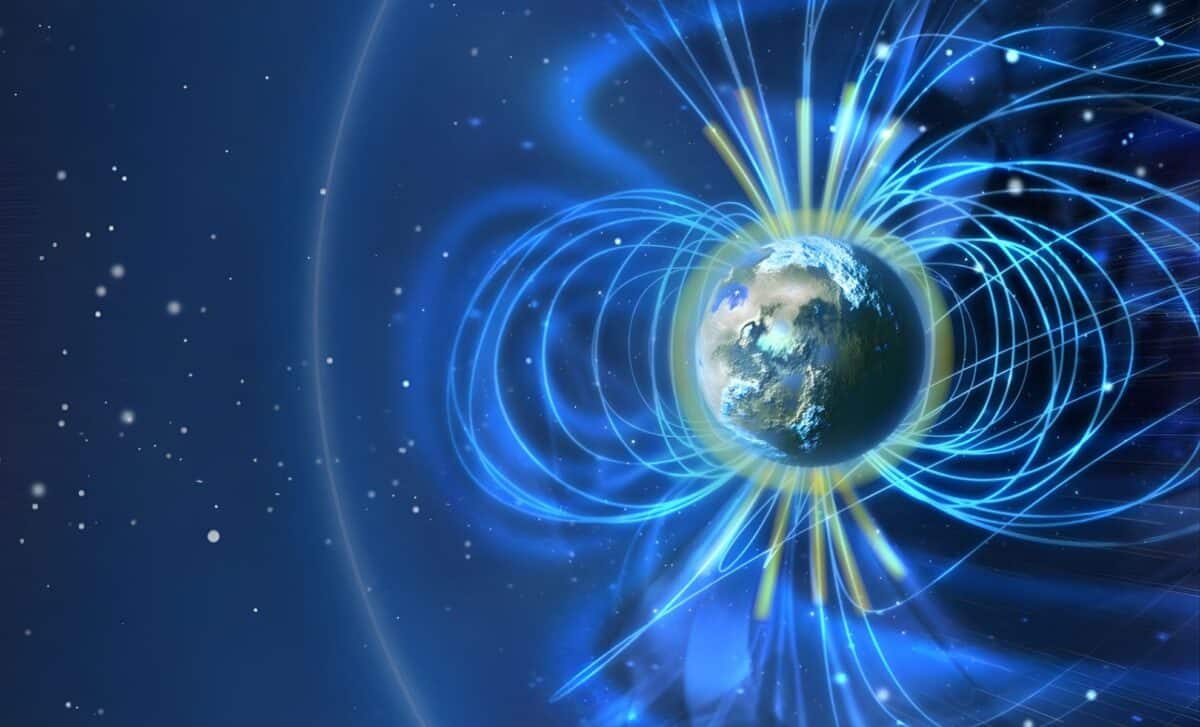
A sediment core from the North Atlantic has revealed that one of Earth’s magnetic field reversals during the Eocene lasted far longer than expected. Earth’s magnetic field has reversed hundreds of times over geological history, with roughly 540 flips recorded over the past 170 million years.
The duration of these reversals matters. A weakened magnetic field exposes the planet to higher levels of cosmic and solar radiation. Understanding how long these transitions last is key to interpreting both past environmental conditions and potential future scenarios.
Long Magnetic Reversals Found Off Newfoundland
The new evidence comes from an 8-meter sediment core extracted off the coast of Newfoundland in the North Atlantic. Tiny magnetic crystals embedded in the sediments recorded the direction of Earth’s magnetic field as the layers accumulated over time.
According to the study published in Communications Earth & Environment, researchers identified two polarity reversals within a section dating back about 40 million years to the Eocene. One transition lasted approximately 18,000 years. Another extended for at least 70,000 years; far longer than the commonly cited 10,000-year duration.
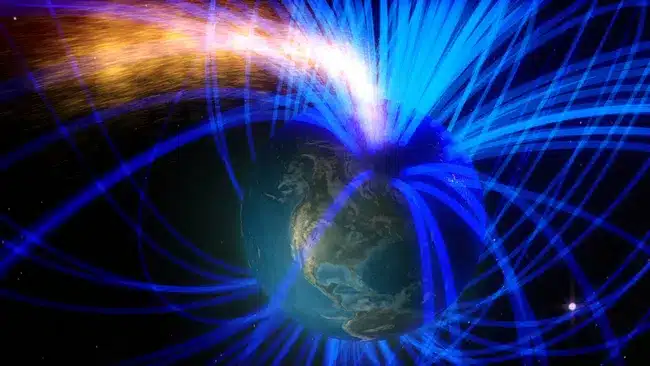 Illustration of charged solar particles flowing along Earth’s magnetic field lines toward the poles. Credit: NASA’s Goddard Space Flight Center
The polarity shift was not confined to a narrow layer. Instead, it stretched across a broad portion of the sediment column, indicating a prolonged and complex transition rather than a rapid switch.
An Unstable Magnetic Flip
The magnetic signal preserved in the core showed more than a simple flip. The field appeared to hesitate, with multiple “rebounds” in which polarity briefly shifted before changing again. Lead author Yuhji Yamamoto of Kochi University stated that:
“This finding unveiled an extraordinarily prolonged reversal process, challenging conventional understanding and leaving us genuinely astonished.”
Computer modeling conducted by the team suggested that reversals under certain conditions could last up to 130,000 years, although such an extended event has not been observed in the geological record.
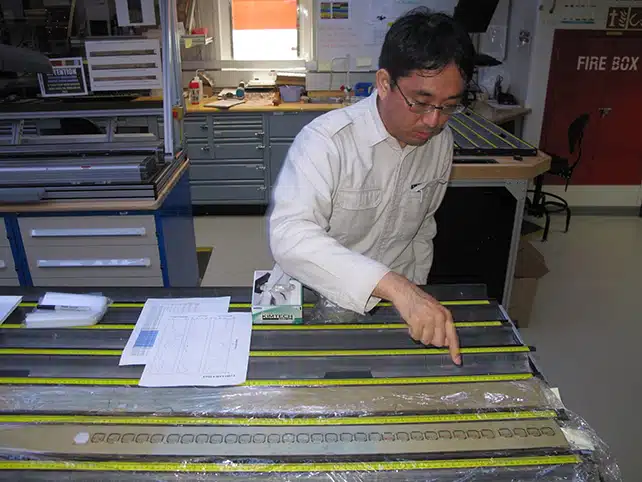 Yuhji Yamamoto examining a sediment core sample. Credit: Peter Lippert
Echoes of the Brunhes-Matuyama reversal
The Eocene record is not unique. Researchers note that comparable rebound patterns appeared during the Brunhes-Matuyama reversal roughly 775,000 years ago.
A 2019 study found that this more recent reversal lasted around 22,000 years. The recurrence of rebounds in both cases suggests that geomagnetic reversals may be inherently complex events rather than orderly transitions. As paleomagnetist Peter Lippert from the University of Utah explained that:
“It’s basically saying we are exposing higher latitudes in particular, but also the entire planet, to greater rates and greater durations of this cosmic radiation.”
He also noted that such exposure could logically be associated with higher rates of genetic mutation and even atmospheric erosion.