

You are probably thinking, “I’m too slick to fall for some Facebook scam.”
You’d be surprised.
People of all ages and education levels fall for these scams every day.
Given many of my Yahoo readers here are middle-aged and older, and thus, a prime target for financial exploitation, it feels prudent to share an extremely common Facebook Marketplace scam that an inordinate number of people are falling for.
I’ll show you exactly how it happens—and how I dealt with it recently.
What happens with this scam
Last month, I listed my monitor on Facebook. I kept it simple, listing the price, condition, my location, and included a few photos.
What surprised me was, within five minutes of my posting, I got three messages that all had strikingly similar conversation patterns.
Each person asked, “Is it for sale still?”
Then, “What condition is it in?”
Despite those details being prominently listed on the item description. But in my hopes of having a buyer, I convinced myself that people are lazy, and maybe Facebook was suggesting the auto-complete questions to send.
Then, I clicked on their profiles and noticed all three were newly created Facebook accounts with little activity and that their locations were spread all over the world—far away from my home here in Tampa. Both were big red flags.
I forged ahead and things quickly got weird when we tried to move forward with the sale.
All three had some weird explanations about how their friend, brother, or sibling would be the ones picking it up. I figured, “Whatever. These are all obviously scammers.”
Then, predictably, they all said they couldn’t do cash and asked if I had Venmo. I said cash only for two and they immediately blocked me. The third, I decided to play the game instead.
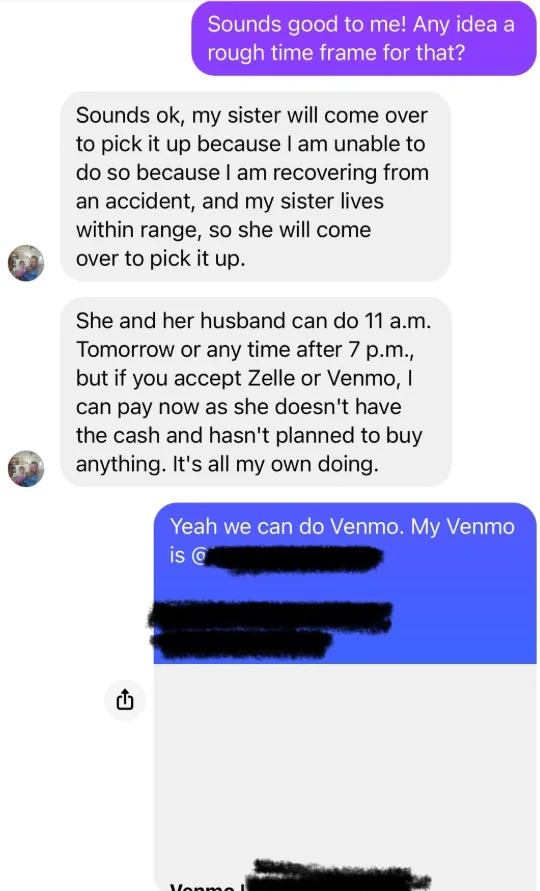
I gave him one of my secondary email addresses and he sent me a screenshot of an error sending the money. Then he said, “I need you to set up a business account. I’m unable to send if you don’t confirm it.”
Then I receive a fake Venmo email asking me to send additional money to set up this business account.
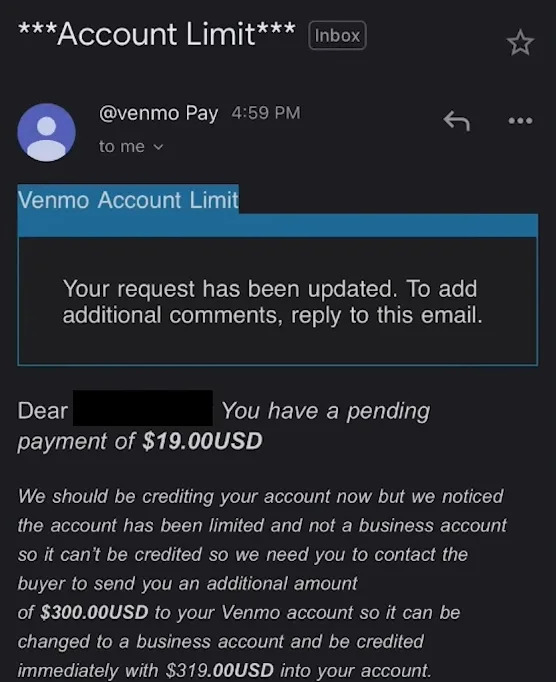
Also, take note of the above message, how it is poorly and clunkily worded. An actual certified email from a big company like Venmo would have much cleaner language, and use an actual email address from Venmo corporate (which ends in @venmo.com —anything else is fake). Also, these employees rarely if ever engage with actual customers about transactions like this.
There are many versions of this scam. Sometimes, it will say you need to “expand your account” or offer some other reason that a modification is needed. They’ll always dangle the apple of some credit that’s waiting on the other end.
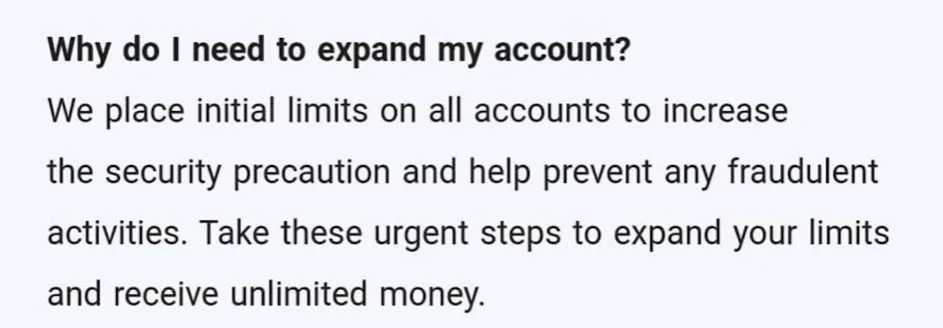
Again, note the ridiculous wording above. Saying “the security precaution” makes it sound like there is only one security risk, which is fantasy. Also note the “urgent steps” to receive “unlimited money”. This hyperbole should always be a red flag.
These are called scam-spotting techniques and they have exploded in popularity in recent years. Many of them are run by organized crime groups in Southeast Asia. Sometimes they are lone wolves, looking for a quick buck. Other times, it’s huge teams working in unison.
These scammers are slick and don’t feel bad if you’ve already been duped. My spouse, who is quite bright and educated, very nearly lost $800 buying a saddle on Facebook Marketplace and it followed a similar playbook: the person was unable to deliver the saddle personally, they couldn’t be contacted via phone for a conversation, they had a roundabout story about why they needed to use Venmo.
Beware anytime the person complicates the transaction. It should be a very simple process: they come to look at the product, decide if they like it, then buy it themselves with cash.
Why should you care?
A 2024 survey by the TSB Bank fraud team found that more than a third of Facebook Marketplace ads were fake and listed by scammers. The highest saturation of scams were in automotive, followed by phone, shoes and clothing. But you can and should expect to encounter more scams also. Beware of pricing where it seems too good to be true given the nature and quality of the product.
Per the FTC, more than $12.7 billion was lost in fraud in the US in 2025, with more than one third of people reporting scams having lost money to one. Around $1 billion of that fraud was lost to transactions initiated on social media.
How you can avoid the scams
First, make sure all your transactions happen with cash.
There should be no need to create accounts, send confirmation numbers, provide passwords, or any other shadiness scammers try to pull out.
Beware of weird stories, unnecessary extra steps, long stories and excuses.
Check the Facebook profile of the prospective buyer. If they are a new account with limited visible activity, it’s one possible red flag.
If the buyer offers to send you extra money that you’ll use to pay “his courier”—watch out. They may be sending you a bad check and the money you send to the courier will be stolen from you when the check bounces.
Remember there is no “upgrade” required to use Venmo or PayPal.
A final confirming step can be having a phone call with them. If they get squirmy and try to avoid that direct interaction, it’s another sign.
I will often say “cash only” in my listings, which acts as a sort of mosquito spray against scammers: not perfect, but a helpful step.
Lastly, if you see lots of repetitive messages—like I did—it’s often bots that are combing the listings. They will say “is the item still available” rather than name the item outright.
Be careful and always listen to your gut. Never give away your personal information.
Always, always, always deal in-person with cash.