
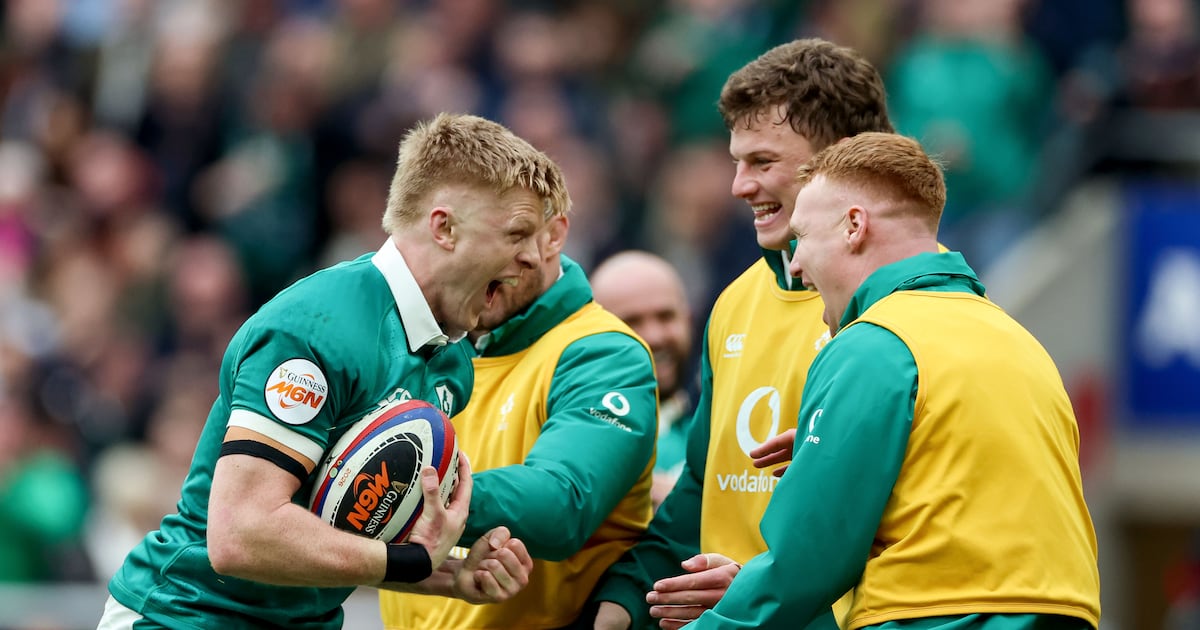
Strictly speaking, there’s no real midway point in the Six Nations, but this being the only fallow week it’s thus the only time to pause for breath and have a midterm report.
Ireland
Apocalypse not after all. Ireland are even back to third in the world rankings. As in 2021, we really should have listened to Andy Farrell, Johnny Sexton, Caelan Doris et al when they again assured us they were preparing well and a truly brilliant performance like last Saturday’s was in the making.
Save for ongoing scrum issues, perhaps understandable in the absence of three loose heads, the 42-21 win over England at Twickenham ticked almost every box.
Andy Farrell had the team perfectly primed, one by one convincing all his players that they were better than their counterparts in a meeting last Wednesday. There will be further ups and downs before the next World Cup but Ireland 2.0 under his watch are taking shape, and potentially destabilising reports of Farrell moving to Saracens after Australia 2027 seem wildly speculative.
Given his contentment with life in Ireland and family circumstances, if anything one could envisage him extending his stay.
An array of big-game players produced world-class performances, the defensive sets established a foothold and their accuracy at the breakdown led to the most fluid attacking performance in over a year.
Even the scale of the absentees have even become a strength, with Stuart McCloskey nailing down the number 12 jersey and Robert Baliucoune providing a cutting edge, while Jack Crowley has assuredly quietened the outhalf debate – for a while at least.
The supporters are back on board too, although judging by the 20,000-plus present in Twickenham and a peak audience of over 1 million on RTÉ, maybe they weren’t that fickle anyway.
Another caveat is that Ireland, like others, have shown a previous ability to produce one emotionally and perfectly pitched display which can be hard to reproduce in such a congested tournament.
Although you’d hope that last Saturday will liven up the Aviva, a rejuvenated Wales and Scotland at home will also be different challenges. Ireland are still 30/1 to win the title and the bookies seldom have it wrong, but four wins, a Triple Crown and a second-place finish would represent a positive tournament before the summer matches against the Wallabies and Japan in Australia, and the All Blacks in their Eden Park fortress.
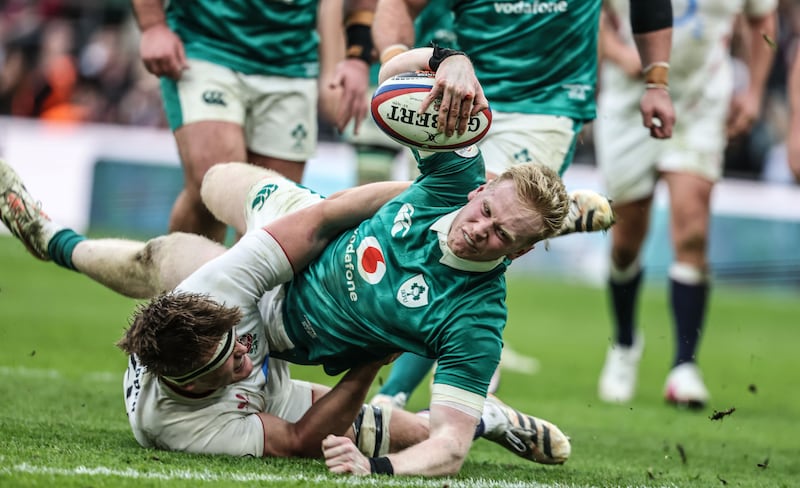 Ireland’s Jamie Osborne scores a try against England in Twickenham on Saturday. Photograph: Inpho England
Apocalypse now? Apparently so. Two fairly dismal defeats in a row have utterly deflated the optimism generated by a 12-game winning run, which now seems like a typing error.
That 12-game winning run should not be erased with the benefit of hindsight. But it was kick-started by one-point home wins over a profligate France and Scotland, and there was no South Africa, or indeed Ireland, in there.
In Saturday’s aftermath, Ellis Genge admitted that they had probably bought into the hype around them, but as an Australian acquaintance put it to me an hour or so after the game in Twickenham: “When will they ever learn?”
They can look almost robotic if opponents dilute their power game and aerial game, and also open up an early lead – as Scotland and Ireland have done on successive Saturdays.
They are lacking an auxiliary second playmaker – although the difference made by the introduction of Marcus Smith before half-time was striking – but suddenly questions abound, and they have been exposed by two teams who attacked with width; witness 51 missed tackles in two games with success rates of 78 per cent and 72 per cent.
 France’s Louis Bielle-Biarrey celebrates his side’s victory at the end of the Six Nations match against Italy at the Stade Pierre-Mauroy in Villeneuve-d’Ascq on Sunday. Photograph: Sameer al-Doumy/AFP via Getty France
In a typically undulating, unpredictable tournament, three serene bonus point wins have demonstrated options aplenty in personnel and style, retaining their power but reverting to a amore mobile pack.
Fabien Galthié has evidently had a change of tack in affording his array of playmakers and speedsters more freedom. This helps Les Bleus to seemingly make their own luck, as in scoring off an opposition overthrow and a miscued fly hack against Italy – albeit it also helps when you have instinctive geniuses like Antoine Dupont, Mathieu Jalibert and Thomas Ramos, not to mention the lightening Louis Bielle-Biarrey.
Despite Murrayfield being a bogey ground and a finale in le Crunch which has made them nervous in the past, France are 2/7 for another Grand Slam and 1/14 to retain their title.
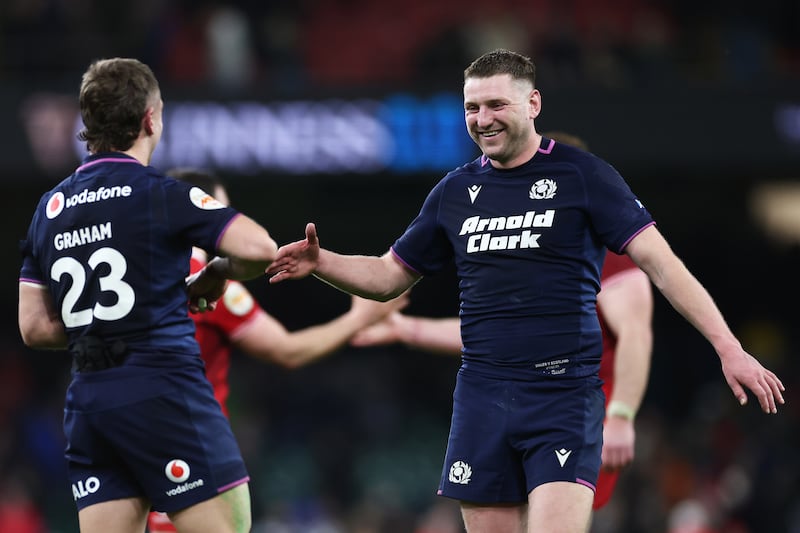 Scotland’s Finn Russell and Darcy Graham at Principality Stadium in Cardiff after their win over Wales. Photograph: Dan Istitene/Getty Scotland
Apocalypse then? There were calls aplenty for Gregor Townsend’s head after they lost their opening game in a sodden Stadio Olimpico, when the conditions were perhaps a leveller, albeit Italy won the game with two tries in that ‘dry’ opening quarter.
Yet they have the Indian sign over England and though it would have been typical of them to subside and lose against an unrecognisable and inspired Wales last Saturday, Finn Russell again pulled the strings and they kept cool in the enclosed Principality cauldron to outscore the home side by 21-6 after half-time.
They could yet down France at home but either way all roads lead to a potential Triple Crown shoot-out, complete with ramifications for the next World Cup pool meeting, on the final Saturday in the Aviva.
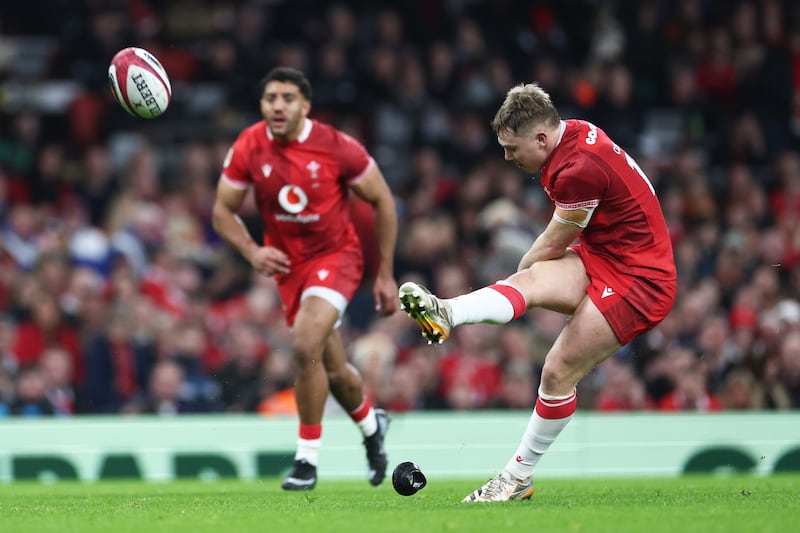 Sam Costelow of Wales successfully kicks a penalty conversion during the match against Scotland. Photograph: Dan Istitene/Getty Wales
From the depths of despair, Wales rediscovered themselves against Scotland and the Principality Stadium demonstrated both their enduring loyalty to, and love of, their national rugby team.
The work-rate of Dewi Lake, Rhys Carre and Alex Mann was off the charts, Sam Costelow gave the team real direction and despite the loss they will surely draw confidence and hope from that display.
Alas, Costelow and back rower Taine Plumtree will likely miss the rest of the tournament after both were forced off during Saturday’s defeat.
Italy
Gonzalo Quesada’s side have been the most talented Azzurri team in Six Nations history, although after a deserved opening win over Scotland, they’ve had little luck in losing to Ireland and France.
One thinks of the ball bouncing out of Tommaso Menoncello’s grasp in the Aviva and those two breakaway first-half tries against France in Lille on Sunday.
The net effect is that their tournament can still go one of two ways, with England at home followed by Wales in Cardiff.