
Unlock the Editor’s Digest for free
Roula Khalaf, Editor of the FT, selects her favourite stories in this weekly newsletter.
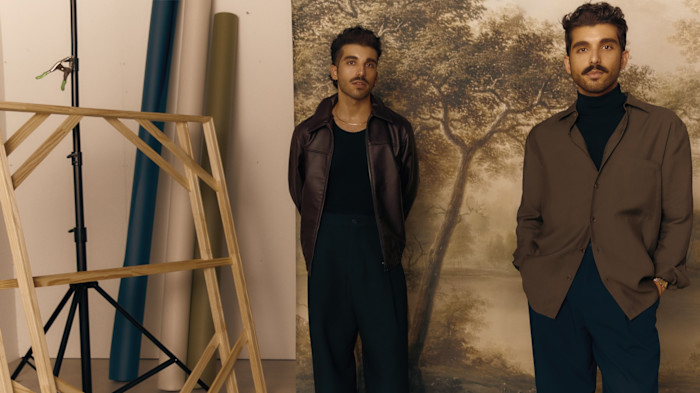
“People always ask us if we’re going to break up at some point,” says Erick Jiménez of his twin brother, Elliot, and their creative partnership. The pair have worked together as photographers for some 20 years. Elliot responds: “He’s stuck with me. He doesn’t have a choice.”
As identical twins and first-generation Cuban Americans, they have duality in their DNA. They were born in Florida but their artistic vision was shaped by their heritage. Their current solo show at the Pérez Art Museum Miami combines the evocative aesthetic of their commercial work – fashion editorial for the likes of Vogue Thailand and Harper’s Bazaar Italia – with a mysticism mined from their family history.
 The Rebirth of Venus, 2025 © Elliot & Erick Jiménez. Courtesy the artists and Spinello Projects
 El Monte (Ibejí), 2024 © Elliot & Erick Jiménez. Courtesy the artists and Spinello Projects
Titled El Monte (The Wilderness), the exhibition immerses viewers in the woozy world of Lucumí, a syncretic religion that emerged in Cuba during the late 19th century blending west African Yoruba beliefs with elements of Spanish Catholicism and a dash of spiritism. The twins give it their own spin: anonymous figures hold daggers and wear ruffs; some have rams’ horns; a drowned Ophelia is covered in moths. The result is a kind of gothic Caribbean surrealism.
As well as photographs, the show includes chapel-like spaces, 17th-century furniture and a large womb-like ceiba tree installation. “Elliot and Erick’s work builds a bridge between Miami’s Caribbean communities, its religious and spiritual practices, and those of their ancestors,” says the show’s curator, Maritza Lacayo. “The gallery is transformed into something mysterious and whimsical.”
Like Lucumí, Elliot and Erick were born of exile. Their mother and father fled communist Cuba with their paternal grandparents in the 1980s, heading first for Costa Rica, then to the US. They eventually settled in Miami; after their parents divorced the twins were raised by their Afro-Cuban grandmother. “We grew up with a matriarch,” says Erick. “She’s always been the head of the household, the breadwinner, the one you go to when there’s a problem.”
 From left: One to Bind, 2025, Ibejí Altar, 2025, and One to Break, 2025, on show at the Pérez Art Museum Miami © Zachary Balber/Elliot & Erick Jiménez, courtesy of the artists and Spinello Projects
 Erick (left) and Elliot at their studio © Erick & Elliot Jiménez
 A Rolleiflex camera in Erick’s home office © Erick & Elliot Jiménez
Their grandmother worked as an aesthetician and the twins were immersed in the realm of manicures and facials. “We were exposed to the beauty industry when we were very young,” says Elliot. He notes a link between the experience and how their careers focus on the nuances of appearance.
Growing up, we were referred to as ibejí, twins. They have their own deity
It was also through their grandmother that the brothers discovered Lucumí and its sacred stories (patakis), which link Yoruba gods and Catholic saints like the merging of characters from DC Comics and the Marvel universe. However, such theological amalgamation was a taboo subject during their childhood: “There was always a sense of, ‘Don’t speak about it outside the house’.”
The duo started taking photographs as teenagers, individually to begin with and then together. “We enrolled in a black-and-white film photography class simply to fulfil an elective requirement at high school,” recalls Elliot. “We assumed it would be an easy credit; instead, we fell in love.”
 Children of the Moon, 2025 © Elliot & Erick Jiménez, courtesy of the artists and Spinello Projects
Their signature style of portraiture – bringing together moody colour and chiaroscuro with a love of staged compositions – has attracted significant attention. In 2023, they photographed Puerto Rican rapper Bad Bunny for the first Spanish-language cover of Time magazine; their hazily atmospheric image depicted Benito Antonio Martínez Ocasio with all the gravitas of a renaissance painting. That same year, their monumental billboard Reclining Mermaid – a representation of Yemaya, another Lucumí deity – took over a Miami street corner during the Art Basel fair.
Today they describe themselves as spiritual rather than religious; their work brings together “a lot of overlapping conversations, not just about our heritage but also how this connects to our own personal journey and stories”, says Erick. “Growing up, we were always referred to as ibejí, which is the Yoruba name for twins. They have their own deity within the cosmology.”
“All the projects we do, we have done together,” says Erick. He refers to his brother as a “lifetime collaborator”. Until 2021 they lived together in Miami. They also have a place in New York where they continue to cohabit. “As identical twins, we share similar interests and friends, so we often spend time together outside of work,” says Erick. “You’d think we’d get bored with each other but we’re constantly surprising one another.”
 Elliot (left) and Erick outside Erick’s home in Miami © Elliot & Erick Jiménez
 Ophelia, 2025, on show at PAMM © Zachary Balber/Elliot & Erick Jiménez, courtesy of the artists and Spinello Projects
 Who is the Ram and Who is the Knife?, 2025, by Elliot & Erick Jiménez © Elliot & Erick Jiménez, courtesy of the artists and Spinello Projects
Their identical appearance is enhanced by an in-sync sense of style. Both sport a moustache on a bed of stubble (in subtly different ratios). “We only dressed the same when we were kids because our family dressed us that way,” they say. Yet neither do their outfits differ wildly; “we’ll occasionally overlap, the same jeans, a jacket,” says Elliot. “Sharing pieces has always been a plus but we like having our own points of view.”
Elliot seems the more gregarious, Erick more contemplative. And they have their own individual strengths at work as well. “When it comes to the technical side of things, I’m usually the one that will take the lead,” says Erick. “And then when it comes to editing and composition, Elliot will jump in.”
 Sikán (After Belkis Ayón), 2025, on show at PAMM © Zachary Balber/Elliot & Erick Jiménez, courtesy of the artists and Spinello Projects
Concepts for shoots are created collectively like filmmakers going through a process of pre-production. But do they always agree? “No!” laughs Elliot. “There’s a lot of back and forth,” adds Erick. “We will challenge each other. There’s a lot of bickering at times.”
Recommended

And what about the idea that identical twins are somehow psychically linked? “Twins have this innate connection,” acknowledges Erick. “At least we feel it. It’s hard to describe. It’s not necessarily mind-reading, but I think there’s a strong sense of [knowing] each other. Within Lucumí, they always say the ibejí are basically one spirit in two bodies.”
Elliot & Erick Jiménez: El Monte is at Pérez Art Museum Miami until 22 March