
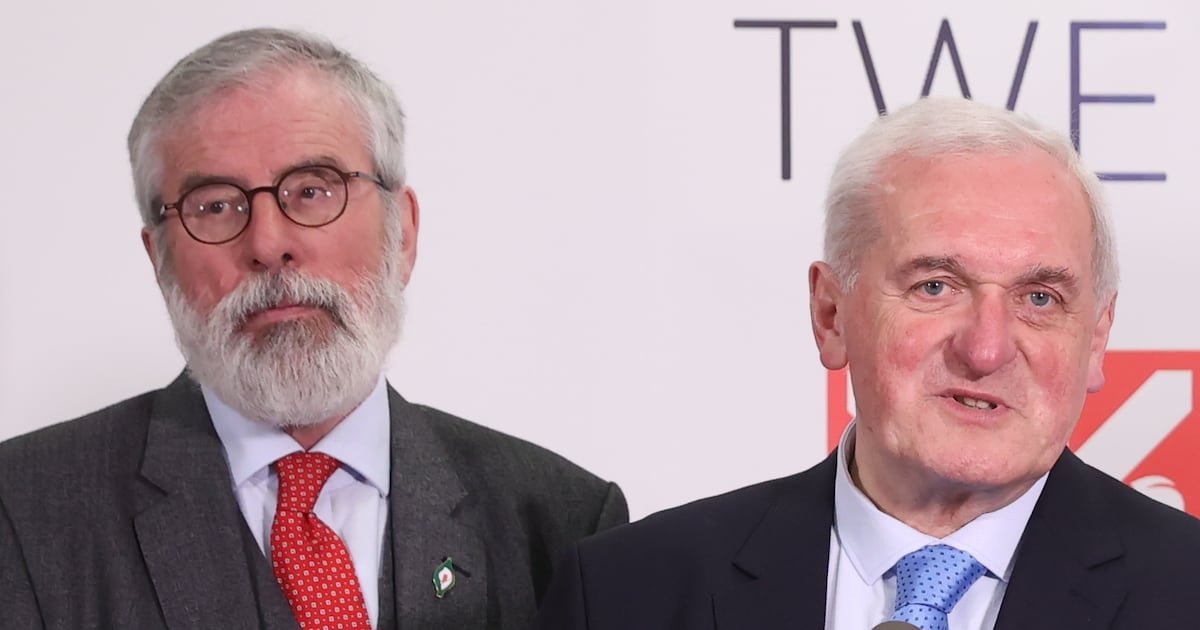
Bringing an end to conflicts involves speaking to participants on the basis of parity of esteem, but no party should be allowed “shoot their way to the table”, former taoiseach Bertie Ahern told TDs and senators on Tuesday.
Ahern and former Sinn Féin leader Gerry Adams spoke to the Oireachtas Committee on Foreign Affairs about the Irish peace process and whether its lessons could be of use in the Middle East and elsewhere.
Both men said it was crucial for the Palestinian people to have a unified leadership that was pursuing a set of defined objectives.
Without a unified political position, Ahern said, “it is a road to nowhere”.
The former Fianna Fáil leader said there was a need for an international peace conference attended by a unified Palestinian leadership and an end to the focus on violence.
“If they don’t work now, it will all just re-enact itself again. Those kids will grow up and those kids will become adults and those kids will become freedom fighters or terrorists or whichever side you are on. And that’s the sure thing,” Ahern said.
Asked by Labour TD Duncan Smith whether governments should engage with Hamas, Adams said governments did talk to them “when it suits” and “we can’t choose the representatives of the Palestinian people”.
Hamas was “a fundamentalist Islamic” organisation and he did not agree with that, but that was beside the point, he said.
Ahern said that during the Irish peace process the Mitchell Principles established the rule that parties involved in violence could not be at the table.
“Sovereign governments can’t talk to people who want to shoot their way on to the table,” he said.
The Mitchell Principles were “crucial” to the Irish peace process, so talks based on similar rules should be looked at in the Middle East and in conflicts elsewhere, such as Africa.
When trying to get parties to engage in a peace process “it is not so simple that you can talk to whoever the people are”, he said in response to Fine Gael Senator Garret Ahearn.
Ahearn said Adams, in his opening remarks, when referring to the conflict in Gaza, said peace would never be secured through security or military means.
“That was not always the position of the IRA,” he said. “When did that change happen within the IRA and how did it come about?”
In response, Adams said successive IRA leaderships engaged in dialogue over the course of the conflict, with Protestant church leaders, loyalists and unionists.
He said the IRA was “very, very, very much” a response to what was “happening on the ground” and British “militarisation”.
Sinn Féin consciously went after Irish America, the Irish government and the late John Hume to ensure “an alternative” was there, he said.
In his opening remarks, Ahern said it was virtually impossible to create a peace process without parties who were committed to resolving the conflict.
“Real peace and reconciliation take root when the leaderships on both sides of a conflict accept that the only outcome that will be sustainable in the longer term is one involving compromise and accommodation,” he said.
Adams called for the immediate passing of the Occupied Territories Bill and the Illegal Israeli Settlements Divestment Bill, 2023.
He told Cathy Bennett of Sinn Féin how he considered the Board of Peace established by US president Donald Trump to be “an exercise in colonialism” and he did not see anything coming out of it.
Ahern said illegal Israeli settlements were “obnoxious” and designed to “wreck” any prospect of a two-state solution.