
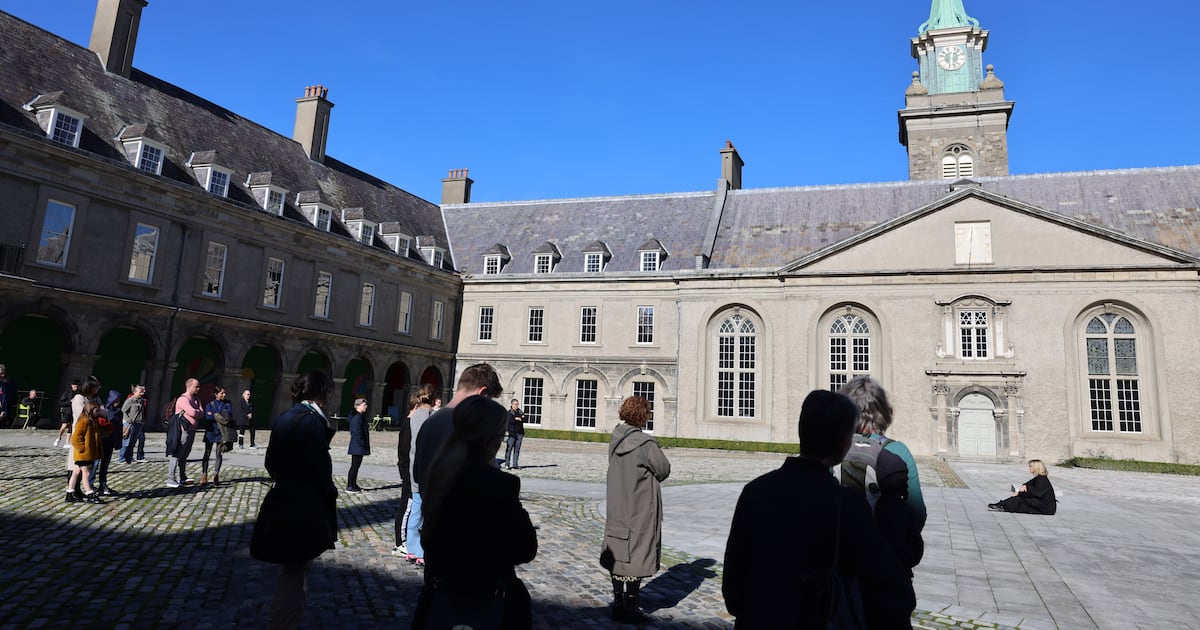
The Irish Museum of Modern Art (Imma) has said its cultural significance is being “entirely overlooked” in a State plan to renovate its building in Kilmainham, Dublin.
Ali Curran, chair of Imma’s board, said related issues between the museum and the Office of Public Works (OPW) had been “escalating for some time”, and may require the intervention of Minister for Culture Patrick O’Donovan.
Imma is now seeking legal advice with regard to the draft plan relating to the conservation of the museum’s site in Dublin 8.
In a letter seen by The Irish Times, Curran said she believed Imma’s “cultural significance” and “contribution to Irish life” were being “entirely overlooked”.
The draft plan, the letter argued, “strays some distance from what may be expected… into areas of constitutional revision and dilution of Imma as the operator of the site with an emphasis on the strategic repositioning of the OPW, undermining the museum’s mandate”.
Curran made the remarks in a letter to Feargal Ó Coigligh, secretary general at the Department of Culture, last month.
In the letter, dated January 14th and obtained under Freedom of Information, she said Imma’s board was “extremely concerned” about the plan.
Curran said Imma needs more space for its programming, but there were “several instances” in the plan which propose certain parts of the premises requiring renovation would be used exclusively by the OPW in the future.
Curran informed Ó Coigligh that Annie Fletcher, Imma’s director, was “engaging legal advice to decide how to respond” to the conservation management plan (CMP) “and the operating procedures as they contain clauses that are in direct contravention of the existing management agreement”.
In the letter, Curran said she believed “departmental input” was needed to resolve the situation.
Imma has operated at the Royal Hospital Kilmainham (RHK), one of the oldest classical buildings in Ireland, since 1991. The OPW assists in its maintenance and preservation.
Curran said Imma’s board and executive were “mindful of the excellent work” the OPW does in ensuring the RHK site is well maintained and accessible. However, she said elements of the draft plan “go well beyond this scope”.
The document includes “several incorrect or misrepresented statements”, but “the overarching issue is the reframing of the heritage value of the site as the priority above the cultural and social use”.
[ Imma’s relentlessly on-message programme highlights its identity crisisOpens in new window ]
“The board is extremely concerned about this CMP as it minimises Imma’s presence on site and proposes buildings on the site for OPW use, in clear contradiction of the existing management agreement that gives sole managerial, programming and operational responsibility to Imma, while giving the OPW responsibility for conservation and maintenance of the buildings and site,” the letter stated.
A spokeswoman for Imma said that, as of yet, there has been no meeting between representatives of Imma and either the Department of Culture or the OPW regarding the plan. She said Imma’s board has written to the OPW requesting that the draft of the CMP be revised.
“It was agreed between Imma and the OPW that plans for site development under the [National Development Plan] would be delayed until the CMP was accepted by all parties.”
A spokeswoman for the department said the “feedback” provided by Imma forms “part of the ongoing dialogue between the stakeholders that will enable the final version of the plan to be fully reflective of both the conservation needs of the site and also its position as the home venue of a living national cultural institution”.
The department is “supportive of these joint objectives”, she said.
The OPW was contacted for comment.
The RHK, which was constructed in the 1680s, was used as a home for retired soldiers for almost 250 years. The site served as Garda headquarters from 1930 to 1950, but fell into disrepair until 1980, when then-taoiseach Charles Haughey approved plans to renovate the site as a cultural space.