
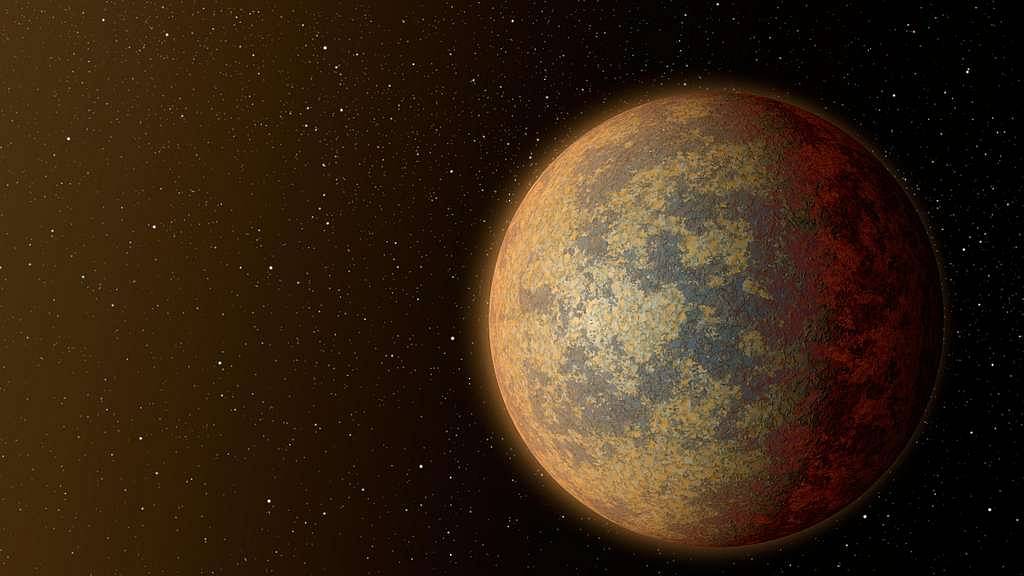
 Artistic depiction of a super-earth. Image in public domain.
Super-Earths are some of the most intriguing planets in our galaxy. They’re rocky planets significantly larger than Earth, but also smaller than gas giants like Neptune or Saturn. They’re interesting because we find them a lot, and because several of them are in the “habitable zone” — the Goldilocks area where liquid water could exist.
But there’s a problem. A planet’s magnetic field is essential for protecting life, and many of these planets were thought to have no such field.
A new research challenges that idea. The new study argues that unlike the Earth’s magnetic field, which comes from the core, these planets’ magnetic field could come from magma in the mantle.
“This paper suggests that, like in many other things, exoplanets might not necessarily follow the solar system paradigm concerning magnetic field generation,” Luca Maltagliati, a senior editor at Nature Astronomy, who was not involved with the new study, wrote in a brief piece summarizing the findings.
Looking in the Wrong Place
Super-Earths planets are beefy cousins to our home world, weighing in at three to ten times the mass of Earth. Because they are so massive, the physics inside them gets weird. On Earth, the planet’s iron outer core stays semi-liquid and keeps moving because of heat escaping to the surface. But on a massive Super-Earth, the weight of the planet is so immense that it can actually squash a core into a solid, frozen lump, or keep it so hot and pressurized that it doesn’t move enough to create a field.
Miki Nakajima and her team at the University of Rochester had another idea. Their question was: can rocks conduct electricity? Normally, no. If you stick a battery to a piece of granite, nothing happens. But Nakajima’s team suspected that at super-high pressures, things might change.
They squeezed these rocks to pressures up to 1,400 Gigapascals using high-powered lasers. That is roughly 14 million times the pressure of Earth’s atmosphere at sea level. Under that kind of pressure, something incredible happens: the electrons in the magma start to roam free. The rock becomes “metallic”. In other words, they could conduct electricity.
Interestingly, the team also debunked a long-held theory. Many scientists thought you needed a ton of iron in the magma to make it conductive. The laser experiments showed that even pure magnesium oxide becomes conductive at high enough pressures. The pressure itself does the heavy lifting, not the chemistry. This means even “iron-poor” planets could be magnetically active, provided they are big enough — specifically, between 3 and 6 times the mass of Earth.
×
Thank you! One more thing…
Please check your inbox and confirm your subscription.
What This Means
Earth-like planets have a thin crust, a large mantle (which contains a lot of molten magma), and a core. Inside these super-Earths, the magma inside the mantle could be generating a magnetic field that can protect life on the surface.
Perhaps most shocking is the sheer power of these rock-based shields. The team’s model shows that a mantle-driven dynamo is typically ten times stronger than a traditional core-driven dynamo. This effect is most prominent in planets 3-6 times the mass of Earth.
This research shifts our entire perspective on what makes a planet “Earth-like.” We’ve spent years looking for twins of our own planetary structure, but nature is far more creative. The universe might be full of “magma-shielded” worlds that look nothing like home on the inside but provide the same safety on the outside.
It also gives us a glimpse into our own past. Scientists believe the early Earth, shortly after it formed, was a molten ball of chaos. It likely had no solid inner core back then. How did it have a magnetic field to protect the first stirrings of life? It’s possible that a young Earth was also powered by a basal magma ocean. While Nakajima’s current experiments focused on the higher pressures of Super-Earths, the team is already moving on to test the lower pressures — around 130 GPa — that would have existed inside the infant Earth.
A New Chapter in Astronomy
Of course, this is still just a hypothesis. Researchers have shown that these planets could have magnetic fields driven by magma, but we haven’t yet observed such a field.
That may soon change.
We are on the verge of a new era of astronomy. In the coming years, new telescopes might be able to detect the magnetic signatures of these distant worlds. When we finally find a signal, we might not be looking at the pulse of an iron heart, but the glow of a metallic ocean deep in the dark.
Ultimately, this research shows us that habitability isn’t just about being the right distance from a star. It’s about what’s happening in the basement. It turns out, a massive ocean of liquid rock might be the best insurance policy a planet can have.