
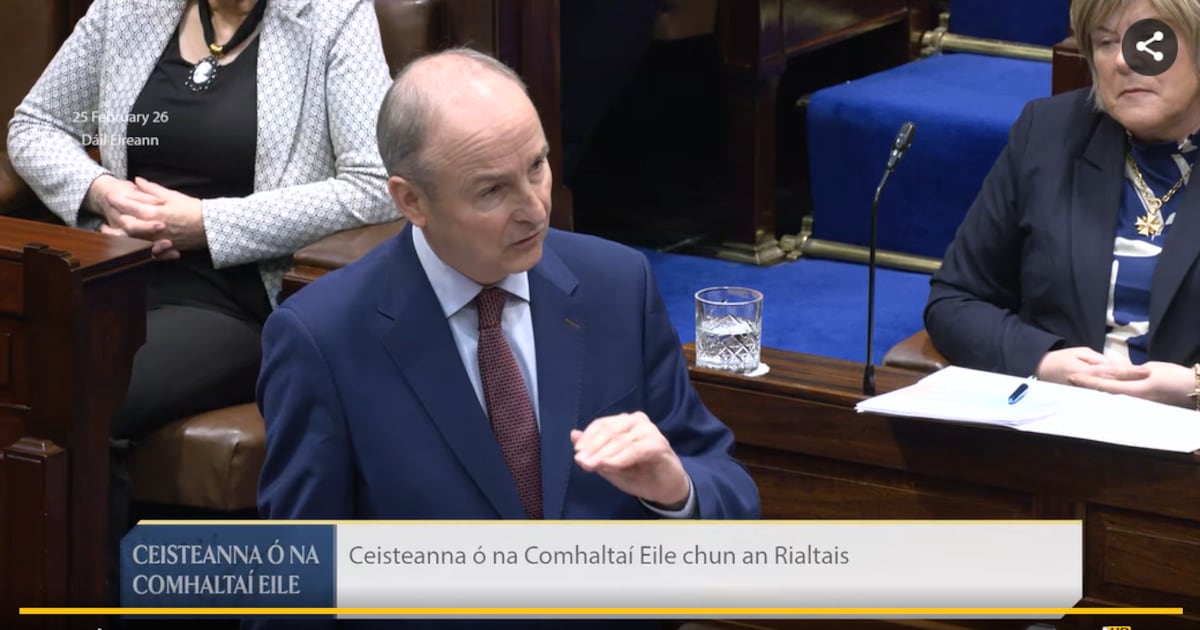
Main pointsTaoiseach Micheál Martin has apologised on behalf of the State to survivors of abuse in industrial and reformatory schoolsThe International Protection Bill, described as the most radical reform of immigration law in the State’s history, is due to be debated in the Dáil this evening‘What planet are you on?’: Taoiseach and People Before Profit TD Paul Murphy clashed earlier during a debate on Irish neutralityA series of protests calling for support for special needs assistants are due to take place across the country later on WednesdaySinn Féin’s Mary Lou McDonald said the country’s largest landlord claimed investors could make an extra €21 million a year in rents under new rulesKey reads
Jack White – 2 minutes ago
Minister for Foreign Affairs Helen McEntee said she wanted to particularly acknowledge the “four people who, I believe, have brought us to this point and who have made today happen”.
Marie O’Halloran reports:
One of many speakers to name Mary Donovan, Mary Dunlevy Greene, Miriam Moriarty Owens and Maurice Patton O’Connell, the Minister said: “They represent many, many other survivors of institutional abuse and other industrial schools.
“I met all four in my previous role as minister for education, and I really wanted to thank them for the time that they afforded me in our engagement and during our time.
“I’m very conscious that I am not the first person that they had to relay their story to and the horrors that were inflicted upon them, their siblings, their family members.”
The Minister said it was an “intergenerational trauma that has been inflicted on them and their communities”.
Jack White – 13 minutes ago
Minister for Justice Jim O’Callaghan has confirmed in the Dáil that survivors do not have a criminal record “by virtue of their detention in any industrial school”.
O’Callaghan added that written certificates can be provided to those who wish to have further confirmation.
“The State did not and does not regard individuals as having committed a criminal offence, and that no criminal record is recorded against them, by virtue of their detention in any industrial school.
“With regard to children who were detained in industrial schools and who were subsequently transferred to a reformatory school solely by virtue of their detention in the industrial school, they are likewise not considered to have had any criminal record.
“No person and, in particular, no agency of the State, should regard these individuals as having committed a criminal offence, or having a criminal record.”
Certificates confirming this can be issued to survivors on a “case-by-case basis”, including posthumously, following receipt and review of records, he said.
The process for obtaining such certificates will be put in place by the Department of Justice “as soon as possible”.
“I would like to express my sincere sympathies to those who experienced detention in industrial schools, and hope that confirmation that the State does not consider these individuals to have a criminal record is a small but meaningful acknowledgment of the need to repair this harm,” O’Callaghan said.
Jack White – 19 minutes ago
Minister for Education Hildegarde Naughton told the Dáil “we are now moving to a new phase” of State supports to meet the key needs of survivors, Marie O’Halloran reports.
“Eligible survivors will be provided with a medical card, which will enable them to access certain health supports and services through the HSE. This entitlement will be for life and will not be subject to means testing or review,” she said.
The Department of Health is working closely with the HSE “to ensure that these supports, including health liaison officers, are in place as soon as possible”.
An updated education scheme “will now also provide payments of €600 per year to survivors to support informal learning, self-development and wellbeing.
“My department is finalising arrangements so that these important supports for survivors can be delivered as soon as possible.”
She told the survivors, “nothing we do now can ever make up for the harm that you have suffered” and the “horrific abuse” they were subjected to.
“However, it is vital that this harm and its ongoing impact on the lives of the survivors is addressed.”
Jack White – 32 minutes ago
Labour leader Ivana Bacik warned the Government’s apology must have “meaning” and “impact”.
Parliamentary Correspondent Marie O’Halloran reports:
Bacik welcomed the package of measures the Taoiseach announced, including financial assistance, prioritised access to social housing, trauma-informed healthcare and education supports.
However, survivors had told her they were “now keen to get a timeline” of when those services will be put in place.
“They and their families are understandably anxious to know when the commitments will be upheld, when will the services be made available.”
Bacik said it had taken great bravery and courage “to shine a light, and the campaign has taken far too long”.
She told survivors: “The trauma we know inflicted upon you at such a young age, will last a lifetime, and you shouldn’t have had to protest so long in this late stage of seeking justice”, through their demonstration and hunger strike outside Leinster House.
Jack White – 43 minutes ago
Sinn Féin leader Mary Lou McDonald said the scale and depth of the “abuse, violence, hurt, and life-lasting trauma suffered by victims has rippled and reverberated for decades”.
“Sometimes as quiet and uncertain as a whisper, sometimes powerful enough to rock our collective conscience, but always there,” she added.
Marie O’Halloran reports:
The Dublin Central TD told the Dáil: “The industrial schools were a State-sanctioned system of abuse of vulnerable children, operated on the watch of successive Fianna Fáil and Fine Gael governments.
“Children who needed care and safety were instead met with the most unimaginable cruelty. They were criminalised and victimised, swept under the carpet of society, swept behind iron gates, swept into places of unspeakable brutality.
“Responsibility for impoverished children was handed to the religious orders, and then a blind eye was turned to the extreme violence inflicted on them.”
McDonald said “we’ve heard the powerful testimony of many survivors”, but it was still “hard to comprehend the gravity of the beatings, the sexual abuse, the emotional and mental torture, the excruciating tension of not knowing when that next horror would come, every minute, every hour of every day”.
Childhoods were destroyed, “lives ruined, unspeakable damage done, the physical scars run deep.
“The mental, emotional scars wrapped tightly around every heartbeat and every breath taken. For survivors, this is not a chapter of history, because the trauma is with them still today.”
Jack White – 56 minutes ago
‘We can never apologise enough for what happened’, says Tánaiste
Tánaiste Simon Harris thanked survivors “for their campaign to highlight the ongoing legacy of trauma bestowed by this country’s shameful history of cruelty towards children”.
Parliamentary Correspondent Marie O’Halloran reports:
Harris said in telling their stories, “you have brought about a renewed focus on the terrible experience of all survivors and a further acknowledgment by the State of the dreadful harm that was done to children.
“The State has sometimes compounded the wrongs of the past by failing to admit them quickly enough and failing to comprehensively acknowledge our part in them.”
“I am glad that we are recognising the hurt and pain of those abused in childhood in State institutions. Every time the silence that once surrounded your suffering is broken is a moment of light shining in the darkness.”
They had heard on many occasions “of the systematically cold and harsh treatment of children and the endemic culture of abuse which went unchecked in our State for far too long.
“It is right that we should hear these harsh truths in this House, and it is right that we should apologise for them. In truth, we can never apologise enough for what happened.”
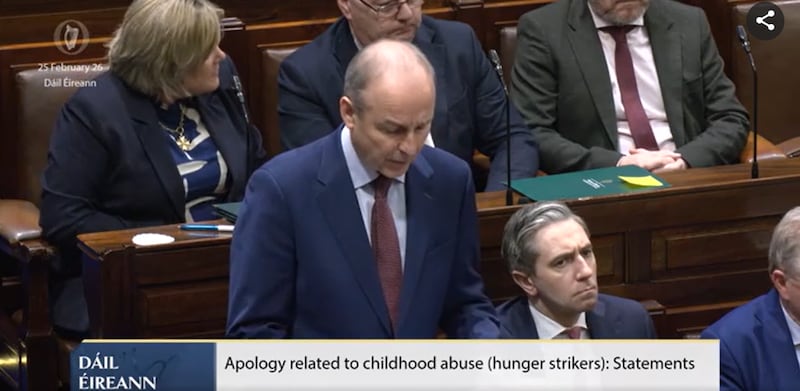 Taoiseach apologises on behalf of the State for the abuse and neglect. Photograph: Oireactas TV
The Taoiseach said he wanted “to categorically confirm for the record, that the State did not, and does not regard” individuals in industrial schools “as having committed a criminal offence, and that no criminal record is recorded against them”.
He was addressing survivors’ concerns about having criminal records because of their detention in industrial and reformatory schools, Marie O’Halloran reports.
The Taoiseach added: “No person and, in particular, no agency of the State should in any way regard these individuals as having committed a criminal offence or having a criminal record.”
A formal statement to this effect will also be issued today by the Minister for Justice, he said.
“Survivors have felt stigmatised throughout their lives, and we must be clear and categoric in removing any taint of stigmatisation from public discourse and the public record.”
He told survivors their presence is a “testament to your tireless commitment to shining a light into the dark corners of both our past and present”.
The Taoiseach said: “I want to unequivocally apologise to you and reiterate on behalf of the Government, the State, and all the citizens of the State, the profound sorrow for the terrible pain and abuse suffered by you.
“What you endured on a daily basis as innocent children was harrowing, heartbreaking and wrong.”
The Taoiseach acknowledged concerns among some survivors about the adequacy of supports approved in 2023 in areas including health, advocacy and education, which was the subject of the recent campaign by survivors, Marie O’Halloran reports.
“This included an enhanced package of health services and supports, supports for those who wish to engage in education and training and access to advocacy supports through a new independent advocacy service.
“Work is well under way on putting these services and supports in place,” he said.
Following the conclusion of a mediation process to address the concerns raised, the Government has agreed to provide further improvements to these services, Martin added.
These include strengthened access to health services for survivors “through appointment of dedicated health liaison officers and better access to counselling and physiotherapy services”.
The Government has also agreed to provide additional funding for education grants, he said.
There have also been calls for a Contributory State Pension for this group of survivors.
“I discussed this with survivors, and we recognised the complexity of the issue,” Martin said.
They were exploring ways to address this issue, and the Government “has approved the expansion of the education support payments scheme under the Act to include provision of support for informal learning, self-development and wellbeing activities”.
Katie Mellett – 1 hour ago
Taoiseach apologises on behalf of the State for the abuse and neglect
“I am very sorry for what was done to you,” the Taoiseach said. “I apologise on behalf of the State for the abuse and neglect that you suffered. What happened to you was wrong, shocking and should never have happened.”
In his address to survivors he said: “I fully recognise that for those who suffered institutional abuse the traumatic impact has been enduring.
“The deep personal toll that it has taken on the lives of survivors was brought home to me again in my recent engagements with the group who are here today.
“I was moved to hear each of your personal stories and I am deeply sorry for the harm that you suffered as a consequence of the abuse you experienced in state institutions.
“When we met, you made me aware of the abuse also suffered by some of you who were boarded out from industrial and reformatory schools.”
Martin said: “In January 2021, on behalf of the Government, the State and its citizens, I apologised for the profound generational wrong visited upon Irish mothers and their children who ended up in a Mother and Baby or County Home Institution.
“I also acknowledged that some children who were subsequently boarded-out experienced heart breaking exploitation, neglect and abuse within the families and communities in which they were placed.
“As I said at that time, and wish to reiterate today, regardless of the pathway from which individuals were boarded out, this was unforgivable.
“Government recognised that there were many situations where children in boarded out arrangements were wrongly and harshly treated.
“They were not raised as part of a family or given the opportunities they should have been in relation to their care and education. We know that some were physically, emotionally and sexually abused.
“The Government recognises the suffering and damage that this abuse has caused, and we will continue to support you as much as possible, over and above supports that have already been put in place.”
Katie Mellett – 1 hour ago
‘Abuse ruined their childhoods and was, and remains, an ever-present part of their adult lives,’ says Taoiseach
The Taoiseach said “as a country and as a Government, we recognised that too many of our children were denied the love, care and security that should have been theirs, reports Parliamentary Correspondent Marie O’Halloran.
“Abuse ruined their childhoods and was, and remains, an ever-present part of their adult lives, reminding them of a time when they were without support or protection.
“We recognised the gravity of this wrong and undertook to do all we could to overcome the lasting effects of their ordeals.”
The first major step to “full transparency and perspective involved the establishment of the Commission of Investigation into Child Abuse”, known as the Ryan Commission. Its final report was published in May 2009.
“It detailed disturbing and significant levels of historic abuse of children, who were placed by the Irish State in residential institutions, particularly industrial schools and reformatories, run by religious orders.”
Referring to reform of childcare laws, Martin said the 1991 Child Care Act was a “fundamental change of approach to child protection”.
It prioritised child protection and modernised State services to protect vulnerable children.
“Irish child protection was significantly transformed and moved to a proactive, state-managed system focused on the rights and safety of the child. The act remains the fundamental framework for protecting children.”
Martin added: “We now have a comprehensive approach to deal with the traumatic impact of previous abuse, to protect children and to strengthen structures and accountability for child protection in this country.”
Katie Mellett – 1 hour ago
State apology to survivors of industrial and reformatory schools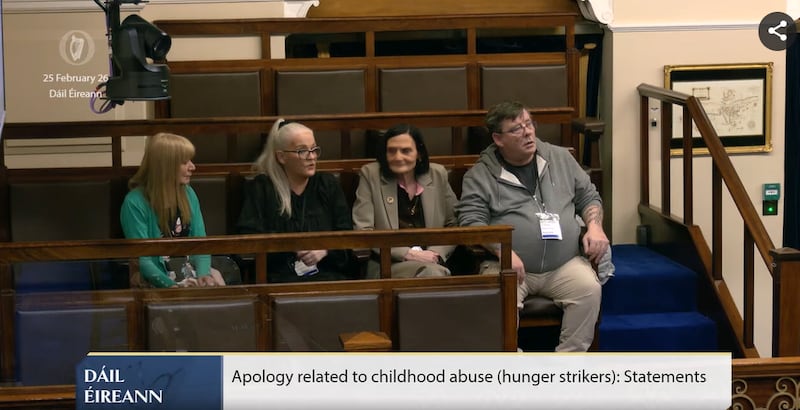 State apology to survivors of industrial and reformatory schools. Photograph: Oireachtas TV
Taoiseach Micheál Martin has begun addressing the Dáil to issue a formal State apology to survivors of industrial and reformatory schools, reports Parliamentary Correspondent Marie O’Halloran.
The apology follows a 51-day hunger strike outside Leinster House by four survivors who sought additional supports for those abused, including the provision of medical cards.
The strike ended in November 2025 and following mediation the Government made a number of commitments to address survivors’ concerns.
The apology builds on a State apology in 1999 to victims of institutional abuse and takes account of the 2021 apology to survivors of mother and baby homes.
Martin started his address by welcoming a group of survivors from industrial and reformatory schools who he met to “discuss their concerns and to share their individual stories and experiences”.
He named the four survivors: Mary Donovan, Mary Dunlevy Greene, Miriam Moriarty Owens and Maurice Patton O’Connell.
Martin said in 1999 the then government “agreed to enact a series of steps to give victims of childhood abuse an opportunity to be heard”.
The Government “made a sincere apology to the victims of childhood abuse”.
He quoted from then taoiseach Bertie Ahern’s speech in May 1999: “On behalf of the State and all of the citizens of the State, the Government wishes to make a sincere and long overdue apology to the victims of childhood abuse for our collective failure to intervene, to detect their pain and to come to their rescue.”
Martin added: “I reiterate that apology today.”
Katie Mellett – 2 hours ago
SNA protests to take place this evening
A series of protests will take place this evening to call for support for special needs assistants (SNAs).
This follows the Government’s decision to pause the controversial SNA cuts it previously proposed.
It has been reported that protests will take place across the country in counties Meath, Roscommon, Westmeath, Limerick, Galway, Donegal, Kildare, Offaly and Kerry.
Protests are also organised for 5pm this evening at Cork City Hall and outside the Dáil on Kildare Street in Dublin.
Katie Mellett – 2 hours ago
‘What planet are you on?’ Taoiseach asks People Before Profit TD
The Taoiseach said the Government was acting to defend subsea cables and the gas interconnector to Britain.
“If anything happens to them, or to the gas interconnector, the economy wouldn’t last 10 days,” Martin said.
He asked Murphy: “Are you saying we shouldn’t co-operate with Britain to protect the gas interconnectors with the United Kingdom? That we should just ignore it?
“Are you saying we should ignore all of our European partners and protecting undersea critical infrastructure, such as subsea cables, such as the interconnector with France that will be completed in the next year?”
He asked Murphy: “What planet are you on” to deny people the opportunity for jobs and energy security.
In response, Murphy said, “the planet that I’m on, Taoiseach, is a planet where you introduce a budget that cuts income for disabled people by €400 million, and that decreases the income of the lowest, the poorest people in this country,
“And it is the same planet where you are scaremongering to justify giving our euros to the French and British.”
But Martin said Murphy believed “we should stand alone in isolation, talk to nobody, talk to nobody at all, apparently … and we will be able to procure, we will have all the in-house expertise”.
“The truth is you don’t believe in having an army at all,” and “your concept of militarisation is that we do not need armies,” Martin said.
Katie Mellett – 2 hours ago
Taoiseach and People Before Profit TD Paul Murphy clash over Irish neutrality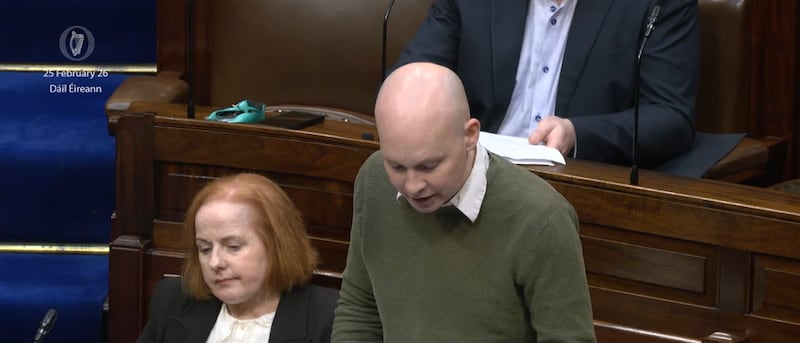 People Before Profit TD Paul Murphy clashes with Taoiseach Micheál Martin over Ireland’s neutrality. Photograph: Oireachtas TV
Taoiseach Micheál Martin and People Before Profit TD Paul Murphy clashed over Ireland’s neutrality after reports that Ireland has asked the French navy and Royal navy to help patrol Irish seas during Ireland’s six months EU presidency starting in July.
Murphy suggested in the Dáil, the terms of the co-operation would lead Ireland into closer links with Nato, reports Parliamentary Correspondent Marie O’Halloran.
“It is part and parcel of an agenda of militarisation and dismantling neutrality,” he said, describing the State’s maritime security strategy launched on Wednesday as “a shameful abandonment of any independent foreign policy.
“Instead, it commits us to deep military co-operation with old colonial powers of Britain and France, advocating further integration with Nato and using huge amounts of public money to defend the infrastructure of big tech companies.”
He claimed “this is a strategy written for the big tech companies that want us to pay to protect their cables, by the arms lobbyists who want our money for their weapons and by Britain and France.”
The Dublin South-West TD said the State was born out of a struggle against British imperialism. “It is why people have a deep connection to an independent foreign policy, a consistent opposition to all imperialism and support for neutrality.”
He accused the Taoiseach of “throwing all of this away”.
Katie Mellett – 4 hours ago
Taoiseach says there should be an annual review of the SNA system
Taoiseach Micheál Martin said Government policy had been to increase investment in special needs education and the number of SNAs which he reiterated had risen from 16,420 in 2020 to more than 25,000 from September this year.
“That’s what I signed off on,” and what the Government signed off on in terms of estimated agreed SNA numbers.
“When I said we didn’t sign off, there was no memo before Government saying we’re going to cut SNAS in individual schools or specific schools.”
He said there should be an annual review of the SNA system and the allocation was based on need and the number of children.
Labour education spokesman Eoghan Kenny said the reality was the level of resources “didn’t keep up with the level of need” and “overnight we were able to get €19 million”, as he asked if there had been “penny pinching”.
He also said there was a requirement for 600 special classes but funding for 400 and he asked “will every single child that’s entitled to a special class be given a special class for the next academic year”.
The Taoiseach insisted that “our story has been one of expansion in special education”.
He said requirements for special needs places “have increased this year exponentially” and “over and above anything contemplated”.
He said the State’s “obligation is to provide that place. There will be need for more special classes. There will be huge challenges now because of the exponential rise in children this year compared to last year or previous years.”
Katie Mellett – 4 hours ago
SNA controversy is “another case of announce, backlash, retreat, re- announce”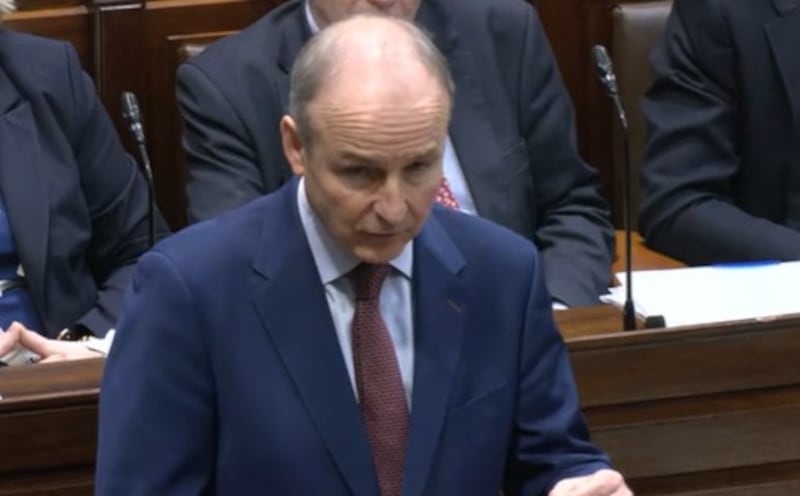 Micheál Martin speaking in the Dáil on Wednesday. Photograph: Oireachtas TV
The special needs assistant (SNA) controversy was raised again in the Dáil by Labour education spokesman Eoghan Kenny during Leaders’ Questions, reports Parliamentary Correspondent Marie O’Halloran.
He accused Taoiseach Micheál Martin of trying to put the blame for the outcry over the review of SNA allocations on the National Council for Special Education (NCSE).
Almost 200 schools had been set to lose SNAs before the Government’s allocation of €19 million and guarantee that all schools would retain their SNAs for the next school year.
It is “another case of announce, backlash, retreat, re- announce”. He asked how much damage had the Government “now done to special education in this country” when every year “there is fear, anxiety, worry for parents across the country”.
The Cork North-Central TD highlighted Micheál Martin’s comment to the Dáil on Tuesday that the Government “didn’t sign off on this initiative”.
He said the Government created this policy and got the NCSE to implement it.
“They did as they were told. They informed schools of their decisions based on the policy that your Government created.”
Kenny also highlighted the Taoiseach’s comment that the role of the SNA is primarily for the child and not the school. He pointed out that the 2014 circular “clearly states” SNAs “are not allocated to individual pupils, but to schools as a schools-based resource” and he called on the Taoiseach to clarify his remarks.
He said the level of resources “didn’t keep up with the level of need” and “overnight we were able to get €19 million”, as he asked if there had been “penny pinching”.
Katie Mellett – 4 hours ago
Industrial and reformatory schools survivors to receive apology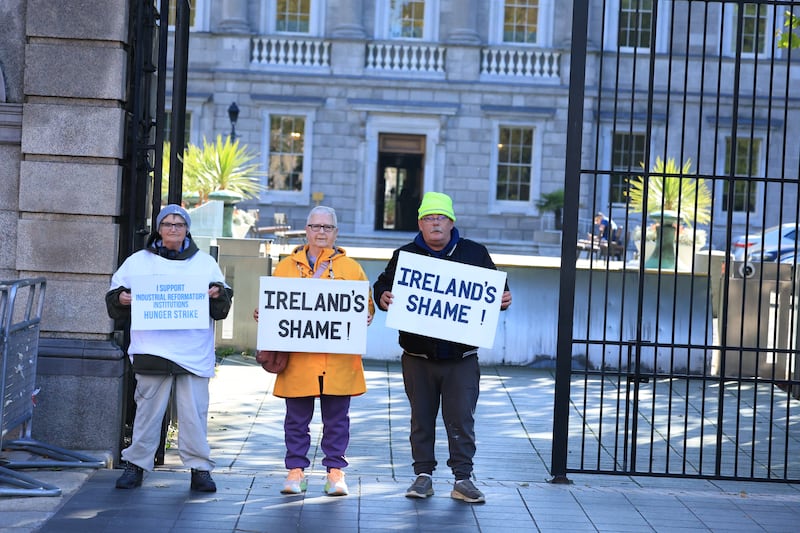 Survivors of industrial and reformatory schools protest outside Leinster House. Photograph: Stephen Collins/Collins
Survivors of industrial and reformatory schools ended their hunger strike which had been under way for nearly eight weeks outside the Dáil when Taoiseach Micheál Martin and other members of the Government tabled proposals in November, 2025.
Later today, an apology related to childhood abuse is expected to be issued in the Dáil.
Four survivors, Miriam Moriarty Owens, Mary Donovan, Mary Dunlevy Greene and Maurice Patton O’Connell were on a hunger strike protest for 51 days.
For more, read Public Policy Correspondent Martin Wall’s article.
Katie Mellett – 4 hours ago
Watch along live
Katie Mellett – 5 hours ago
Taoiseach’s response to Mary Lou McDonald
Taoiseach Micheál Martin said renters in existing tenancies will have their rents increased by 2 per cent not 25 per cent when the Residential Tenancies Act takes effect.
He insisted “existing tenancies would not be impacted negatively as a result of the changes”.
The Housing Finance Agency did an analysis because the Housing Commission said “we needed to create certainty, clarity and stability in the rental market for the long term”.
He added that the Minister for Housing “has balanced that with greater security of tenure for tenants” for six years, “essentially ending no fault eviction.”
He said this was a “very significant protection”. The legislation “will give far more legal protection to renters than they’ve ever had in the history of the State. That is the bottom line.”
Martin said people representing property interests “don’t like the security of tenure that’s provided and the protections that are provided to renters. And there’s been a lot of disquiet actually among many representing landlords.”
They had to have “a balanced approach to protecting renters” and “also then facilitating a far greater degree of construction” particularly of apartments in cities.
Katie Mellett – 5 hours ago
‘Security of tenure, my eye,’ says McDonald while discussing rent increases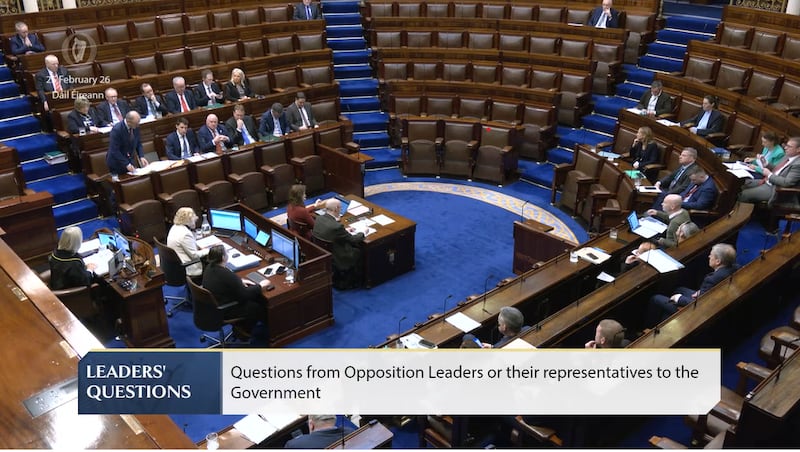 Leaders’ Questions in the Dáil. Photograph: Oireachtas TV
Corporate landlords will be able to increase rents by 25 per cent when changes in tenancy rules come into effect on March 1st, the Dáil has heard during Leaders’ Questions.
Sinn Féin leader Mary Lou McDonald said the largest landlord in Ireland has told investors they stand to make an extra €21 million a year in extra rents once the legislation comes into effect, reports Parliamentary Correspondent Marie O’Halloran
She said Ires Reit which owns thousands of residential properties is “‘predicting a 25 per cent potential rental income uplift with minimal added costs’. That‘s a direct quote.”
“We know that corporate landlords and vulture funds are rubbing their hands in glee and popping champagne corks at the thought of the huge profits they stand to make as a direct result of your legislation. They’re not even hiding it,” McDonald said.
This “paints a frightening picture of the size of the rent increase coming down the tracks due to your decision. The property funds are set for a bonanza.”
McDonald said for tenants “it means having to find more than €5,000 extra a year, that’s just to cover the increase.”
She said “the biggest corporate landlord in Ireland is saying out loud the very thing you denied. They will make a fortune from your legislation, all on the backs of renters.”
She called on Martin to “intervene to stop renters being crushed by these massive increases”.
“You said that this was all about providing stability for renters. Now, how in the name of God is allowing renters to be hit with the 25 per cent increase providing them with stability?”
“Security of tenure, my eye,” she added.
McDonald said the legislation was never about rent stability.
“It was always about feathering the nests of the big property funds. And now, Taoiseach, you’ve been found out.”
Katie Mellett – 5 hours ago
SNA allocation controversy
The controversial review of SNA allocations was proposed but was paused following widespread criticism from teachers, parents and unions.
Two-thirds of the 584 schools reviewed before the pause were set to retain or increase the number of SNA posts but 194 were informed of planned reductions. Some schools reported they would lose four or five positions.
The Government announced an extra €19 million will be spent on SNAs this year to ensure there are no cuts to existing service provision in schools.
Taoiseach Michéal Martin said in the Dáil, the Government never signed off “on the scale and impact” of the SNA allocation review.
For more, read here.
Katie Mellett – 5 hours ago
Fianna Fáil ministers disagree over decision to stop funding League of Ireland astro pitches following incident at Oriel Park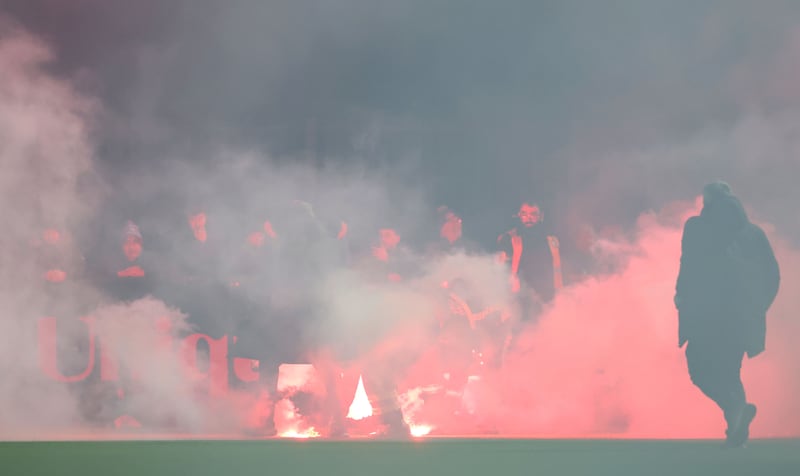 A view of flares on the pitch at Oriel Park in Dundalk on February 20th. Photograph: Nick Elliott/Inpho
The Fianna Fáil Minister of State for Sport has broken rank with his senior Fine Gael colleague over a decision to stop all funding for League of Ireland astro pitches, reports Parliamentary correspondent Marie O’Halloran.
Charlie McConalogue said he agreed “absolutely” with Minister for Sport Patrick O’Donovan on the need to “come down like a tonne of bricks” on fans who threw flares on the pitch at Oriel Park in Dundalk during the soccer Louth Derby, last Friday between Dundalk and Drogheda United.
But said: “I don’t believe, however, that we should be collectively punishing all clubs for the criminal behaviour of a small number of people participating in hooliganism.”
O’Donovan said in the wake of the match, the first played on the Department of Sport-funded astro surface that “any and all astroturfs going into League of Ireland clubs are to be stopped until I’m satisfied that the League of Ireland and the FAI are going to take this seriously”.
O’Donovan, who attended the match, acknowledged that stopping funding for astro pitches in the League of Ireland would “hurt a lot of people”, but added “we can’t be making investments on behalf of the taxpayer … to literally see them being set on fire”.
A 12-year-old boy suffered facial injuries when he was struck by a flare thrown in the stand and significant damage was caused to the new pitch.
In the Dáil, McConalogue said the Government committed €3 million in funding to support the League of Ireland.
“But we must also ensure it’s safe for all and indeed in particular families to attend these games.”
“We must come down forcibly on this behaviour, and there must be consequences for the people carrying out these acts and indeed the responsible club.”
He said they had to make sure clubs not responsible “are supported and not affected by the recklessness of others”.
Katie Mellett – 5 hours ago
Dáil Business Today
Good morning, today is a busy day in a Dáil.
After 10am, a motion regarding expanding access to General Practitioner care is being discussed.
At 12pm, Leader’s Questions will begin.
At around 12.35pm, Other Members’ Questions will commence.
After 1pm, statements on Special Needs Assistants will be read and discussed.
After 3.30pm, an apology related to childhood abuse survivors will be issued.