
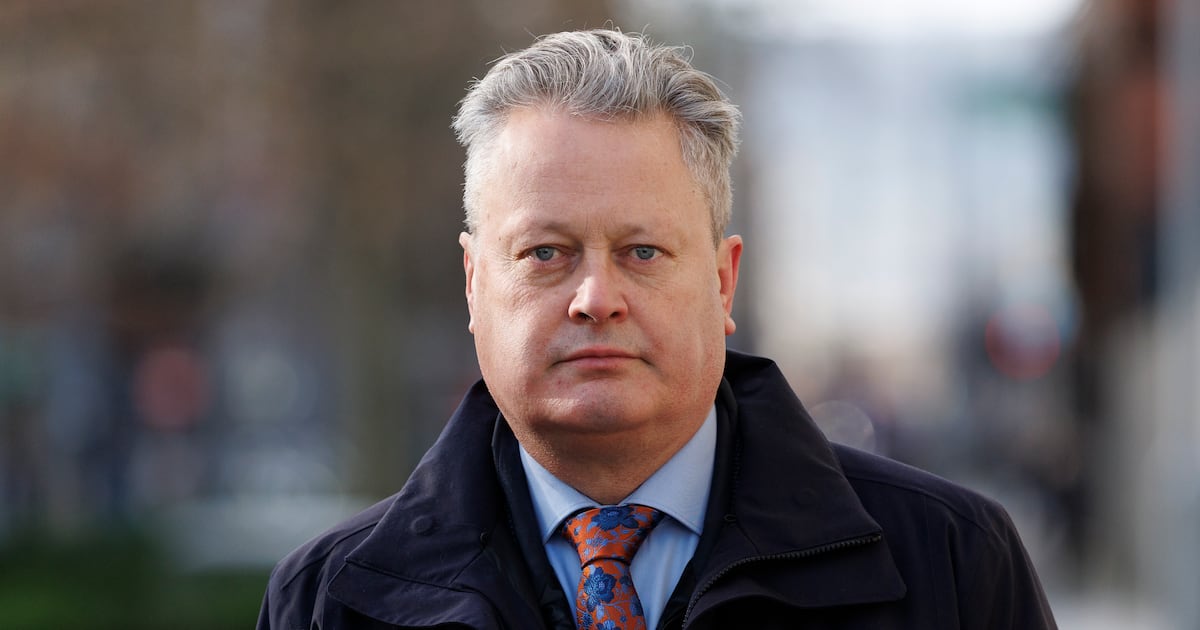
The Police Service of Northern Ireland (PSNI), MI5 and the Metropolitan Police unlawfully obtained the phone data of a prominent Northern Ireland journalist in multiple operations over a period of more than 10 years, a tribunal has heard.
Vincent Kearney was wrongly referred to as a “suspect” in a criminal investigation and the PSNI complied a detailed profile of intelligence material on him and his family – including his date of birth, phone numbers, car registrations, the names of his wife and mother-in-law, and his mother-in-law’s address.
On one occasion in 2013, the PSNI obtained and kept information on more than 1,580 calls and texts made and received by Kearney over a two-week period.
The details were revealed on Wednesday during a case taken by Kearney and his former employer, the BBC, at the Investigatory Powers Tribunal (IPC), an independent judicial body which deals with complaints regarding the unlawful use of covert investigative techniques by public authorities.
Kearney is currently Northern editor for RTÉ News but was previously home affairs editor at the BBC in Northern Ireland.
In written submissions, barrister Jude Bunting, representing Kearney and the BBC, said the disclosed documents revealed they had been subjected “to a long and consistent campaign of unlawful interference with their confidential journalistic material”.
He told the tribunal, “We have seven different occasions in which very significant material at very significant volumes and time periods … obtained by multiple different state bodies.
“On each and every one of those occasions it wasn’t in accordance with the law, and on each and every one of those occasions it was disproportionate.
“The material we’ve seen demonstrates an unhealthy interest in journalists at the heart of the PSNI.”
[ Natalie McNally suffered ‘prolonged assault’, murder trial hearsOpens in new window ]
The general secretary of the National Union of Journalists, Laura Davison, told the BBC the body “need to know” whether other journalists have been affected. She called for “a full public inquiry into surveillance into journalists in Northern Ireland”.
Kearney and the BBC complained to the IPC after reports the journalist had been targeted by the PSNI, MI5, Durham Constabulary and the Metropolitan Police. The hearing began in London on Wednesday.
MI5 admitted last year it had “unlawfully” obtained Kearney’s communications data between 2006 and 2009.
The Metropolitan Police conceded it unlawfully obtained his data in 2012, while Durham Constabulary said it acted lawfully in retaining documents following a PSNI-commissioned operation from 2017-2018.
On Wednesday, Bunting outlined a minimum of seven separate operations carried out by MI5, the PSNI and the Metropolitan Police between 2006 and 2018 in which Kearney’s confidential phone data was obtained, which he said were “all … conceded to be unlawful”.
He said they were “disproportionate”, failed take into account the need for an overriding requirement in the public interest, and were aimed at identifying Kearney’s sources.
[ American Michael Kelley charged with murder of Kerry sheep farmer Michael GaineOpens in new window ]
These included four applications by the PSNI for Kearney’s phone data following his receipt of a call from the Continuity IRA claiming responsibility for the 2009 murder of PSNI officer Stephen Carroll.
In 2013, the PSNI applied for Kearney’s incoming and outgoing calls and subscriber details as part of Operation Samarium – which looked at allegations that a senior member of the PSNI’s management had received corrupt payments – and made the “false assertion”, the barrister said, that Kearney was a suspect and the information was needed “to identify the suspect and other criminal associates”.
“He wasn’t a criminal. He wasn’t the suspect. His contacts weren’t criminal associates,” Bunting said.
Outlining the impact of the surveillance on Kearney, the barrister said that for a “less experienced journalist, they would have been career-ending”, they had “materially affected his ability to work”, and had affected his employer and his family.
Listing numerous sources who “won’t speak to him any longer”, he cited one “who said he was an MI5 tout … being called an MI5 tout in Northern Ireland is something which can pose a serious risk of harm”.
He said Kearney should be awarded “substantial” damages.
The barrister for the PSNI, Cathryn McGahey, said the force “readily accepted the unlawfulness of what occurred”.
PSNI officers “were acting in good faith”, she said, and “no one had any reason to believe they were acting unlawfully” because they were acting in accordance with the relevant code of practice.
“In each case, the PSNI were investigating serious criminality” and, in the case of the murder of Stephen Carroll, “the most serious criminality”.
The barrister added that the police had “conceded without question the remedies of a declaration of unlawfulness, deletion of the material” and an undertaking to confirm when it had been carried out.
“These applications and authorisations do not provide any indication of a campaign against a journalist or journalists,” she said.
The case will continue in a closed hearing on Thursday, with a ruling expected in the next few months.
[ Rathmines residents urged to ‘calm down’ as judge orders school not to fell treesOpens in new window ]
Speaking in advance of Wednesday’s hearing, Kearney said the case “has established that I was the target of a systematic and years-long pattern of law enforcement agencies illegally accessing my journalistic sources and mapping my professional activity”.
“I was treated as a suspect rather than a journalist,” he said. “The concessions made reveal repeated and consistent illegality on the part of multiple public authorities over a period of many years.
“This was taking place on an almost annual basis between 2006 and 2014 while I worked as a correspondent for BBC Northern Ireland.
“This has had a chilling effect on my ability to conduct public interest journalism, with source relationships damaged and, in some cases, destroyed.
“The unlawful activities of those charged with upholding the law have irrevocably damaged my ability to perform my lawful duties as a journalist.
“Those responsible must be held to account and mechanisms put in place to ensure this kind of activity cannot be repeated.”
A BBC spokesperson said the “extent and effect of unlawful interference in Vincent Kearney’s work as a BBC journalist is a matter of serious concern”.
“It strikes at the heart of the protections that are in place for public interest journalism … what happened in this instance was wrong and must never be repeated.”
The managing director of RTÉ News and Current Affairs, Deirdre McCarthy, said, “The scale of the covert surveillance and accessing of journalist Vincent Kearney’s communications data by British security and policing agencies is deeply concerning.
“As an all-island public service media organisation, RTÉ places ongoing importance on defending press freedom of journalists across Ireland. The protection of journalist sources is the cornerstone of ensuring a free and independent media.”