
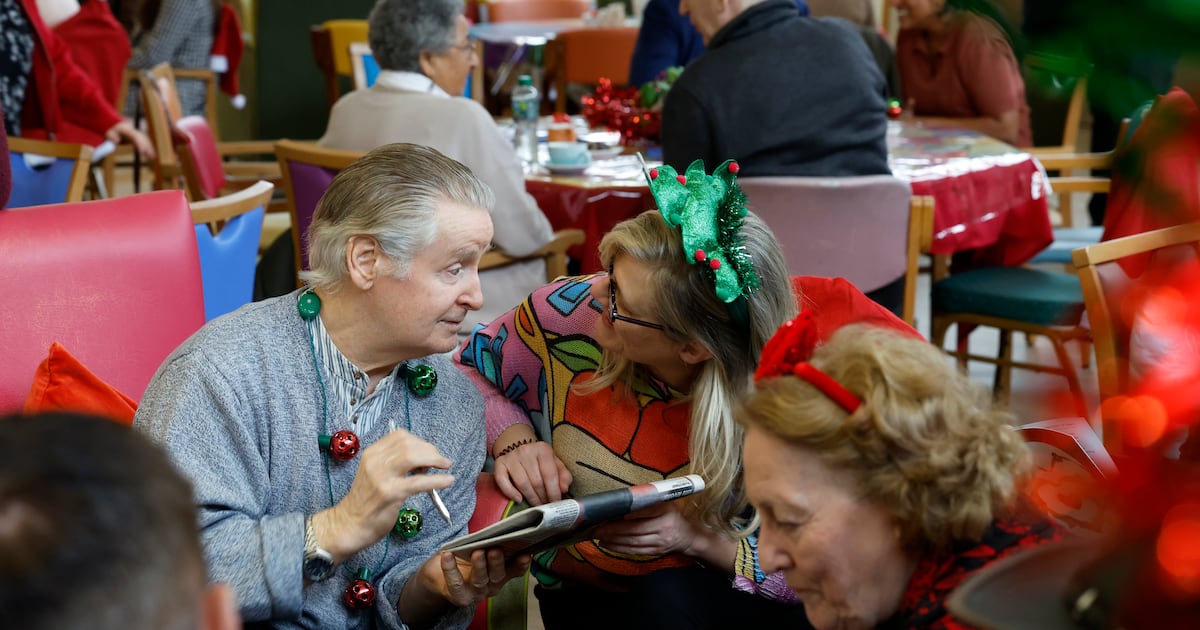
After a 36-year career in Aer Lingus that included several customer-facing roles, Reena Ryan says, with a knowing smile, she has a bit of experience dealing with people. Nothing, she adds, however, had entirely prepared her for volunteering to work with people who have dementia.
She has been doing just that for more than a year now, as a barista for a few hours a week at St Joseph’s in Shankill, Co Dublin, a St John of God-run facility described as the country’s largest such place solely dedicated to dementia care, and helping out in whatever other ways she can about the place.
“We do a mean cappuccino,” she says like she means it, “and I also do activities on a Friday morning – softball exercises, fun and games, movement. I love it. Whatever you give, you get back in spades.”
Ryan, from Blackrock in Dublin, was one of many of the centre’s 120 volunteers to attend a recent event to launch a report on how the programme they participate in might be replicated across the sector, enhancing not just the lives of the growing number of people living with dementia in nursing homes but also of those who, like her, have some time on their hands and a desire to make a positive impact.
Graham Murray, an accountant with Bank of Ireland, traces his own involvement back in part to a kidney transplant he had more than 15 years ago, and how good everyone in his life, including his employers, were to him at the time.
“I wanted to give something back,” he says. “It was between this and Tidy Towns for me, but I live across the road.”
Murray has been coming to the centre for about five years, a portion of that time during Covid, when one of the roles he performed was disinfecting furniture between family visits.
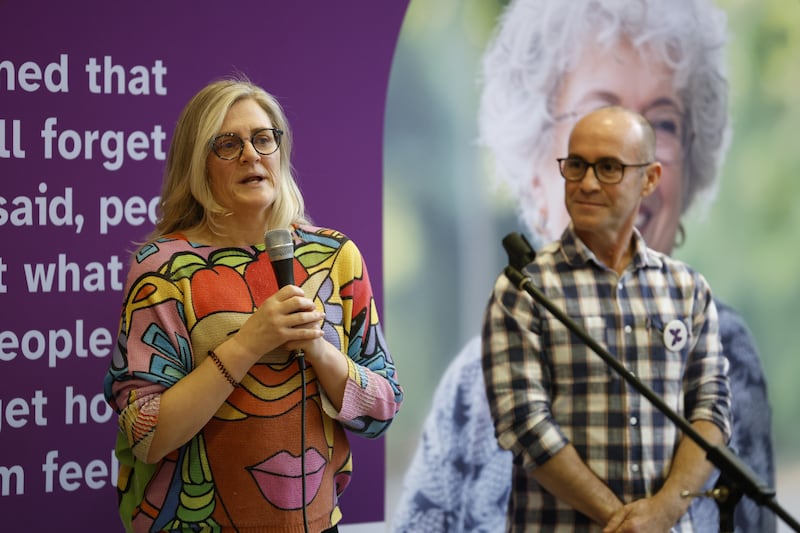 Volunteers Rachael Davies and Graham Murray speak at the Volunteer Day launch of St Joseph’s Shankill & Dublin City University research on the impact of structured volunteering in dementia care. Photograph: Nick Bradshaw/The Irish Times
Now, most his time at the centre involves just sitting with residents, chatting, engaging with them, playing games and sometimes helping them adjust to the fact they are living in a new environment, one shared with people they didn’t actually choose.
“You’re that bit older, living with eight to 10 people in a house together. You have all these different personalities and the commonality is they all have the one disease, that they all need support and care. Of course, people are going to spark off each other from time to time, it’s only natural you know, but you take them aside, have a bit of a chat, maybe get someone else to speak to the other person and let it all calm down.”
This, Murray says, is at the more challenging end of the role. He also recalls being upset when he started over some of the residents having dolls they believed to be their children. “But you get training, and the staff are so good; you can speak with them any time. There’s a great support network, and then there are the really positive moments, when you know you’ve made a connection, a difference to a person. One of those could give you enough satisfaction for a year.”
All of the volunteers speak movingly about the sense of family and those moments of connection.
Rachael Davies got involved because after her marriage broke up, she found she had time on her hands. “I was in a really bad place,” she recalls, “and needed to get myself out, socially, to meet people. Coming here, I just found talking to the families, or especially the residents – you were able to forget about your own problems for those two hours. Everyone has a story to tell.”
She and Jenny Lewis, sitting a few feet away as we speak, run musical quizzes for the residents. “It’s amazing how much the music means to them,” says Davies. “They all like different things, one loves Elvis, another is more into rock. Some of them love Joe Dolan,” she says. “But you might say to them: ‘Oh, do you remember that Joe Dolan song? What’s the start of it?’ And they’re like: ‘No’.
![Peter Slater with volunteer Rachael Davies: 'It’s amazing how much the music means to the [residents],' says Davies. 'They all like different things, one loves Elvis, another is more into rock. Some of them love Joe Dolan.' Photograph: Nick Bradshaw/The Irish Times](https://www.newsbeep.com/ie/wp-content/uploads/2026/02/3YBRYGBEEZBJ3EWRTR7W7OMGQA.JPG) Peter Slater with volunteer Rachael Davies: ‘It’s amazing how much the music means to the [residents],’ says Davies. ‘They all like different things, one loves Elvis, another is more into rock. Some of them love Joe Dolan.’ Photograph: Nick Bradshaw/The Irish Times
Peter Slater with volunteer Rachael Davies: ‘It’s amazing how much the music means to the [residents],’ says Davies. ‘They all like different things, one loves Elvis, another is more into rock. Some of them love Joe Dolan.’ Photograph: Nick Bradshaw/The Irish Times
“Then you put it on and they just start singing all the words and they go back to the memories of the time associated with that particular song. It’s truly amazing what music does. Incredible.”
[ Siblings urged to seek mediation in dispute over care of mother with dementiaOpens in new window ]
Lewis started coming to St Joseph’s after having been volunteering at a Covid centre where somebody mentioned the programme to her. She too says she gets far more back than she gives, but says every visit is different. “You can’t plan for how people are going to be with you week to week. You are going into their home, you have to respect that, and they won’t want to speak to you every time, that’s not realistic. Sometimes things don’t work between the residents, between them and you; you just have to be in tune with that.”
The residents are residents because they are unwell, she says, and volunteers need to be conscious of that.
Lucy Shepard, another of the volunteers who has come for the launch, talks about having brought her (recently deceased father) Joseph Pheifer to St Joseph’s for daycare 12 years ago. “I walked through the door to be greeted by this absolute feeling of support and love, from the people at the reception desk, the other staff, the volunteers. It was phenomenal.”
She got involved five years ago and has had a variety of roles since, including helping with an online day centre intended to maintain connections through Covid.
Nicola Yau is programme co-ordinator for seven years, since a fundraising manager, Siobhán Grant, who had previously worked for Special Olympics, felt there was potential to have volunteers in to support staff and enhance work the centre could do for residents and those attending from outside. Since proving its worth, Niamh Moore has also been employed as a volunteer support and community support officer.
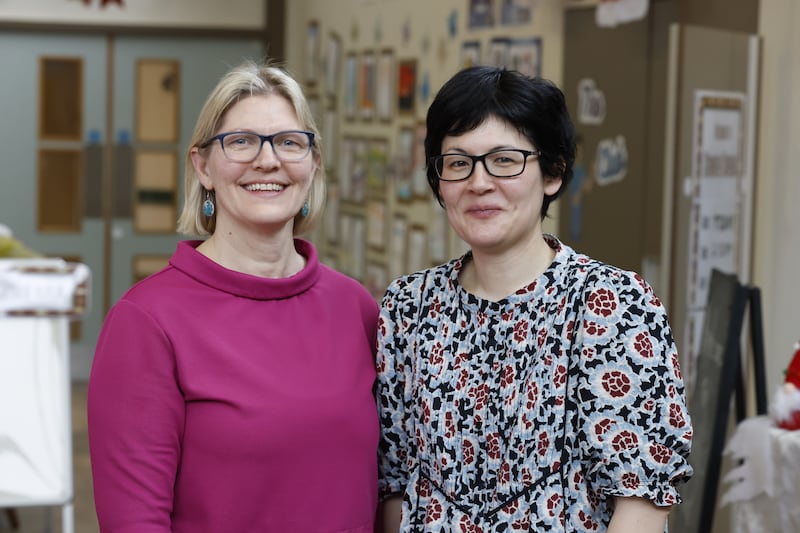 Volunteer support and community support officer Niamh Moore and programme co-ordinator Nicola Yau during the Volunteer Day Launch of the St Joseph’s Shankill & Dublin City University research. Photograph Nick Bradshaw/The Irish Times
The research in the report, which included interviews with 75 people across four stakeholder groups, carried out in consultation with DCU, concluded that the programme was “life-changing for people living with dementia, their families, staff and the volunteers themselves”.
“But it’s not just the volunteer programme,” says Yau. “We do all these community things as well. The cafe took an awful lot of work to get set up and going. But then we do bowling in the community. We do a cinema club, we do cognitive stimulation… all with volunteers involved.”
It is, she says, a unique initiative, but one with enormous potential to be rolled out across the sector. “We’d love to see something like this done in every nursing home,” she says.
With more than 80,000 people in Ireland believed to be affected by dementia now, a number expected to almost double to 150,000 by 2045, the need for more assistance is certainly clear.
At present, Yau says, the programme is augmented by people who are paid, such as a musician whose visits are funded through a grant from Dún Laoghaire-Rathdown County Council. However, the programme has 120 unpaid volunteers, with St Joseph’s generally limiting contributions from each to a couple of hours a week, in order to ensure they don’t become burned out.
At Nursing Homes Ireland, chief executive Tadhg Daly says there are many initiatives around the country intended to improve the experience of residents, but he says the programme at St Joseph’s is “special and well developed”.
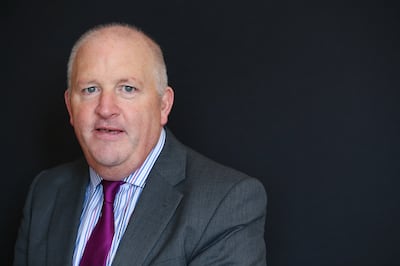 Tadhg Daly, chief executive, Nursing Homes Ireland.
“All homes will have dedicated activities staff and they will run a very diverse and engaging programme tailored to group activities and individuals as required. The activities teams will engage external personnel to support, both paid and volunteers,” he says.
NHI, he says, also works with groups such as Friends of the Elderly and Irish Therapy Dogs.