
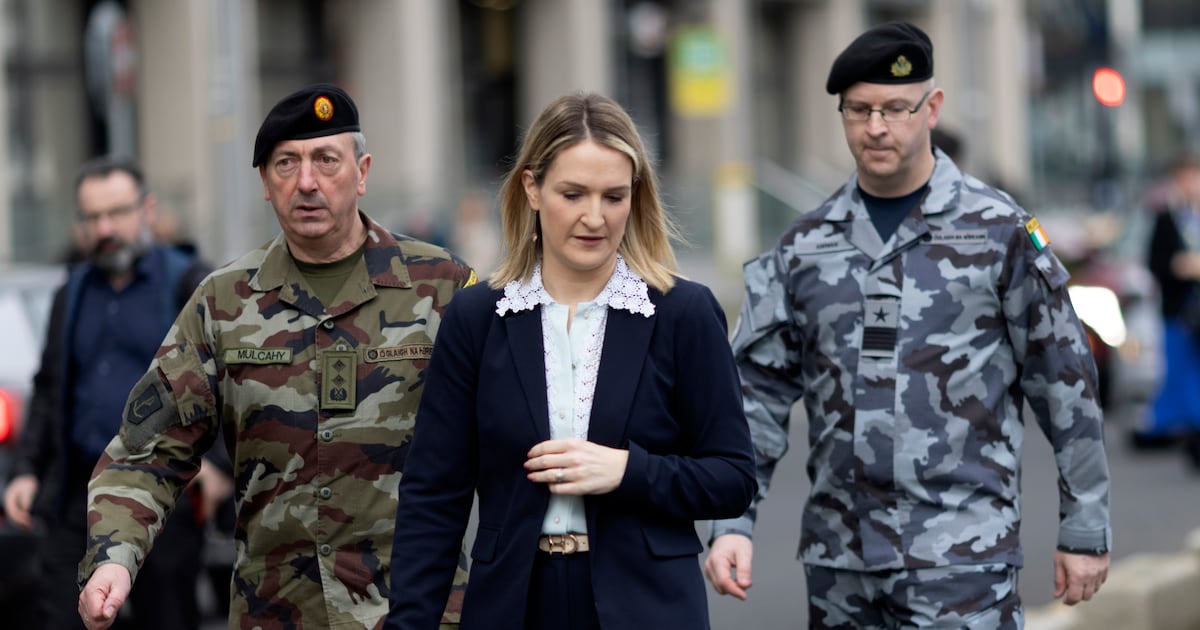
Ireland and France have agreed to significantly increase security co-operation, including the sharing of classified intelligence and the joint procurement of military equipment, according to a new framework agreement.
It comes as Ireland is set to purchase up to €2 billion of military equipment from France in the coming years as part of defence modernisation plans, while also co-operating in patrolling Irish waters.
The France-Ireland Joint Strategic Framework 2026-2030 outlines planned co-operation in economic, cultural and environmental spheres while emphasising the need for increased collaboration on defence.
On Wednesday, while launching a new National Maritime Security Strategy, Minister for Foreign Affairs and Defence Helen McEntee said the Government was “exploring” the possibility of asking France and other countries to provide military assistance to Ireland when it takes over the EU presidency in July.
Such a move would likely involve the stationing of a French naval vessel off the coast of Ireland, which could monitor Irish skies during major EU events and potentially shoot down any threats.
[ Ireland should not fear asking allies for military help, says MinisterOpens in new window ]
“I don’t think we should be afraid to seek assistance if it’s needed from other countries and from allies and partners,” said McEntee, pointing to the fact that Germany provided military assistance to Denmark last year when it held the rotating presidency.
The Minister said the Government was “actively engaged” in examining whether Ireland will need outside assistance during the presidency and “what that might look like”.
She said it is “only prudent” to explore these options.
“We’re only exploring what we might need and what we could do,” she said.
“This is normal practice, to work with each other and to collaborate, be it on our seas or be it on land.”
Earlier in the week the Government agreed in principle to purchase up to 300 armoured vehicles and artillery systems from arms manufactures part-owned by the French state as part of a potential €600 million deal.
Other big deals include a €60 million sonar system and €100 million worth of communication equipment from the French defence giant Thales and three aircraft worth a total of €300 million from the French aviation company Airbus.
The Government has also committed in principle to purchasing a €500 million military radar system from as yet unnamed French companies.
The new high-level framework, which was signed last month, said Irish-French co-operation “must reflect the turbulent period we are in and ensure that our efforts are directed to those areas where collaboration is either indispensable or where it offers the prospect of demonstrably better outcomes for our citizens”.
Ireland will expand and deepen co-operation “on security and defence issues” with a focus on exchanging classified information and combating “disinformation and hybrid attacks”.
There will be increased joint training exercises involving the two countries’ militaries and an emphasis on educational exchanges for troops.
Additionally, both governments will examine the possibility of joint purchases of military equipment under the EU SAFE Regulation. This regulation allows countries to team up to procure weapons, resulting in shorter wait times and lower costs.
Such a move would “strengthen European security of supply and industrial resilience”, the agreement said.
The agreement will see increasingly frequent meetings between the two countries’ defence ministers and the secretaries general of the departments of defence.
The two governments will also hold “annual consultations” to “share expertise and co-operate” on defence matters, including peacekeeping, maritime and cyber security and hybrid attacks.
On the policing side, there will be increased co-operation between the Garda, the French National Police and the French Gendarmerie with a focus on combating drug trafficking and money laundering.
France is to send a “police co-operation attache” to Dublin, mirroring the Garda attache already stationed in Paris. There will also be increased collaboration in training and intelligence sharing between the various police forces.