
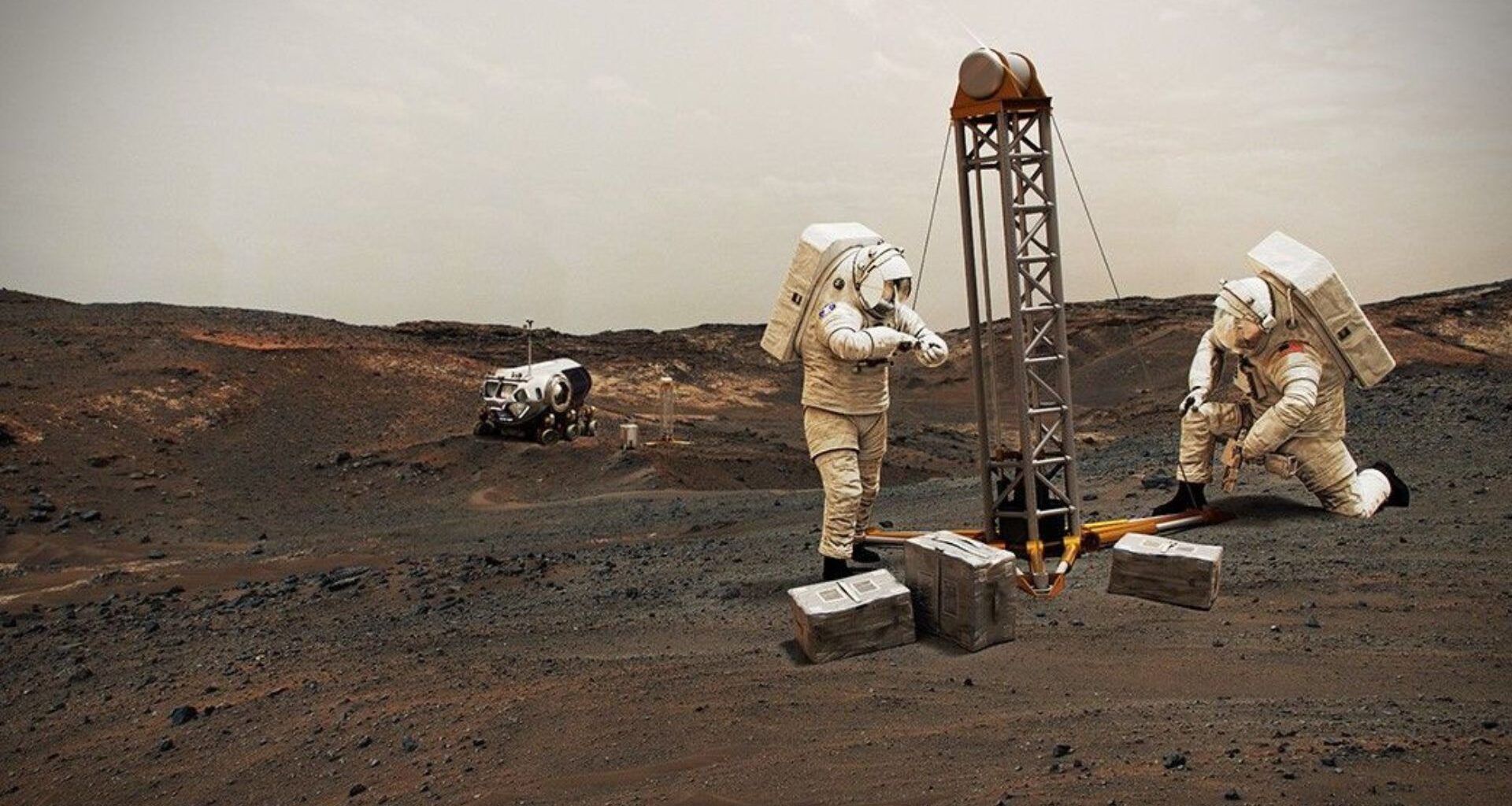
The dream of a sustainable human presence on the moon or Mars has long been rooted in science fiction. Making it a reality is far more complex.
One obstacle at a time, researchers worldwide are chipping away at the impossible to find viable paths forward.
Now, a team of researchers from various universities has come together to investigate how to transform barren extraterrestrial surfaces into fertile farmland.
The researchers hope to create sustainable agriculture for future lunar and Martian colonies by combining recycled human waste with simulated space soil.
The method extracted essential plant nutrients like sulfur, calcium, and magnesium from the otherwise inert minerals.
“In lunar and Martian outposts, organic wastes will be key to generating healthy, productive soils, explains Harrison Coker, the first author on the study.
“By weathering simulant soils from the moon and Mars with organic waste streams, it was revealed that many essential plant nutrients can be harvested from surface minerals.” Coker
The Martian’s survival strategy
For a colony to be self-sustaining, it cannot rely on constant resupply missions from Earth.
Freeze-dried food can sustain for a few months, but not for extremely long missions.
However, the surfaces of both bodies consist of regolith — a dusty, rocky substance incapable of supporting plant life.
In this new effort, the goal is to transform barren celestial surfaces into productive farmland by using recycled plant and human waste to produce the fertilizer needed to kickstart space agriculture.
This concept mirrors the plot of a popular science fiction novel and film, Martian.
In this movie, a stranded botanist successfully transformed inhospitable regolith into a viable growth medium by fertilizing it with waste left behind by his crewmates.
Researchers are now testing the scientific feasibility of this fictional survival strategy, exploring how recycled waste from Earth can be used to cultivate crops on the Moon and Mars.
To test this agricultural strategy, NASA researchers at the Kennedy Space Center developed Bioregenerative Life Support Systems (BLiSS).
BLiSS uses bioreactors and filters to convert synthetic wastewater into a nutrient-rich solution.
In a controlled experiment, the team combined this “effluent” with simulated lunar and Martian soil, agitating the mixture for 24 hours to observe how chemical interactions could transform barren regolith into a viable medium for plant growth.
Further testing required
The experiment demonstrated that treating simulated lunar and Martian soil with BLiSS effluent effectively extracts essential plant nutrients — such as sulfur, calcium, and magnesium — from the raw minerals.
Furthermore, microscopic analysis revealed that this process physically “weathers” the sharp, abrasive regolith particles, creating a smoother, more soil-like structure.
These chemical and physical changes suggest that recycled waste could transform hostile celestial dust into a nurturing environment for plant life.
This research provides a foundational roadmap for extraterrestrial agriculture. Of course, challenges remain. Real lunar and Martian regolith differ from Earth-based simulants.
Hence, further testing with authentic lunar and Martian materials is required.
Nevertheless, this study offers insights into the waste-to-fertilizer cycle, a process that remains a cornerstone for the long-term survival and sustainability of future human colonies in deep space.
The study was published in the journal ACS Earth and Space Chemistry.