
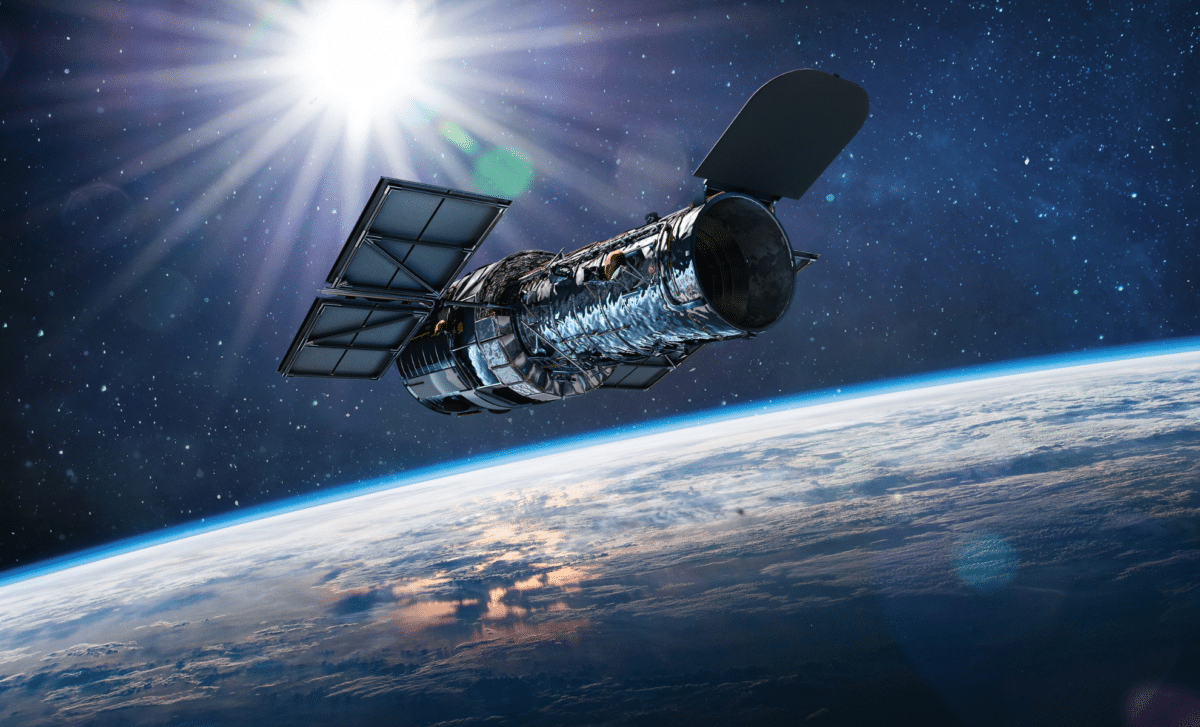
The Hubble Space Telescope, one of NASA’s most iconic scientific instruments, has been an invaluable tool for astronomers for over three decades. However, recent data reveals that its orbit is decaying at a faster rate than anticipated, raising concerns about the telescope’s future. According toThe Register, the Hubble may re-enter the Earth’s atmosphere as early as 2028, as its altitude drops due to orbital decay.
Hubble’s Accelerating Orbit Decay: A Growing Concern
Since its launch in 1990, Hubble has provided groundbreaking images and scientific data that have reshaped our understanding of the universe. However, the telescope’s mission is reaching a critical juncture. Recent reports from astronomer Jonathan McDowell show that Hubble’s orbit is rapidly decaying, and the altitude loss has become noticeable. Initially placed at an altitude above 600 km, the telescope’s orbit has since dropped below 500 km, with no mission yet approved to boost its position. This accelerated descent is largely attributed to increased solar activity, which has expanded Earth’s atmosphere, creating more drag on Hubble’s orbit.
The implications of this decay are concerning, as Hubble was not designed to last indefinitely. While it has been successfully maintained and serviced by Space Shuttle missions in the past, those options are no longer available. The telescope was last serviced in 2009, and without a clear plan to reboost Hubble’s altitude, the aging spacecraft is at risk of eventually re-entering the atmosphere. McDowell’s plot suggests that without intervention, the telescope could be lost as early as 2028. The rising solar activity only exacerbates this problem, speeding up the inevitable.
Because it’s been a while, here is an update of my plot on the altitude of the Hubble Space Telescope versus time
— Jonathan McDowell (@planet4589.bsky.social) 25 février 2026 à 07:11
NASA’s Struggle with Funding and Maintenance
One of the key factors contributing to Hubble’s precarious situation is its stagnating funding. Dr. John Grunsfeld, former NASA astronaut and associate administrator for NASA’s Science Mission Directorate, pointed out that the budget for Hubble has significantly decreased over the years. As Grunsfeld told The Register, “We’re already down about 30 percent in funding for Hubble.” This funding cutback has led to a reduction in the resources available for the telescope’s maintenance, including its ability to extend its lifespan with a much-needed altitude boost.
The lack of funding reflects broader financial constraints at NASA, which has prioritized new missions over the upkeep of older projects like Hubble. Despite its continued success in capturing stunning images and yielding crucial data, the lack of investment means that Hubble is slowly being “whittled away.” Grunsfeld’s assertion, “They’re just trying to whittle away at it,” underscores the frustrations of those who have worked on the project. This situation is not unique to Hubble; it represents a broader issue of funding disparities for older, successful programs within NASA.
NASA’s inability to secure enough financial support for Hubble’s future is compounded by the reality that the spacecraft’s maintenance is increasingly difficult and expensive. With new missions like the James Webb Space Telescope already active, there’s a perception that NASA may be less motivated to invest in Hubble’s continued operations. But the truth remains: Hubble’s potential loss would represent a major blow to scientific progress and our ability to explore the cosmos.
The Impact of Solar Activity on Hubble’s Orbit
Solar activity plays a pivotal role in the accelerated decay of Hubble’s orbit. As the sun enters periods of heightened activity, the solar wind and increased radiation cause Earth’s atmosphere to expand, creating more drag on objects in low Earth orbit. This phenomenon, known as “orbital decay,” is responsible for the rapid decline in Hubble’s altitude.
NASA has been closely monitoring this situation, but the influence of solar cycles cannot be entirely controlled. As the sun approaches its next peak of activity in 2025, it’s expected that the increased solar radiation will cause even more drag on the telescope. While Hubble is still operational, the expansion of Earth’s atmosphere presents a major challenge, and the telescope’s future hangs in the balance.
Given the current trajectory, it’s clear that Hubble’s orbital decay will continue to worsen. Without a mission to boost its orbit, the telescope is on a path toward inevitable re-entry into Earth’s atmosphere, where it will burn up. This makes it crucial for NASA to either allocate the resources needed for a reboost mission or to consider alternative ways of preserving Hubble’s legacy. However, as we approach the latter years of the decade, it appears that time is running out for this iconic observatory.