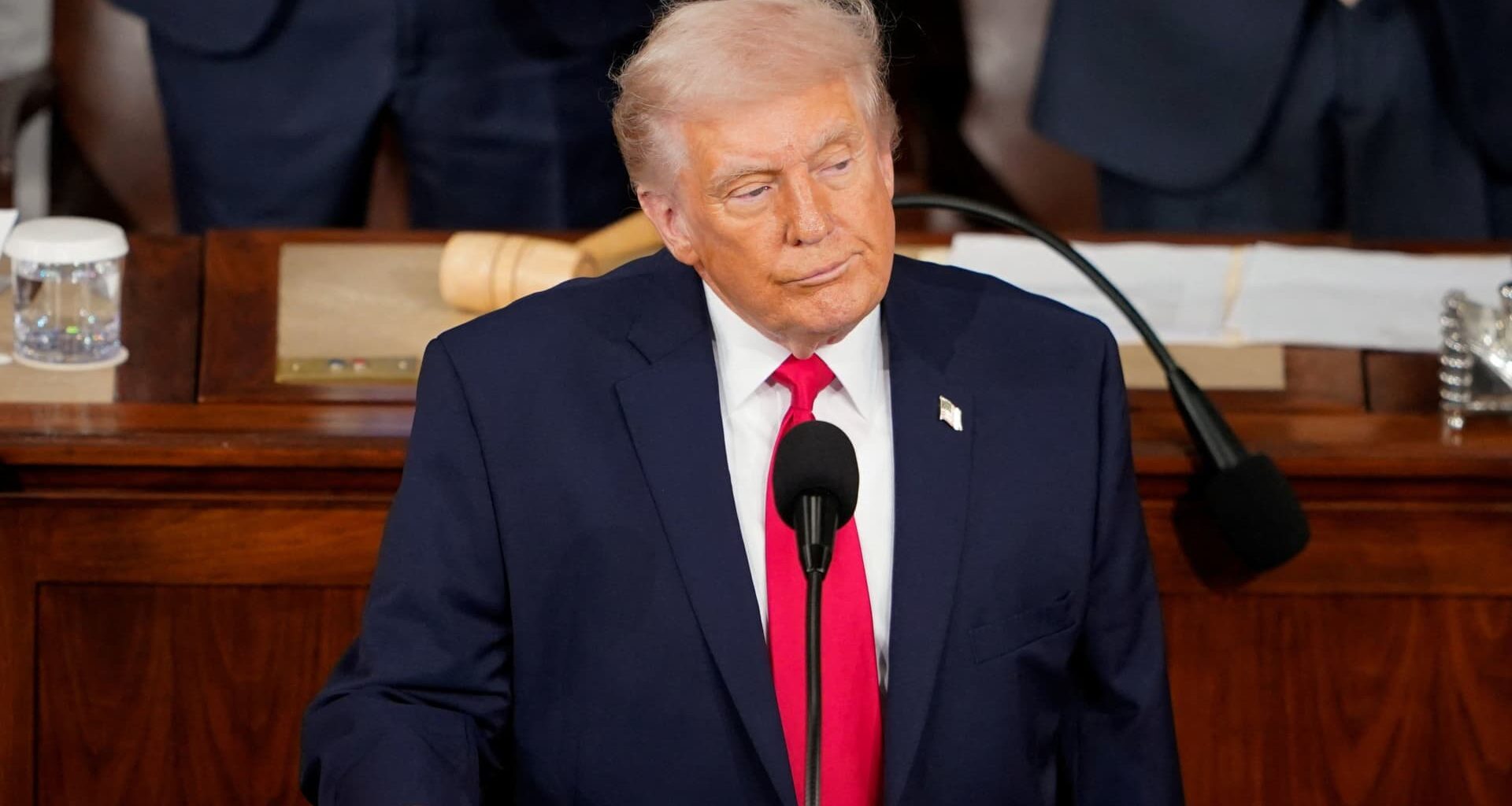
President Donald Trump says he plans to roll out a new type of retirement account for workers who don’t have access to a 401(k) or another type of workplace plan.
“Half of all of working Americans still do not have access to a retirement plan with matching contributions from an employer,” Trump said during his State of the Union address Tuesday. “To remedy this gross disparity, I’m announcing that next year my administration will give these often-forgotten American workers … access to the same type of retirement plan offered to every federal worker. We will match your contribution with up to $1,000 each year as we ensure that all Americans can profit from a rising stock market.”
It’s unclear exactly how Trump’s plan will be rolled out or what final form it will take. Speaking with reporters on Tuesday, Treasury Secretary Scott Bessent suggested the law could be passed through reconciliation, much like the One Big Beautiful Bill Act. Despite Trump’s allusion to “next year,” there is currently no set timeline for the proposal to take effect.
In the meantime, some 40.6 million full-time American workers do not participate in a retirement plan, and about 48.8 million do not benefit from an employer match, according to White House figures.
If you fall into that bucket, you don’t need to wait until Trump’s proposed accounts take effect to start saving for retirement in a tax-advantaged way, or, in some cases, earn a form of a matching contribution from the government, financial experts say. Here’s how you can start saving now.
How to invest now if you don’t have a workplace retirement plan
Currently, for employees who don’t have access to a workplace plan, tax-advantaged retirement investing options are limited.
“It’s a pretty shallow bench,” says Douglas Boneparth, a certified financial planner and president of Bone Fide Wealth in New York City. “Assuming you’re not self-employed or own a business, you’re basically looking at individual retirement accounts.”
With a traditional IRA, contributions are subtracted from your taxable income as an upfront benefit, and you owe income tax on money you withdraw in retirement. Roth accounts work in reverse: You fund the accounts with money you’ve already paid taxes on. In exchange for forgoing the immediate benefit, withdrawals in retirement are tax-free, provided you’re over at least 59½ and have held the account for five years.
For 2026, Roth accountholders can make the maximum contribution provided they earn a taxable income of less than $153,000. Eligibility phases out completely for those with incomes above $168,000.
This year, you can contribute up to $7,500 ($8,600 for those 50 or older) to a traditional or Roth IRA. The amount you can contribute “pales in comparison” to higher limits on many workplace accounts, Boneparth says. Savers under the age of 50 can contribute up to $24,500 to a 401(k) in 2026.
What’s more, for now at least, workers don’t get the added saving incentive — and added cash — of a matching contribution outside of workplace-sponsored plans.
Some workers can already earn a ‘match’ for saving
For the 2025 tax year, some workers qualify for the Saver’s Credit, a tax break worth up to $1,000 per individual for those who contribute to retirement accounts. The credit is non-refundable, meaning it can only be claimed to offset taxes owed. To qualify for the full credit, your income must be less than $24,250 for single filers or $48,500 for married couples filing jointly. You can earn a partial version of the deduction with income up to $40,250 for singles and $80,500 for married couples.
But because many lower-income Americans get a tax refund rather than owing a bill, few claim it. Only about 5.7% of taxpayers claimed the credit in 2021, according to the Internal Revenue Service.
That was already slated to change in 2027 with the Saver’s Match, which will be available to taxpayers saving in qualified retirement accounts, whether they owe a bill or expect a refund. The change is part of a 2022 law known as Secure 2.0.
For single taxpayers with an adjusted gross income of $20,000 (or joint filers making up to $40,000), the government will match 50% of up to a $2,000 contribution to a qualified retirement account for a maximum match of $1,000 a year. Single filers with incomes between $20,000 and $35,000 qualify for reduced contributions.
In 2025, the Morningstar model of retirement outcomes projected Americans eligible for the match to receive a boost of 12% to their wealth in retirement.
It remains to be seen how Trump’s proposed retirement account matching program will fit in with the Saver’s Match. Should it make the matching rules more generous — such as a 100% match up to $1,000 rather than a 50% match up to $2,000 — low-income savers and those without access to workplace retirement accounts could have more incentive to save, and more cash compounding in their accounts, says Spencer Look, associate director of retirement studies at Morningstar Retirement.
Plus, adding a dedicated account to receive a government match could also help confusion over how eligible taxpayers were to collect their money, Look says.
Want to improve your communication, confidence and success at work? Take CNBC’s new online course, Master Your Body Language To Boost Your Influence.
Take control of your money with CNBC Select
CNBC Select is editorially independent and may earn a commission from affiliate partners on links.