
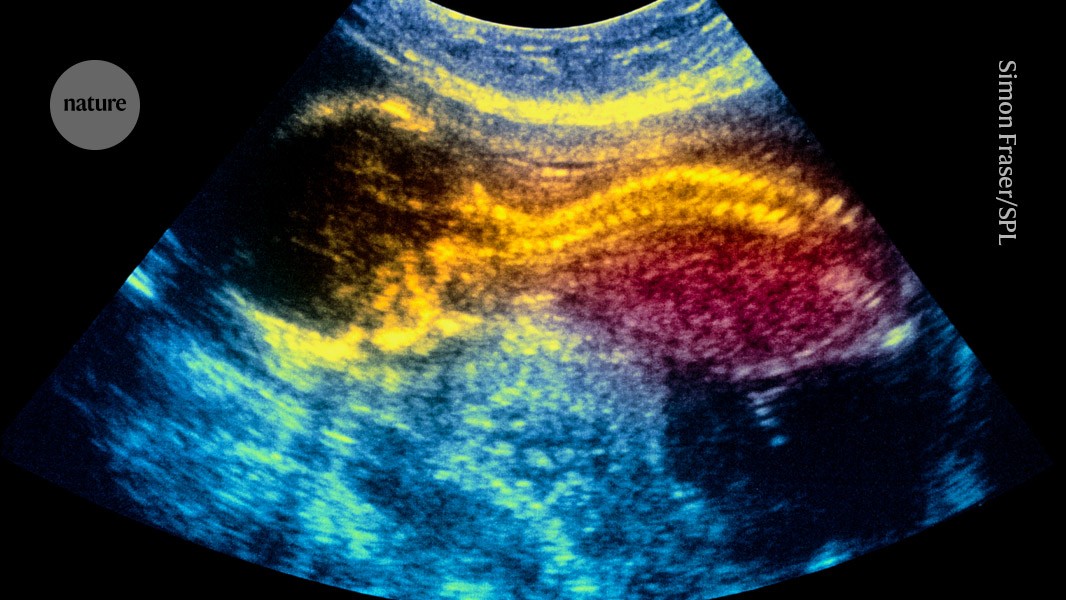
An in utero treatment using placenta-derived stem cells could treat infants with a neural-tube condition called spina bifida. Credit: Simon Fraser/Science Photo Library
Stem cells applied to the exposed spinal cords of fetuses in utero could treat infants with a severe birth complication that affects movement and continence. Researchers report that the therapy is safe, following a small clinical trial in six people1.
Spina bifida, a condition in which the spinal cord is not properly enclosed during gestation, affects fewer than 1 in 1,000 births globally, but occurs at higher rates in low-income countries. The most severe form, called myelomeningocele, can cause excess fluid accumulation in the brain and potential brain damage, as well as paralysis and issues with bladder and bowel control.
Fetal and neonatal surgeon Diana Farmer at the University of California, Davis, led the Cellular Therapy for In Utero Repair of Myelomeningocele (CuRE) trial to assess whether a treatment using stem cells derived from the placenta is feasible and whether it causes harm to pregnant people or their newborns.
Six pregnant women underwent surgery at 24–25 weeks of gestation. During the procedure, stem cells generated from donated placentas were applied to the fetuses’ exposed spinal cords directly. The authors say there were no complications during the surgeries, and the newborns were delivered at around 34 weeks of gestation with no signs of infection, cerebrospinal fluid leakage or tumour growth. Farmer says there were concerns that the stem cells could become cancerous.
All of the newborns showed signs that a complication of their condition called hindbrain herniation — in which the back of the brain descends into the neck and blocks the circulation of cerebrospinal fluid — had been reversed.
“It’s exciting and it’s important that we’re advancing in the field and that we’re looking at novel therapies,” says Clare Whitehead, a fetal-medicine specialist at the Royal Women’s Hospital in Melbourne, Australia. It is also reassuring that the therapy did not cause harm, but it is still too early to know whether it will be beneficial. “With fetal therapy, we have to be very cautious.” Positive results in studies with a small number of participants don’t always translate to benefits in larger populations, she adds.
A long time coming
Currently, women whose fetuses are diagnosed with myelomeningocele can undergo surgery during pregnancy to close the fetus’ spinal cord defect. But Farmer — who led the trial showing that this in utero surgery was beneficial2 — says that nearly 60% of children are unable to walk or move independently following the procedure. This happens because the surgery does not reverse damage to neurons in the spinal cord caused by exposure to amniotic fluid while the fetus is in utero.

Diana Farmer (right), a fetal and neonatal surgeon at the University of California, Davis, led the Cellular Therapy for In Utero Repair of Myelomeningocele (CuRE) trial. Credit: UC Davis
Farmer’s team began testing whether stem cells could reverse spinal cord damage shortly after stem-cell researcher Shinya Yamanaka received a Nobel prize in 2012 for his work using induced pluripotent stem cells, which are mature cells that have been reprogramed to be able to develop into almost any type of cell in the body. Although using induced pluripotent stem cells did not work, Farmer’s team eventually succeeded using stem cells derived from the placenta, first in cell-based studies and then in sheep models. Sheep that underwent surgery to close the defect and received the stem cells were able to stand independently and walk, whereas the control sheep that received only the surgery were not3.