

There are many reasons why you might not want a wild chimpanzee to be operating heavy machinery. Now scientists have uncovered a new one: the ape may well fail a sobriety test.
A study has shown that chimps living in the forests of Uganda regularly ingest enough naturally occurring alcohol to register levels that, in some workplaces, would trigger disciplinary action.
The findings offer the strongest physiological evidence yet for the theory about why humans like alcohol, known as the “drunken monkey hypothesis”.
The study, led by Aleksey Maro of the University of California, Berkeley, took place in Kibale National Park, where chimpanzees gorge periodically on African star apples. Very large amounts of the sugary fruit appear every few years, resulting in a calorific bonanza. When Maro and his colleagues arrived in August last year, the forest was in the middle of such a glut.
Thanks to natural fermentation, the fruit contains modest quantities of alcohol — on average 0.1 per cent, though some samples reached 0.4 per cent
That sounds trivial. But chimpanzees can consume 15 per cent of their body weight in star apples each day. “You see them in the trees, and they are going at it,” Maro said.

To test whether this translated into meaningful alcohol intake, his team became the first to collect urine samples from the chimps, using pipettes to gather splashes left on leaves on the forest floor. They analysed those samples using dipsticks that detect ethyl glucuronide (EtG), which is produced when the body metabolises ethanol.
Of 20 samples tested at a threshold of 300 nanograms per millilitre, 17 were positive. Of 11 tested at a stricter 500 ng/ml threshold, ten exceeded it.
• Wild chimps consume ‘equivalent of pint of lager every day’
That is interesting because in humans, 500 ng/ml is a cut-off point used in some safety-sensitive jobs. Exceed it and, depending on your employer’s rules, you might not be cleared to operate heavy machinery. It is also used in abstinence programmes, where humans pledge to forgo alcohol.
“It would be great if we could go out and just breathalyse the chimps,” Maro said. Since that is impractical, the urine test is “the next best thing”.
The results, published in the Royal Society journal Biology Letters, do not mean the chimps were roaring drunk. EtG can linger in the system after modest alcohol intake.
The chimpanzees consume ethanol only slowly, mixed with fibrous fruit pulp throughout the day. Still, the levels are striking. In one previous experiment, human volunteers given one or two standard alcoholic drinks fell below the 500 ng/ml threshold within 24 hours. The chimpanzees, by contrast, were regularly over it.
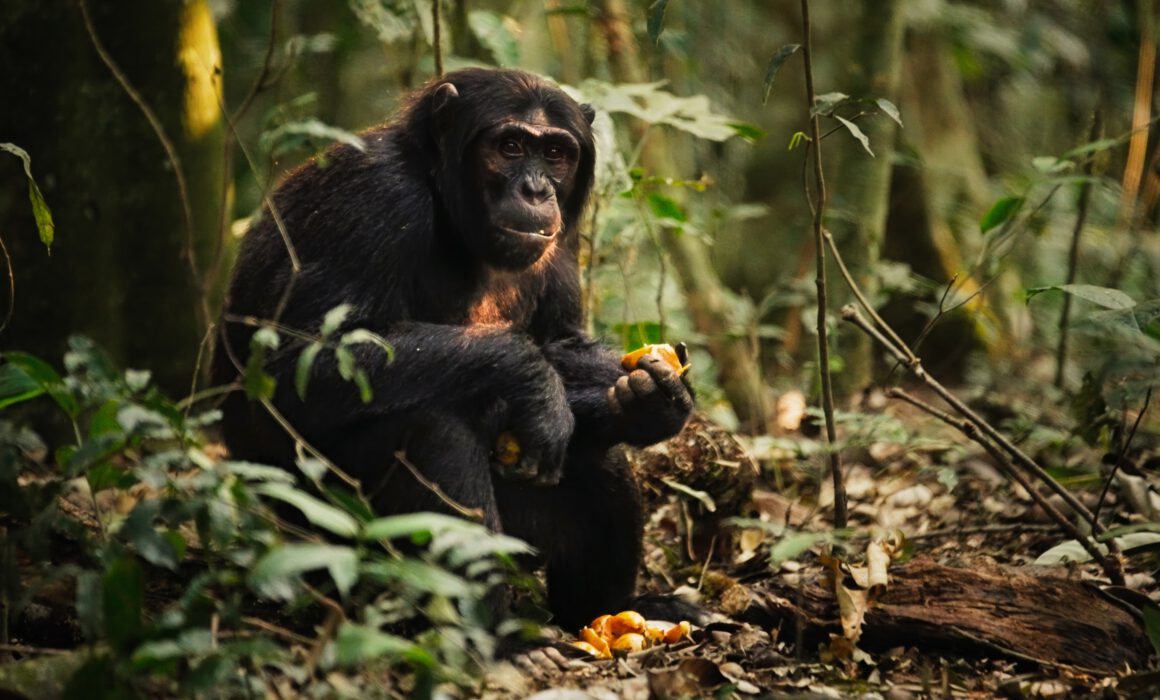
Chimps gorge on fermented fruit in Kibale National Park, Uganda
UNIVERSITY OF CALIFORNIA BERKELEY
The findings seem to buttress the drunken monkey hypothesis, an idea first formulated by Robert Dudley, a professor of biology at Berkeley, and a co-author of the study.
The idea is that our ancestors evolved to associate the scent of alcohol with ripe, energy-rich fruit. In ancestral forests, faint whiffs of fermentation would have been a useful signal of easy calories.
A taste for ethanol, at low concentrations, would therefore have given these early primates an evolutionary advantage. If the hypothesis is true, this helps explain our own fondness for the stuff.
During years where fermented fruit is abundant, the chimpanzees of Ngogo, in the north of the national park, spend more time travelling to distant areas of their home territories than usual. It is tempting to think that the booze is making them more adventurous. However, Maro believes it is more to do with the sugar providing a burst of energy.
• Chimps sharing boozy fruit may point to the origins of pub culture
Whether the chimps prefer the more fermented fruits, and whether their behaviour shifts with higher EtG levels, remain open questions. The urine tests, used for the first time in this study, may mean it is possible to find out.
For now, the findings offer a little more evidence that that humanity’s complicated relationship with drink may have roots in the forest.