
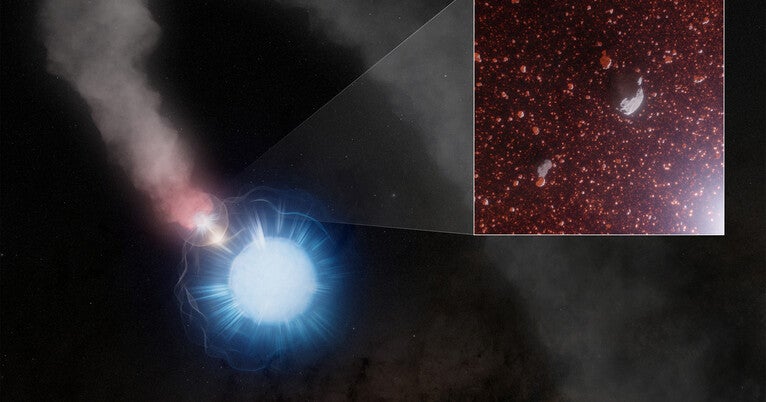
For the study, Wu and his coauthors looked at data from the James Webb Space Telescope (JWST) and the Atacama Large Millimeter/submillimeter Array (ALMA) to better understand WR 112’s stardust.
While previous mid-infrared images from JWST revealed bright spiral arcs of dust in WR 112, the researchers saw no dust in ALMA’s sensitive millimeter observations. Only warm, tiny dust grains could hide from ALMA’s view; it is one of the most powerful millimeter telescopes on Earth.
By analyzing the combined data from JWST and ALMA, the researchers found that the dust grains in the extended spiral structures are, for the most part, likely to be smaller than one micrometer, and most of them should be only a few nanometers (or billionths of a meter) across.
“It’s amazing to know that some of the most massive stars in the universe produce some of the tiniest dust particles before they die,” said Wu, who conducted the study as part of a summer undergraduate research program at the California Institute of Technology. “The difference in size between the star and the dust it produces is about a quintillion to one.”
The international team also found evidence that the dust from WR 112 comes in two distinct sizes: a larger group of nanometer-sized grains and a smaller group of grains about 0.1 micrometer across. This discovery reconciled decades of conflicting measurements of similar binary systems, which revealed only very tiny grains or only larger ones.
The researchers also explored several physical processes that can, in principle, break up or evaporate dust grains near the harsh radiation field of the stars. They said the processes tend to destroy intermediate-sized grains under certain conditions.
Because WR 112 is one of the most prolific dust producers of its kind — producing as much as three Earth moons’ worth of dust every year — the new grain-size measurements have big implications for how much carbon dust massive binaries can contribute to the broader galaxy.
Wu’s mentor on the study is Yinuo Han of CalTech, who is a co-author of the paper. Additional co-authors come from institutions in the United States, the United Kingdom, Japan, the Netherlands, Australia, and Germany.