
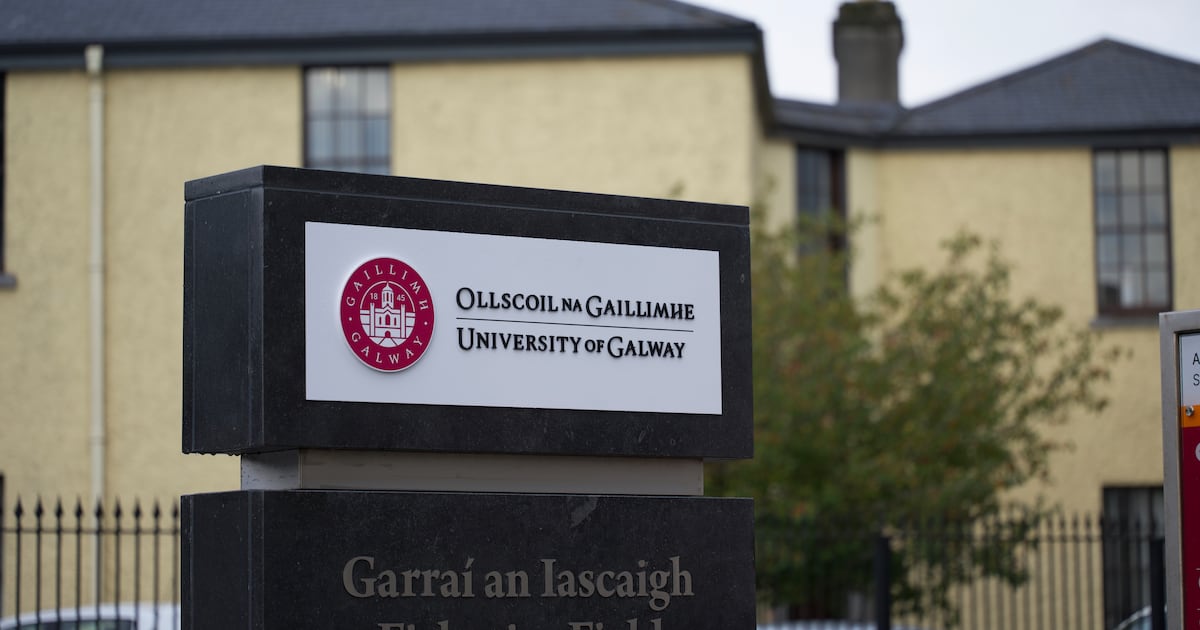
The University of Galway is proposing to discontinue and replace its general arts course due to an international downward trend in popularity as students are increasingly attracted to “direct routes to employment”.
An internal report seen by The Irish Times notes that reform of the university’s undergraduate provision within its College of Arts, Social Sciences and Celtic Studies has become “urgent”.
A review of arts courses was initiated by the college executive committee (CEC) in 2024 in response to a “sustained decline” in student numbers.
This decline, described in the report as “not cyclical but structural”, is seen across the college’s Bachelor of Arts degree (GY101), which has 23 subject options, and a number of its direct-entry denominated programmes, such as computer science and mathematical studies.
Its GY101 degree, in particular, which has seen a continuing decline in student numbers since 2011, dropped by 35 per cent from 749 registrations in 2019 to 491 in 2024.
The report describes projections for CAO first preferences for arts degrees at the university over the coming years as “concerning”, with a forecast predicting a continued year-on-year decline, falling from 1,768 first preferences in 2023 to 1,184 by 2030.
While all arts courses had an entry threshold above 350 points in 2025, points required would have been lower if not for a “strategic reduction in domestic intake”, the report notes.
The limit on intake was not due to increased demand, but to ensure students who are accepted are “ready for education”.
“Without applying a points cap and aiming to fill programmes to capacity, some courses would have experienced significant reduction in CAO points,” it reads.
[ Choosing a third-level course: How rewarding is a degree in the arts?Opens in new window ]
It outlines a number of processes driving the current downward trend in first-preference applications and student registrations, including the “drift away” from arts courses both nationally and internationally.
The report suggests this drift reflects the “perceived lower occupational return” from such degrees, noting that students are increasingly attracted to programmes perceived to offer “direct routes to employment”.
This is alongside a “shift in emphasis within higher education” towards Stem (science, technology, engineering and math) and business degrees.
An “already narrowing applicant pool for arts programmes” and demographic changes are also noted as contributory factors, with secondary school enrolments on a downward trajectory.
Difficulties in sourcing accommodation may also increasingly shift demand towards institutions with more affordable housing options, or alternative degree pathways, such as studying abroad or online.
“These pressures are not unique to Galway; students at other major Irish universities are experiencing similar difficulties,” it says.
The CEC recommended a “transformation” of its course offering to reverse the declining trend.
Under the proposal, the GY101 degree and direct-entry programmes would be discontinued and replaced by a new suite of “contemporary programmes designed to meet the learning needs of students”.
While such a transformation is viewed as potentially high-risk, “to the extent that we are abandoning a model that we know can sustain us at least in the short-to-medium term, in favour of a blue-sky offering”, it is also possibly “high-gain”.
These contemporary programmes, which would embed skills development, are likely to attract new domestic and international students, the report says.
Although the risk associated with the proposed transformation could be deemed “too great” at a later stage, a roadmap estimates that new courses could begin from September 2028.
A spokesman for the University of Galway said it is “conscious” of changing demographics and students’ interests and is exploring options for a range of “new and exciting courses in arts”.
He added that “no changes are being introduced at this time”.
“This is an early stage consultation, in line with best practice in higher education, where we ask our academics to reimagine how arts courses are offered.”