
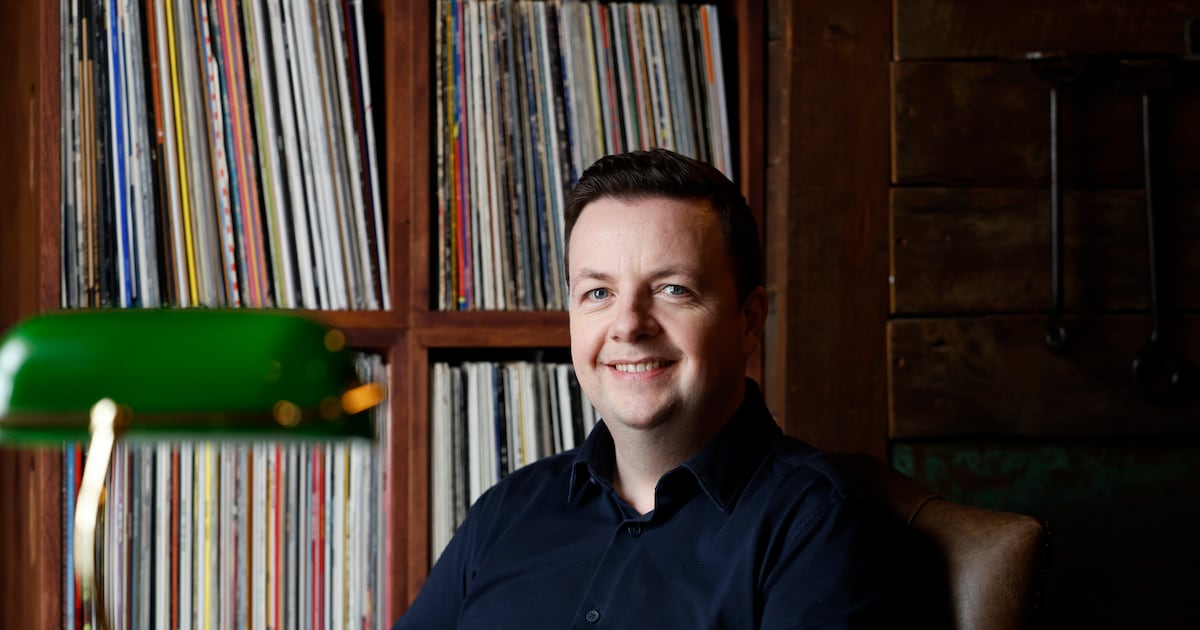
As any listener well knows, lightweight filler material is a regular hazard on radio chat shows, particularly when there’s a lot of airtime to get through. So kudos is due to Oliver Callan (RTÉ Radio 1, weekdays), who is packing his show’s longer running time in counterintuitive fashion, by padding it out with heavyweight topics of profound social import. Anyone seeking frothy content on Tuesday’s programme won’t exactly be disappointed – there’s still plenty of that – but may also be surprised to hear Callan sombrely discuss how our lives are soon to be upended by AI, and not in a good way.
Callan is joined by Dex Hunter-Torricke, a former public relations executive for Meta, SpaceX and Google who is now deeply concerned about the impact of AI. He’s not worried, like some AI sceptics, about a post-apocalyptic dystopia of robot drones hunting down humans. Instead Hunter-Torricke envisions a more prosaic yet still bleak future where conglomerates and oligarchs wield enormous economic and political power, while the rest of the population faces unemployment and disenfranchisement.
“We are not at all prepared for that future as economies, as societies,” Hunter-Torricke states. “If we don’t start having a mainstream serious conversation about what to do pretty quickly, the pace of technology and disruption will overwhelm our ability to choose.”
Hearing this, a promised rumination on the politics of playdates suddenly seems enticing. But if Callan’s doomy discussion is at odds with the customarily chirpy air of his show, it’s also thought-provoking, with Hunter-Torricke astutely dissecting big tech’s reckless pursuit of AI: “There is a cultural and intellectual disconnection between Silicon Valley and the reality of ordinary people’s lives.”
Callan, meanwhile, sounds absorbed throughout, even if his suggestion that the AI revolution might fizzle out is dismissed by his guest as “wishful thinking”. The host displays his sly side too, wondering if income from Ireland’s light-touch corporate tax regime might insulate it from the worst effects of AI. “I don’t think being a tech vassal state is a good option,” Hunter-Torricke replies. One wouldn’t necessarily bet against such an outcome, however.
Such sobering encounters are, it’s worth emphasising, the exception. Tuesday’s programme also has the host in infectiously positive conversation with author Cathy Kelly, whose company he clearly enjoys. Not all his items work as well. Wednesday’s brief chat with the barber of Alex Murphy, a young Irish footballer with Newcastle United, is as awkward as the premise is flimsy: now that Callan requires two hours’ worth of material every day, filler of the more conventionally featherweight variety is probably as unavoidable as an AI-dominated future.
Still, as a satirical impressionist as well as a radio host, Callan is alert to wider currents. When actress Amy de Bhrún appears on the show to discuss her short film about a neurodivergent boy, she reveals that the story is based on personal experience, recalling her own reaction when her young son was diagnosed with autism. “There’s a strange grieving process,” she says, “You don’t expect your child to be living in a world that’s not set up for them.”
Callan is by turns larky and empathetic with his guest, but when de Bhrún talks about her luck in finding a childcare facility suitable for her son, the host quickly refers back to the Government’s U-turn on moves to reduce the number of special needs assistants (SNAs) from 200 schools. “It’s a huge relief, and it just shouldn’t have been that way in the first place,” de Bhrún says, “It’s a sign of how little these people know what’s actually going on.” It’s a telling aside: we could do with more emotional intelligence.
While Callan doesn’t always find the optimum ratio of heft and levity on his mid-morning slot, Brendan O’Connor (RTÉ Radio 1, weekdays) appears to be getting the balance just right. His mix of chunky interviews and lifestyle items has proved a striking ratings success, attracting audience numbers second only to perennial chart-topper Morning Ireland. Saturday’s show provides a good example of his formula: in between drily observed spots on fashion and food, the host hears singer-songwriter David Gray recall his life and career.
But the highlight is O’Connor’s candid encounter with Mike Ryan, the Irish epidemiologist and former World Health Organisation (WHO) executive who played a leading role during the Covid pandemic. Having left the organisation last year, Ryan opens up about the toll taken by his pressurised role during the crisis.
[ Mike Ryan: What next for the ‘Indiana Jones of epidemiology’ as he leaves WHO?Opens in new window ]
“I lost quite a bit of my health,” he says, recalling the “viciousness” aimed at him and colleagues. These are not the exaggerated fears of a desk-bound bureaucrat: Ryan recounts hair-raising episodes in hotspots such as Iraq and Afghanistan. (He also stresses that his ordeal was “in the ha’penny place” compared to others’: “The heroes of Covid were the frontline nurses.”)
As is his wont, O’Connor is attentive towards his guest, but ready to casually lob tricky questions. When Ryan notes that WHO didn’t recommend total shutdowns during the pandemic, O’Connor immediately asks: “So were the lockdowns madness?” Ryan diplomatically describes lockdowns as an “escape measure” that was often embraced prematurely: “They’re a very blunt measure and have very big consequences.”
He suggests Ireland fared better than many places, but is well aware that some measures had a detrimental impact, from the curtailment of funerals to the shutdown of education: “The impact of school closures was severe, and has a long-term psychological and societal impact we haven’t even finished paying the price for.”
For all that, Ryan is wary about judging Covid restrictions with 20/20 hindsight. Similarly, O’Connor isn’t only interested in revisiting recent history, however momentous, but – ever alive to audience concerns – he also solicits his guest’s views on current matters: “How do you reflect on child wellbeing in this country?” His guest sighs that more work is needed, lamenting that a wealthy country such as Ireland falls down in providing SNAs or tackling child poverty.
“The measure of society is how we treat our weakest and most vulnerable,” Ryan says. “And right now our must vulnerable are often older persons and children, and we’re not doing a great job on either end of the spectrum.” No wonder we’re struggling to focus on the future: there’s enough to worry about in the present.
Moment of the Week
Following the Government’s hasty about-turn on reducing SNA numbers in schools (see above), presenter Justin McCarthy speaks to Dublin principal Jean Leonard on Morning Ireland (RTÉ Radio 1). Leonard outlines how the proposal – now reversed for a year, at the comparatively piffling cost of €19 million – would have robbed her school of nearly half its SNAs, with dire consequences for pupils with autism and sensory issues: “They’re honestly not able to access any kind of meaningful education without that support.”
She praises the parents who fought against the measure, but isn’t especially hopeful that the matter is resolved. Asked by McCarthy why the bombshell move was proposed by the relevant authorities in the first place, Leonard doesn’t mince her words: “I just think they thought they could get away with it.” A lethal verdict, but probably on the money.