
A Japanese macaque named Punch has gone viral. Here’s how his journey from abandonment to social integration echoes decades of primate research.
JIJI PRESS/AFP via Getty Images
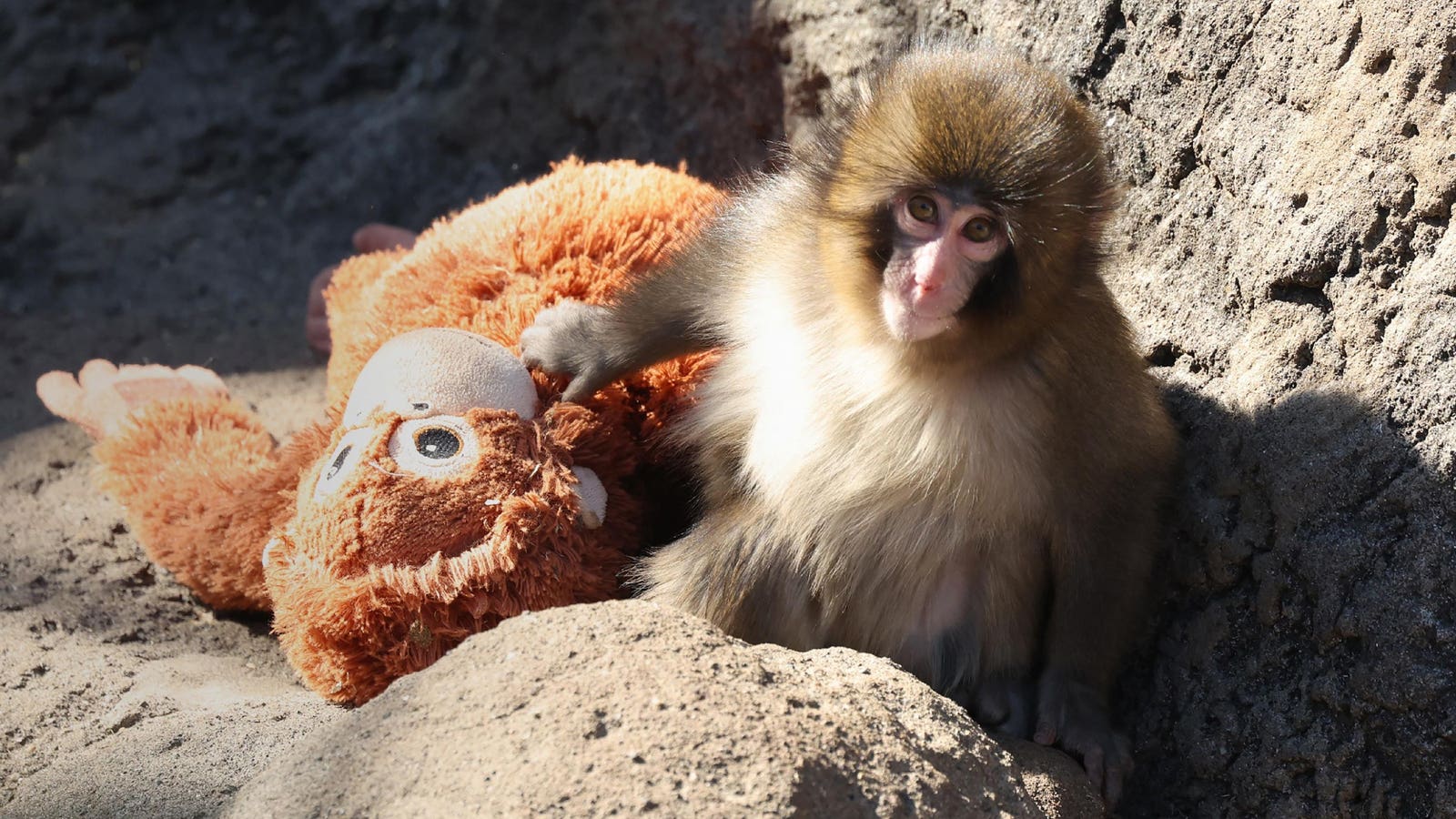
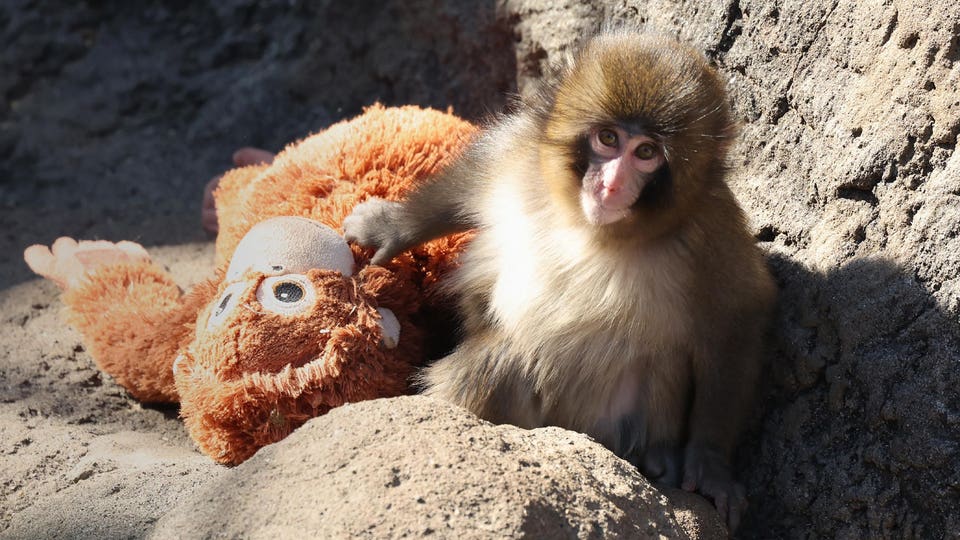
In the last few days, the internet has collectively fawned over a tiny Japanese macaque (Macaca fuscata) named Punch. After being rejected by his mother soon after his birth in July 2025, the fragile infant has found an unlikely lifeline at the Ichikawa City Zoo: a soft, stuffed orangutan toy from IKEA.
Viral videos soon followed. In one, a larger macaque chases and bullies Punch, and we see him instinctively run back to his toy. In another, he sleeps curled around it, arms held around it tightly as though the plush were his mother. Supporters of Punch rallied online: #HangInTherePunch trended, and the toy itself has since sold out in shops from Tokyo to Seoul to the United States.
Naturally, watching Punch walk about his enclosure while fiercely clutching his plush “surrogate mother” has struck a deep chord globally. What few realize, however, is that Punch’s heart-tugging story isn’t unlike what we see in nature. We know this from decades of research on how primates form relationships, cope with stress and establish their place in a social world.
Does Punch See His Toy As His Mother?
In the late 1950s, renowned psychological researcher Harry F. Harlow conducted a study so famous that it has fundamentally altered how scientists think about attachment in primates.
In his groundbreaking 1959 study published in Proceedings of the National Academy of Sciences, infant rhesus macaques (Macaca mulatta) were removed from their mothers at birth. Subsequently, they were presented with two possible surrogate “mothers”:
One was made out of cold wire, and it supplied food to the monkeysThe other was wrapped in soft cloth, but offered the monkeys no nourishment
Fascinatingly, despite the fact that the wire mother held the milk, the infants overwhelmingly preferred to cling to the cloth surrogate, especially in moments of distress.
Harlow found that “contact comfort” (the tactile feeling of safety) mattered much more to the babies than just sustenance alone. This finding overhauled the then-prevailing idea that attachment stems from physiological needs like feeding. Instead, his work suggested that emotional comfort and physical closeness are central to healthy development in primates — including humans.
This research confirms what the internet could only guess: that Punch’s plush is so much more than just a toy. It’s rare to see modern reflections of classical research findings, but Punch is a perfect example.
We can see firsthand that even an inanimate surrogate, with the texture and shape reminiscent of other macaques, can serve as a focal point for an infant’s emotional regulation. And although the zoo’s situation is not a controlled experiment, the parallels to Harlow’s observations are unmistakable.
Punch’s Attachment And Stress
Just as it is for human babies, it’s incredibly stressful for a dependent primate to be separated from its caregiver. As demonstrated in a classic 1975 study published in Developmental Psychobiology, researchers examined infant rhesus monkeys raised with human caregivers or surrogate peers, while also monitoring their reactions to the removal of their attachment objects at 6 months of age.
This photo taken on February 19, 2026 shows a 7 month-old male macaque monkey named Punch, who was abandoned by his mother shortly after birth, sitting with a stuffed orangutan toy at Ichikawa City Zoo and Botanical Gardens in Chiba Prefecture. (Photo by JIJI PRESS / AFP via Getty Images) / Japan OUT
JIJI PRESS/AFP via Getty Images
Unsurprisingly, both groups displayed behavioral distress. They vocalized more frequently, were restless and even engaged in less play than usual. This research lends even further support for the notion that an attachment figure, even if inanimate, plays a real role in emotional regulation for young primates.
This finding parallels those of more modern studies in other primates and mammals, which have shown that early loss of a caregiver can have long-term effects on social development. These studies also show that adverse early experiences (including neglect or maternal abuse) influence stress hormone profiles and social behaviors in juvenile monkeys. This often results in complex consequences that can span generations.
Is Punch Being ‘Bullied’?
Once Punch was introduced to the broader macaque group (called the “Monkey Mountain”), videos began circulating that some observers described as “bullying”: larger monkeys chasing him, scolding him, even dragging him across the ground. Online viewers have since projected a schoolyard-esque narrative onto the footage, in which Punch is an underdog being tormented by bullies.
An important contextual factor to consider is that Japanese macaque troops are structured by strict dominance hierarchies. Unfortunately, Punch lacks maternal protection, yet he’s also part of a female-bonded society in which rank is inherited directly from the mother. In this sense, we’re witnessing him working through a real developmental challenge.
It’s also important to remember that play isn’t the only way social monkeys learn their place in the world. The kinds of confrontational interactions we see in Punch’s viral videos often serve as a means for social boundary-setting in macaque societies.
As difficult as they might be for us outsiders to watch, we mustn’t forget that encounters like these aren’t just instances of unprovoked harassment. Social ranking and cooperation have to be learned through repeated interactions with others, which also includes confrontations and corrections.
So, while it’s easy to look at a primate enclosure and see a “bully” on the playground, what’s actually happening is much more normal — and, more importantly, necessary — than what we initially realize.
Although these behaviors may look overly aggressive to us, they’re not a product of cruelty. For Japanese macaques, these interactions prevent the group from falling into chaos. These rituals, ranging from subtle posturing to direct confrontation, are instrumental in establishing clear social hierarchies, which ultimately dictate who eats first and who gets to mate.
In fact, structures like these actually prevent constant, unnecessary, lethal fighting by setting “rules” that everyone understands.
Punch’s Plush Legacy
Many will be pleased to know that Punch’s story isn’t over yet at Ichikawa City Zoo. Recent reports and visitor clips show Punch engaging in grooming with other resident monkeys, a key affiliative behavior in macaques. Even better, he also seems to be forming tentative bonds with some of his peers. In primates, behaviors like these signal acceptance, trust and reciprocal relationship building.
The most important takeaway for viewers is that Punch isn’t clinging to his toy out of fear, nor is he a victim. Instead, he is working through the necessary steps of social integration. He’s using his comfort object as a secure base from which to venture into real primate social life, just as every primate (including us) must in their formative years.
Punch’s story has captured hearts because it resonates with our own fundamental need for connection. And there’s a rich body of research showing that attachment, comfort and social belonging are biological realities for many species apart from us.
Punch, armed with his orangutan-shaped plush and a growing set of friends, may be an extreme case, but he embodies one principle that seems to be universal among primates: to overcome adversity, we need safe places and loyal companions along the way.
Curious what your inner creature is — whether it’s a snake, a monkey or something entirely unexpected? Take the Guardian Animal Test for an instant answer.
If Punch’s story resonated with you, it may say something about your own relationship with the natural world. Take the Connectedness to Nature Scale to explore how deeply you feel linked to life beyond yourself.