
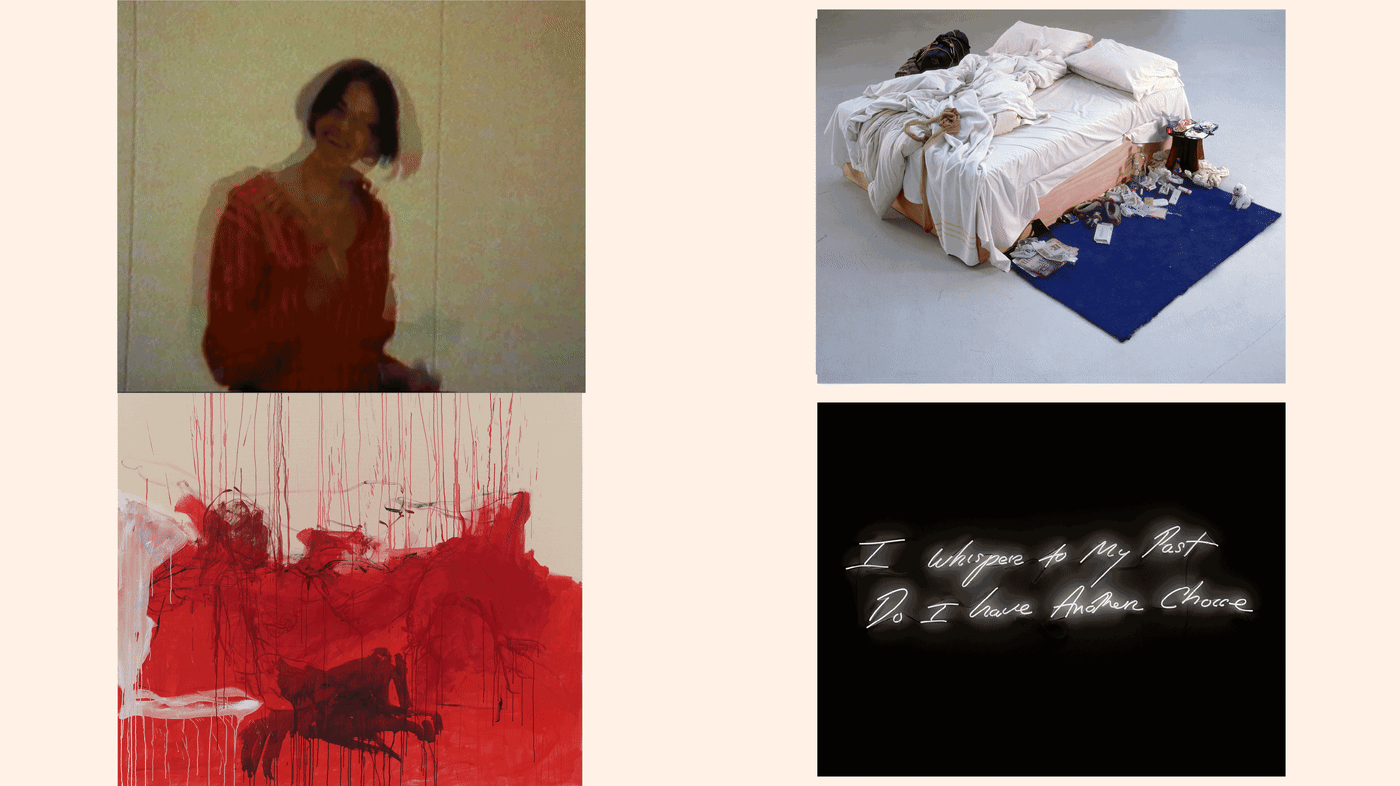
It is nearly 30 years since the installation “My Bed” failed to win the Turner Prize, catapulting its creator to a tabloid fame which shifted, slowly then decisively, from notoriety — the swearing, sexually aggressive provocateur — to public embrace for the national treasure Dame Tracey Emin. That journey, unique among British artists, makes Tate Modern’s sensitive, tightly curated retrospective Tracey Emin: A Second Life so intently a social history that it fascinates quite beyond the realm of art.
At its centre is “My Bed” (1998) — Emin has made nothing as original or significant since. Today the surprise is that, as she says, “it looks so sweet. It’s so sad”, and that it is a knockout sculpture. The crumpled sheets are as sensuously orchestrated as Manet’s in “Olympia”. The geometric square bed versus the chaos of cigarette butts, condoms, tampons, vodka bottles, plays on minimalism, ready-mades, psychodrama, all at once.
 ‘The End of Love’ (2024) by Tracey Emin © Tracey Emin/DACS
“My Bed” was initially read as promiscuous boasting. How wrong we were: it is an unforgettable self-portrait of depression. Following childhood neglect, abuse, rape at 13, and a recent break-up, Emin was suicidal at the time.
Her work already teemed with personal relics, sanctifying a religion of self-exposure, the female body’s martyrdom. Tate’s opening rooms, 1990-93, display her medicine bottle and pills in “My Abortion”, her passport and framed tooth (“the last dead thing to leave my body”) in “My Future”, the appliqué blanket named for her father’s “Hotel International”. In wonky letters, the latter summarises her biography: birth date 3-7-1963; her parents’ romance (“Pam Cashin loved Envar Emin so much”); KFC, the shop beneath the Margate council flat where she grew up with her single mother.
Later comes another reliquary, gold fabric — “the last piece I had from my mum’s curtains” — in “The Last of the Gold” (2002), an embroidered “A-Z of abortion”; the pathos is her closeness to her mother, whom she adored, and her own difficult decision not to become a mother herself. There is also the gaudy, garrulous blanket “Mad Tracey from Margate. Everyone’s been there” (1997), defining the persona of the ballsy victim, defiant yet self-pitying: “Leave him, Trace . . . How it feels . . . Every time I pass Dunkin Donuts I think of you . . . And I said fuck off . . . ”
 ‘Mad Tracey from Margate. Everyone’s been there’ (1997) by Tracey Emin © Tracey Emin/DACS
Emin’s textiles connect to women’s homespun, storytelling traditions; they also unfurl like political banners, at Tate to the incessant, strident soundtracks of two films: Emin booed offstage (“Slag! Slag! Slag!”) in “Why I never became a dancer” (1995), and chronicling her botched abortion in “How It Feels” (1996). She retells this in paint, a faceless, spindly figure outlined in blue, between her legs a thick crimson blot, spilling down the canvas: “And so it felt like this” (2018).
That title could stand for her entire diaristic oeuvre: an outburst of romanticism, the spontaneous overflow of powerful feeling, among the cold, conceptual Young British Artists. Emin wasn’t the first woman artist to mine trauma (Louise Bourgeois is her idol), or to focus on reproductive rights — Paula Rego’s abortion series appeared the same year as “My Bed”. But, media-savvy and feisty, she spoke to and for a wider audience.
Quirkily elegant handwritten neons, smart appropriations of Margate’s cheerful arcade signage, are especially direct. “I could have loved my innocence” (2007) runs in white above a still shocking gathering of stitched and painted nudes: the fragmented “Just Like Nothing” (2009), inscribed “You made me Feel like nothing”; a white mass bearing down on a broken body (“Rape”, 2018); a slender figure shrouded in darkness (“You heard me Scream”, 2022).
 ‘I whisper to My Past Do I have Another Choice’ (2010), one of Emin’s handwritten neon-lit works © Tracey Emin/DACS
Converging art with the messy everyday, Emin smashed taboos about women’s bodies, desires, abuse, periods, pregnancy. Long before #MeToo, her raunchy vernacular yanked female working class life into the rarefied, male-dominated establishment. That is a triumph, assuring her place in British art history.
The price? The show is one extended howl of agony. Its title recalls Matisse’s declaration of “une seconde vie”, when he felt reborn after a cancer operation at 71 and, wheelchair-bound, made the rapturous cut-outs. But although “A Second Life” shines in bright pink neon at the entrance, parallels are biographical only.
Emin was treated for cancer in 2020 by the removal of many internal organs and now uses a stoma bag — graphic photographs line a tomblike corridor. In the catalogue she celebrates her post-recovery relocation to Margate, days spent painting, funding an art school and other community ventures, as “my second life . . . and this is heaven”. It is a generous, fulfilled, heart-warming, giving-back story.
 ‘I am The Last of my Kind’ (2019) by Tracey Emin © Tracey Emin/DACS
It’s absent, however, from the work. While inspiring sympathy, Emin’s recent monumental paintings resemble an inner hellscape. In oozing, seeping, predominantly red paint washed across fragile outlined female forms — “I’m really a real physical painter” — they evoke the body overwhelmed by haunted memories, submerged by illness, leaking, weeping, often dripping text too.
The abortion trauma endures: drooping pink/red figures — “I did nothing wrong” (2024), “You were still there” (2018), addressing the blob of a foetus — are juxtaposed with an abbreviated black Christ, “The Crucifixion” (2022). “I am getting old now but not as old as my broken fucked up vagina that’s so connected to my soul”, scrawled around a downcast nude in “I am the Last of my Kind” (2019), suggests Emin’s grave illness before her diagnosis.
“I never Asked to Fall in Love — You made me Feel like This” (2018), a figure almost obliterated by sweeps of scarlet bleeding around a giant black crab, hangs with “My Bed”.
 ‘I never Asked to Fall in Love — You made me Feel like This’ (2018) by Tracey Emin © Tracey Emin/DACS
After cancer, the bed returns: sickbed for a shattered body in “I went home” (2023), refuge for heartbreak in the huddled mound in “The End of Love” (2024), scene of heaving failing lovers in “Not Fuckable” (2024). Sparest and best, “I watched Myself die and come alive” (2023), a splayed-out nude in bed facing a dark upright spectre, is indebted to deathbed pictures by Edvard Munch, a major influence, along with Egon Schiele’s febrile explicit drawings.
Emin is steeped in art history. Like several ambitious contemporary women painters — Cecily Brown, Jenny Saville, Marlene Dumas — she reclaims mid-20th-century macho abstract expressionism as a living language for female experience. For her, slashing strokes, gestural touches and erasures, describe vulnerability, disfiguration, weakness — too well, for the compositions lack underlying strength and painterly power, and the relentless inward focus is constraining, facile. Joyless, repetitious, hardly distinguishable one from the next, these paintings are offered, it seems to me, as mere tokens, marks of Emin, like the relics, the neons.
Tate’s show, curated by outgoing director Maria Balshaw and a proud swansong for the socially engaged and feminist art which she has always championed, is an absolutely cohesive narrative exhibition. Emin tells her life as it is in a voice necessarily vehement, hectoring, narcissistic. This isn’t a criticism: autobiographical art, especially survivors’ tales, depends on an indomitable sense of self.
Here too Emin has been ahead of the game, anticipating today’s vogue for autofiction and life-writing — Karl Ove Knausgaard’s My Struggle, Helen Garner’s Baillie Gifford-winning diaries — while also looking centuries back, to romanticism, to the ideal of creativity based on the spontaneous overflow of powerful feeling. “Art is for feeling not for looking”, she insists. As the mantra of a storyteller, it serves her well; for painting, it is fatally limiting.
To August 31, tate.org.uk
Find out about our latest stories first — follow FT Weekend on Instagram, Bluesky and X, and sign up to receive the FT Weekend newsletter every Saturday morning