
Tory opposition barbs in UK politics tend to be soaked in hyperbole. Yet its taunt on Friday morning that a crucial byelection result suggests Keir Starmer has “killed” the Labour Party may not be as outlandish as it sounds for the embattled UK prime minister.
The impressive victory overnight for the Greens in Gorton and Denton in Manchester, with Labour pushed into third place behind Nigel Farage’s Reform UK, can only be seen as a disaster for Starmer, his floundering premiership and his party.
Labour’s base of voters is being squeezed from every side. The party is caught in the middle with Starmer at the helm. For how much longer?
This Gorton and Denton seat, with large cohorts of Muslim and white working-class voters, was meant to be a safe Labour constituency. It lost half its vote share in the byelection, compared with the general election in 2024. If this is safety, then calls from within Labour for it to embrace the danger of a leadership change may grow louder.
The pattern had already been well established of chunks of Labour’s working-class base drifting towards the right-wing upstart party Reform, following last year’s Runcorn byelection and a slew of local votes where Farage’s party triumphed.
 Green Party winning candidate Hannah Spencer celebrates with supporters. Photograph: Adam Vaughan/EPA
The fresh disaster for Labour this morning lies in the simultaneous erosion of its base from the left by the Greens, whose candidate Hannah Spencer becomes that party’s first MP in the north of England.
If Labour tacks farther right on issues such as immigration to counter Reform, it risks further boosting the resurgent Greens. If it tacks left to counter the latter, it leaves itself open to further attack by Reform. Starmer is running out of options.
Much of his internal political danger lies in the fact that Labour’s defeat in Gorton and Denton was partially self-inflicted – by him.
Andy Burnham, the popular mayor of Greater Manchester, wanted to contest the byelection but he was blocked by Starmer and his allies. Burnham is known to covet Starmer’s job as prime minister, and by blocking him that threat was held off – Burnham cannot take Starmer’s job as prime minister if he cannot get into parliament.
The Irish Times spent several days in Gorton and Denton last week, and the signs of a potential victory for the Greens were apparent.
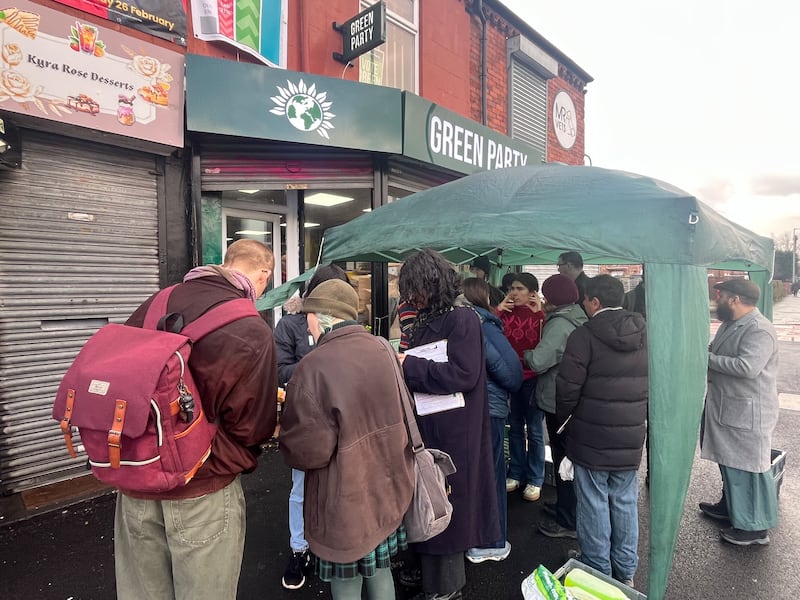 An energised crowd outside the Greens campaign office in Gorton last week. Photograph: Mark Paul
Its canvassers seemed more energised than Labour’s. The Greens’ election posters were also more numerous and better located in the front windows of voters’ homes than Labour’s, which were concentrated more around local businesses.
This newspaper also picked up rumours of a damaging split in Labour’s support among Manchester Muslims, between the Bangladeshi and Pakistani Kashmiri communities. The row was rooted in local political rivalries. Yet its nature suggested that Labour’s candidate, Angeliki Stogia, who was backed by Bangladeshi power brokers, might struggle to win the same level of support from Kashmiris.
This left a gap for the Greens to exploit. That party was already popular among Muslims over its stance on the war in Gaza – the Greens are heavily critical of Israel, and many British Muslims are angry at Starmer’s party for its more measured approach.
Yet the scale of the Green victory with well over 40 per cent of the vote in the byelection suggests it also picked up Labour votes among working-class white people in Denton.
Starmer is not the only leader who will be disappointed with the result. Farage’s Reform failed to make another breakthrough, even if it won the consolation price of pushing Labour into third.
Reform’s candidate, GB News presenter Matt Goodwin, always seemed like an odd, divisive choice in such a diverse constituency, with his particularly harsh views on immigration. A more moderate candidate may have fared better.
The result in Gorton and Denton also underlines the growing sense that Reform may have peaked – its poll numbers in Wales, for example, appear to have slipped a little.
For Starmer, the result in Manchester is unlikely to cost him his job immediately. But his sheen as an election winner, earned in 2024, has long gone. No more can he claim that his Labour is the only party capable of beating Reform.
Starmer now faces the real possibility of a leadership challenge in May after local elections in England and parliamentary votes in Scotland and Wales.
The ructions continue in UK politics, where the old two-party system of the Tories and Labour is dead.