
equipo de arquitectura composes a forest in the house
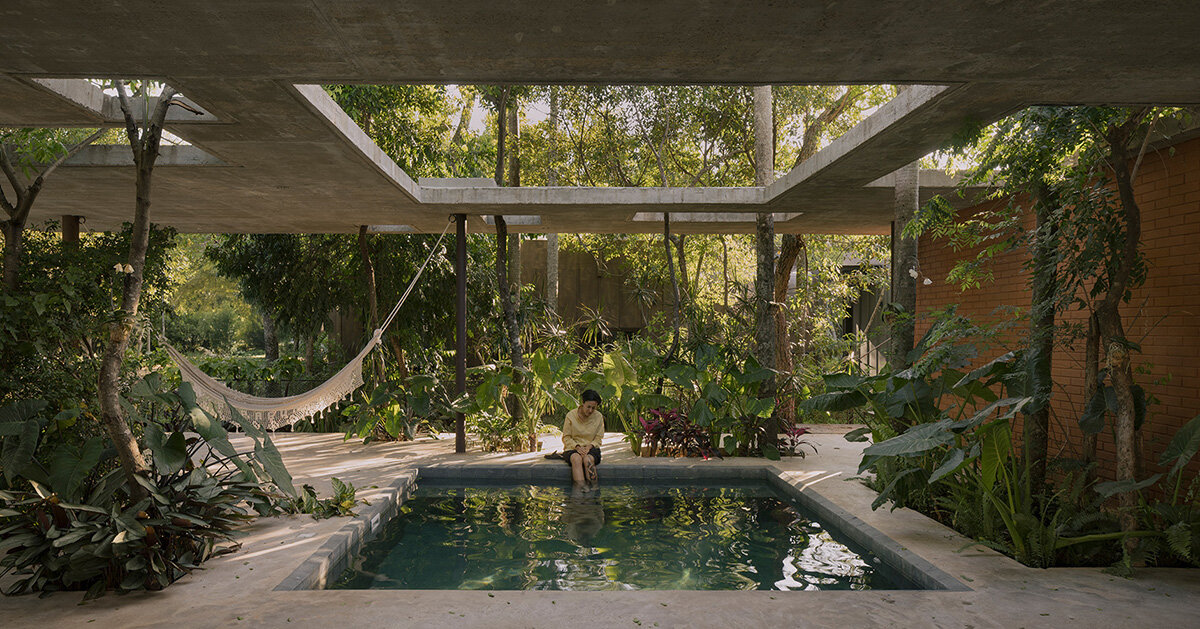
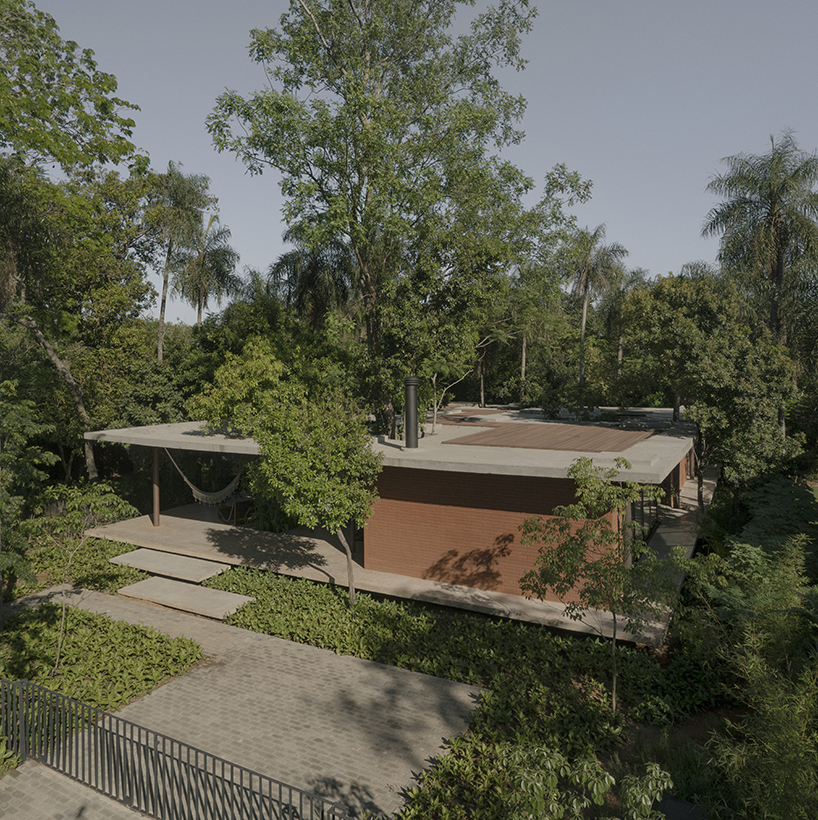
In San Bernardino, Paraguay, Equipo de Arquitectura completes A Forest in the House, a 260-square-meter residence that takes the existing woodland as its primary framework. Architects Horacio Cherniavsky and Viviana Pozzoli allow mature trees to determine the geometry of the plan, inserting compressed earth volumes and shaded voids between trunks.
The fixed perimeter of the roof establishes the limits of intervention. Inside that contour, solids and voids are distributed in response to the position of trees, replacing the conventional orthogonal grid with a more adaptive arrangement. The irregular disposition of pillars contributes to lateral stability while accommodating root systems. Solid volumes are built from compressed earth blocks, reinforcing a material continuity with the ground. Vertical structural elements are placed carefully among trunks, aligned to avoid interference with roots and to visually recede into the wooded background.
all images by Federico Cairoli
philosophy and jazz as spatial framework
Equipo de Arquitectura draws conceptual grounding from José Ortega y Gasset’s Meditations on Don Quixote. Depth and Surface (1914), opening with the reflection: ‘When the phrase ”the trees prevent us from seeing the forest” is repeated, its exact meaning may not be understood. Perhaps the mockery behind the phrase backfires on the person who utters it. The trees prevent us from seeing the forest, and thanks to that, the forest exists. The mission of the visible trees is to keep the rest latent, and only when we realize that the visible landscape hides other invisible landscapes do we feel ourselves to be inside a forest.’ For the Asunción-based architects, this idea becomes a spatial method. The visible trunks frame and conceal and what remains latent shapes circulation, enclosure, and void.
The design process is also compared to jazz composition, referencing Bill Evans’ description of improvisation within structure: ‘Jazz is a concrete process that is not intellectual. You use your intellect to break down the materials, learn to understand them, and learn to work with them. But in reality, it takes years and years of practice to develop the skill necessary to be able to forget all that, relax, and just play.’
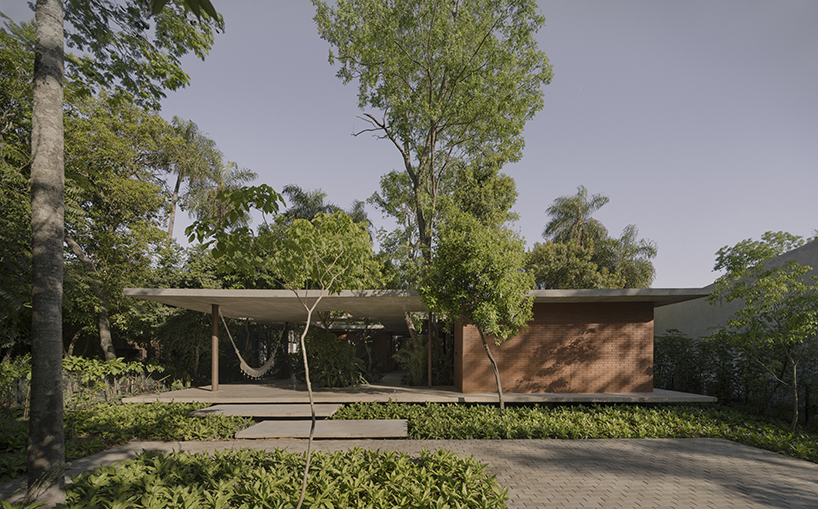
Equipo de Arquitectura completes A Forest in the House in San Bernardino, Paraguay
two horizontal planes shape the residence in Paraguay
The house unfolds across two horizontal layers. The primary plane, the floor, is subtly elevated to allow roots to continue growing beneath it. Above, the ceiling mirrors this geometry and extends outward to form a terrace, positioning occupants at canopy level. This dual-plane strategy organizes both protection and exposure, grounding and outlook. Light and air act as temporal agents within the space. Changing shadows register the passing hours, while wind moving through the open galleries introduces sound and movement. The architects liken these atmospheric shifts to musical rhythm, where silence carries as much weight as sound.
Patios and shaded galleries establish a porous domestic environment. The trees delineate occupation and emptiness, shaping rooms as much as walls do, and vegetation becomes a structural guide. Completed in 2025 with landscape design by Viviana Pozzoli and structural engineering by Felipe Ramírez, the project proposes a quiet rethinking of how architecture can operate within fragile ecosystems.§
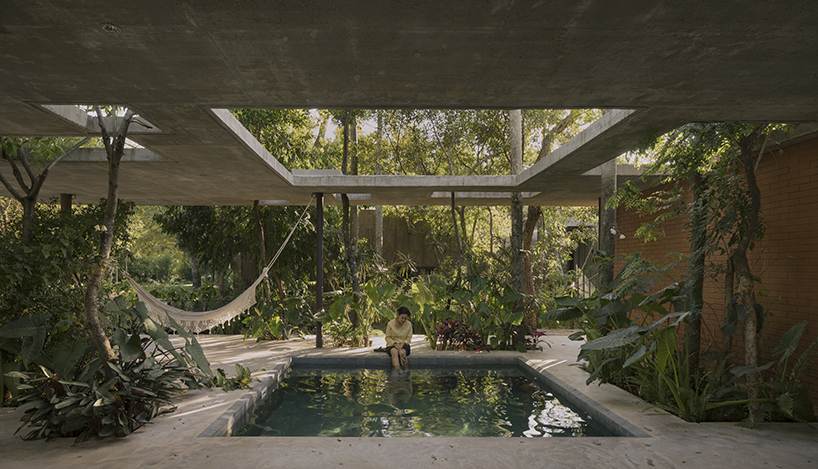
a 260-square-meter residence that takes the existing woodland as its primary framework
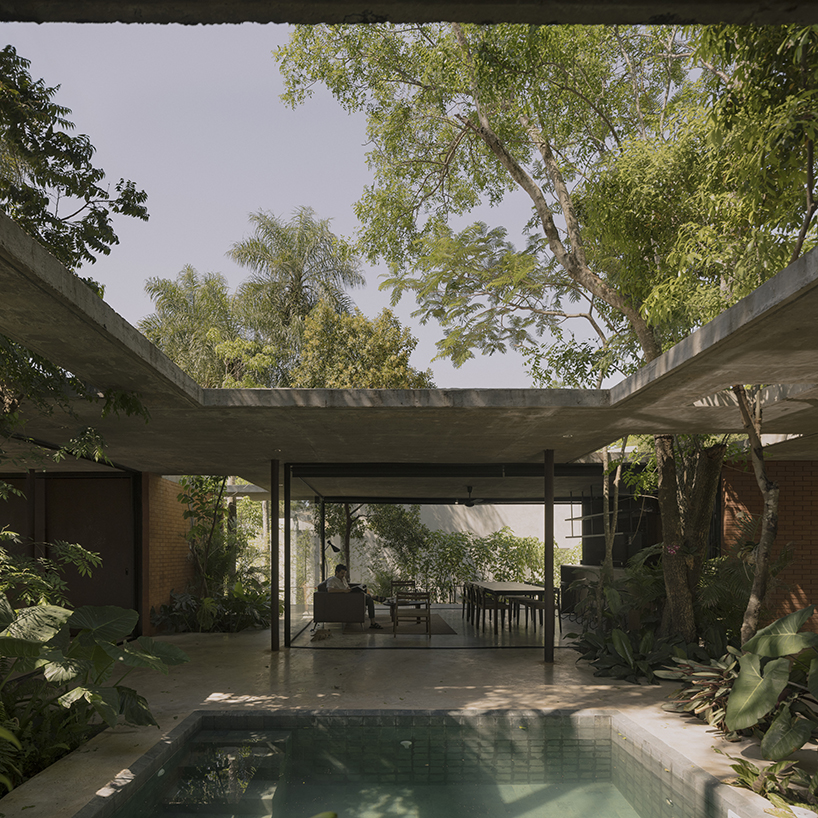
mature trees determine the geometry of the plan
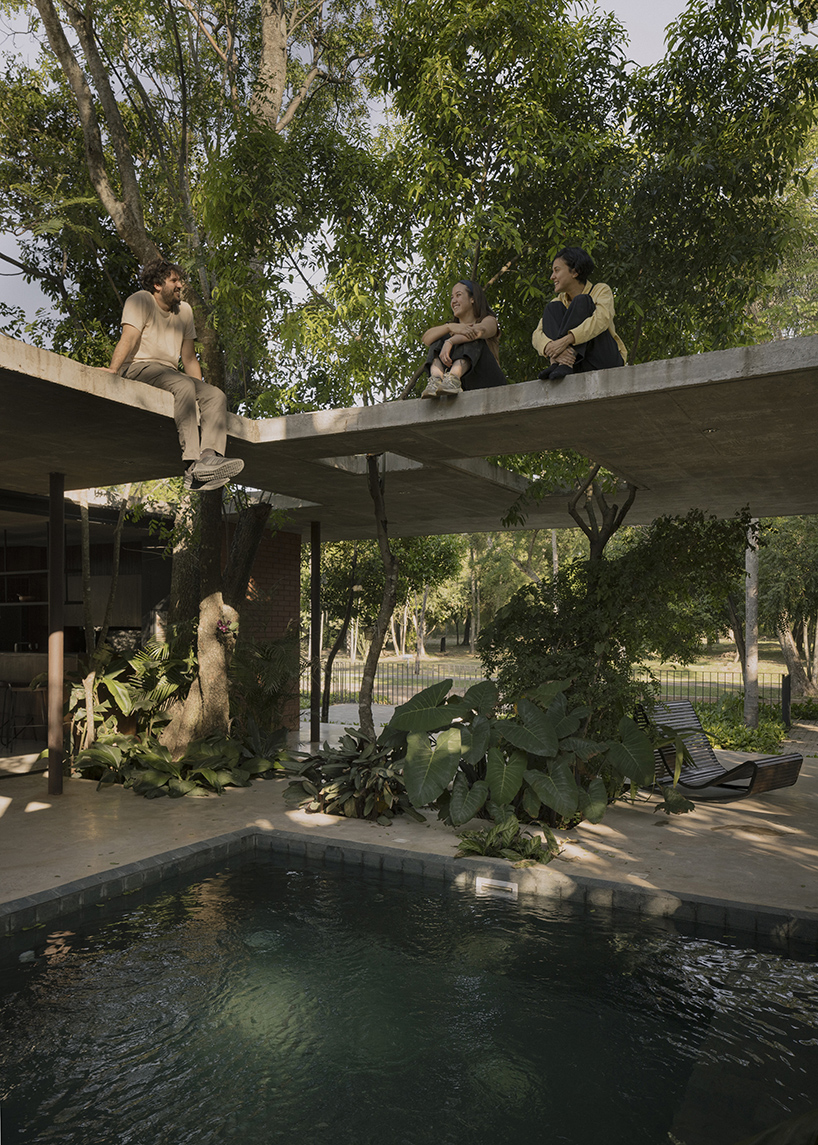
inserting compressed earth volumes and shaded voids between trunks