
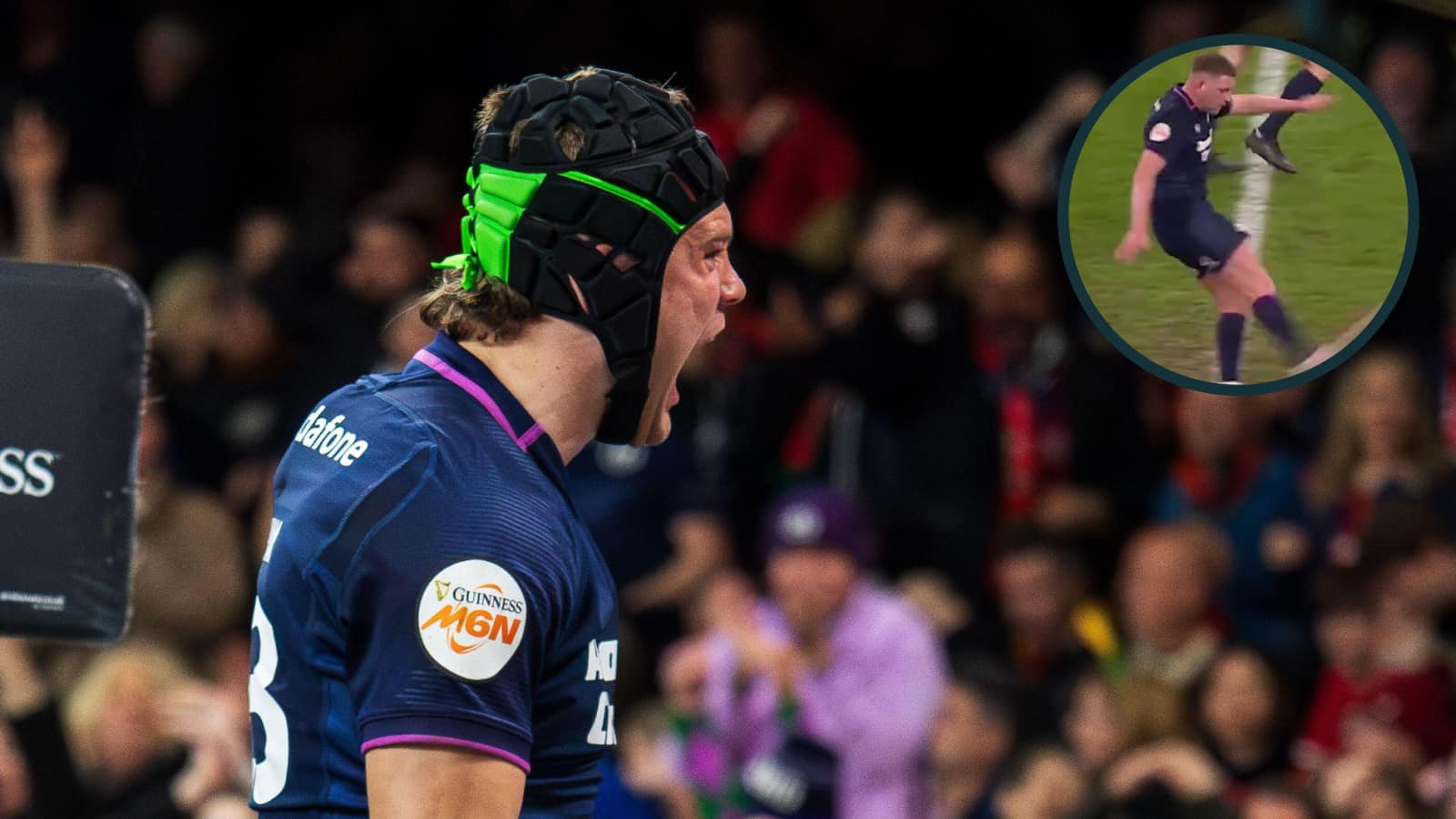
Nigel Owens has weighed in on Darcy Graham’s controversial try in Scotland’s narrow Six Nations victory over Wales at the Principality Stadium in round three.
The Scotland winger’s try came at a crucial time in the match as Wales had just opened up a 23-12 lead through the boot of replacement back Jarrod Evans.
Immediately after the Welsh back converted the penalty, Scotland fly-half Finn Russell charged to the halfway line, executed a quick kick-off with Graham pouncing to regather the ball and score a try that put his side back within striking distance.
George Turner would score in the final 10 minutes to move Gregor Townsend’s men into a 23-26 lead, which they maintained until the final whistle.
Matthew Carley reflects on his decision
Referee Matthew Carley, who was overseeing his 50th Test match, awarded the try for Scotland, deeming that everything that occurred was legal and has stood by his decision when appearing on World Rugby’s Whistle Watch show with Owens and legendary Wales and Lions centre Jamie Roberts.
Roberts began the conversation on the try, saying: “Darcy Graham’s try, a moment of genius from Finn Russell after Jarrod Evans kicks the conversion. Now, some have suggested maybe the wrong ball was used, or Scotland weren’t allowed to do it. Wales had to be better set. How did you see it? Were all the laws followed correctly?”
“The Darcy Graham try was so peculiar,” Carley replied.
“I remember thinking at the time that it was after the kick at goal had been successful from Wales that Finn Russell had run past me a little bit quicker than normal. So, then you’re alerted and your senses are sort of heightened to what’s going on around you.
“So, I knew that the two main things that I needed to be aware of once the ball had been delivered to the pitch was that Wales were on side and ready to receive the kick. The law is that they are behind their own 10 line.
“So, it was a quick scan to ensure that was the case, and then I needed an awareness of where the Scotland players were in relation to the kick-off and ensure that they were on side when Finn Russell kicked the ball.”
Carley hailed the teamwork of the match officials on the day with Karl Dickson and Adam Leal being his assistants, Ian Tempest the TMO and Eric Gauzins the Foul Play Review Officer.
“It was really good teamwork and connection from Adam who had worked his socks off to get into as good a position as he could upfield from the kick-off so that he was quite close to where the ball landed and then he could judge any challenge or competition and then see the grounding,” the English official continued.
“I remember feeling at the time that everything had kind of gone into slow motion, and I think it was the same for everyone.
“In terms of legality, 100% happy, and then obviously you got Tempo [Tempest] and Eric in the background who did their little sweep of it, to make sure that what we’d seen on the field was correct and seven points to Scotland and a try that will be replayed for years to come on highlight reels of the Six Nations.
“Not much more to say other than it was a strange moment, but one I think we can be pleased that we identified and we’re up with and aware of and allowed Scotland to score seven points in that situation. It’s so easy to stop the game and be cautious, but we wanted continuity, we want flow in the game, and they ticked all the boxes they needed to be able to take their chance.”
Nigel Owens’ verdict
Owens agreed that the try was legal, adding that Wales were at fault for not being alert enough to Russell and Graham’s intentions.
“Nothing wrong with it,” he said.
“So, what you’ve got to do is allow the opposition to get back over their own 10m line basically. So, you just can’t run up there and take it and the Welsh players are still in the Scottish half going back. So, they’ve got to have time to go back to the 10 metre line.
“The fact that they got back to the 10 metre line and didn’t turn around to see what was happening next, then that becomes their problem.”
Finn Russell’s kick
While Owens and Carley believe that Scotland ticked all the boxes, the debate around the legality of the try continues to rage online after the Six Nations posted a new angle on the try, raising doubt whether Russell actually dropped the ball before kicking it.
The speeeeeeed of Darcy! 😍#GuinnessM6N #Since1883 pic.twitter.com/NuUh0nxBJU
— Guinness Men’s Six Nations (@SixNationsRugby) February 25, 2026
Many have also rued the fact that the Scotland 10 did not take the kick-off from behind the halfway line and was marginally in front of the line when doing so.
World Rugby law 12.1 reads: “All kick-offs and restart kicks are drop kicks. Sanction: The non-kicking team has the option of the kick being retaken or a scrum.”
And 12.2 adds: “Kick-offs are taken on or behind the centre of the half-way line. Sanction: The non-kicking team has the option of the kick being retaken or a scrum.”
“Great quick thinking by Russell HOWEVER he DIDNT even drop kick the restart he actually punted the ball really poor officiating,” one fan wrote in reply to the video posted on X.
Another added: “Punt Russell! Lucky to get away with this tbh.”
Want more from Planet Rugby? Add us as a preferred source on Google to your favourites list for world-class coverage you can trust.
While Carley and Owens addressed the legalities around the Welsh players being in position and the Scottish players being onside, they did not zone in on Russell’s kick.
READ MORE: Nations Championship venues confirmed for Southern Series but it comes with a twist