
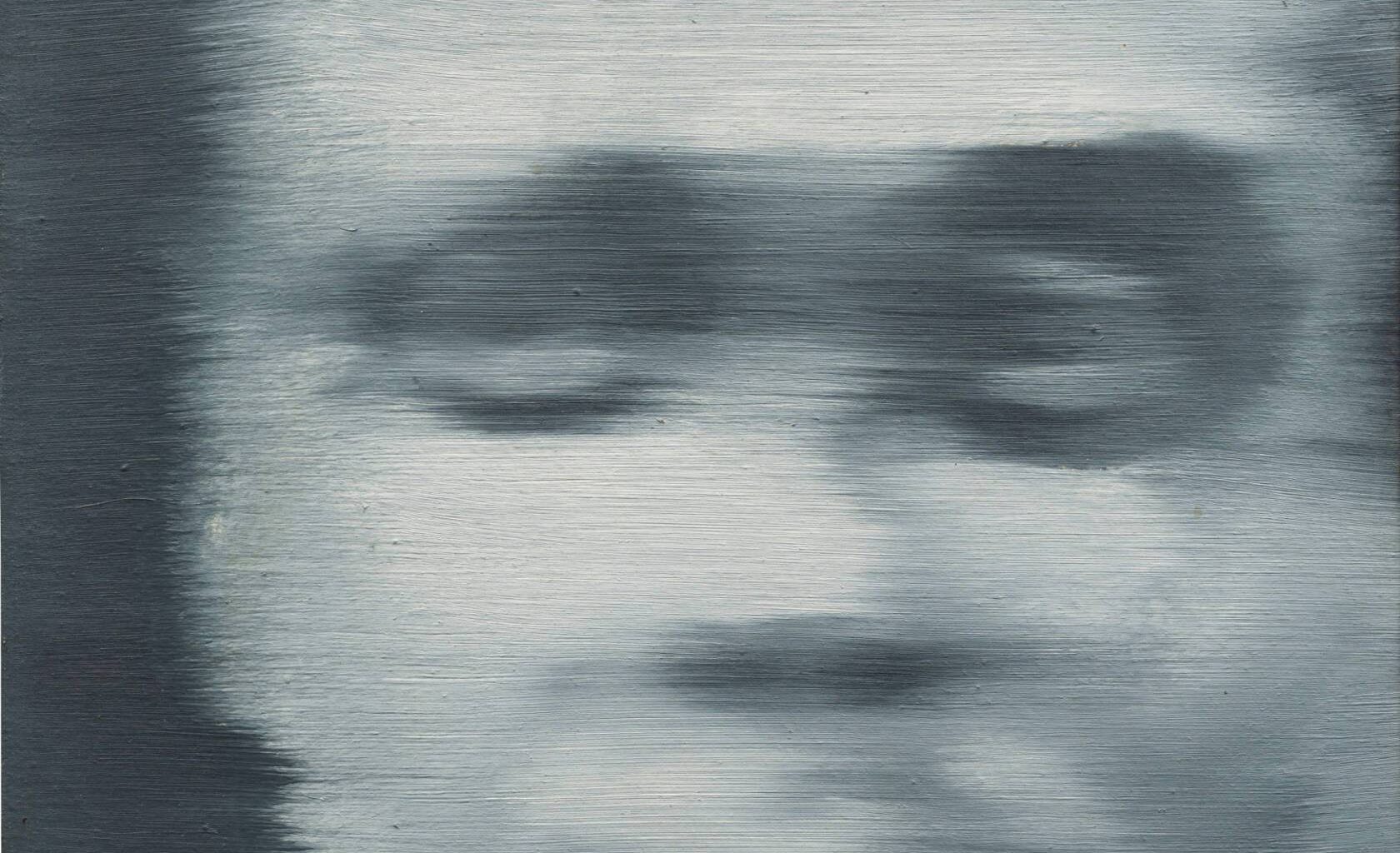
It’s hard to resist journalistic hyperbole when talking about Gerhard Richter: a quick Wikipedia search will show that he’s been called the ‘greatest living painter’, the ‘Picasso of the 21st century’ and ‘the world’s most important artist’. His friend and sometimes-antagonist, Benjamin Buchloh, who published the first full monograph on Richter in 2022, Gerhard Richter: Painting after the Subject of History, and is not inclined to such blanket flattery, acknowledges the ‘exceptional rarity and singularity’ of his work. Now, at age 94, Richter has put his brush down and announced that he will paint no more. What better time for the sweeping, life-spanning retrospective currently being held at Foundation Louis Vuitton in Paris, showcasing the full breadth of the artist’s craft and mastery.
Richter was born in 1932 in Dresden, the ‘Florence on the Elbe’ and the home of Caspar David Friedrich, to whom Richter, especially in his cloud cycles and seascapes, is obviously indebted. At age 10, he was forced to join the Deutsches Jungvolk, the Hitler Youth for teenage boys. His uncle was drafted into the Wehrmacht and killed not long after the last photo of him – which became the basis for one of Richter’s early pieces, Uncle Rudi (1965) – was taken. In 1941, his aunt, Marianne, whom he also memorialised in an early blurred work, was institutionalised for schizophrenia and starved to death under the Nazi euthanasia programme. In February 1945, days after his 13th birthday, Dresden was firebombed by the Allies. The family, which lived just outside of town, barely escaped the destruction. He studied at the city’s Academy of Fine Art, worked for a time as a darkroom assistant, and, in 1961, fled East Germany for Düsseldorf.
The events of Richter’s childhood are the subject of his early work. A black-and-white series titled Aeroplanes (1963-66), based on photographs taken from magazines and newspapers, depicts silver bombers dropping columns of shells through a hazy-grey skyscape. It already displays Richter’s famous blurring technique, in which a brush or squeegee is dragged across the canvas before drying, giving a sense of motion to static images. Richter would continue the theme of ruinous cities a few years later in Townscape Paris (1968), rendered in disintegrating strokes, its grid melting into incoherence. One of these landscapes, resembling an aerial reconnaissance or satellite image, taken from thousands of metres up, is printed on a mirror, giving it the specular quality of a Daguerreotype (the first photographic medium), in which the viewer finds themselves conscripted into the image as its own reflected subject.
In Richter’s painting, there’s always a limit to the image: one sees different things depending on how close or far away one is from the canvas. One piece, 128 Details from a Picture (1978), looks like a series of flyby snaps of the lunar surface, or a desert landscape from high altitude, so far away that they almost become an abstraction. They are, in fact, close-up photos of brushstrokes on a single canvas under different angles and lighting. Extreme nearness and extreme distance produce the same effect. His Annunciation After Titian (1973), a cycle of five pieces, adapted not from the original 1540 painting but from a postcard, a giftshop reproduction, blows up the image (lowering its resolution) and streaks it so heavily that it devolves into hallucinatory swathes of light and colour. Another, Grand Curtain (1967), is large enough that the viewer feels swallowed by the canvas, forcing the eye to relax and let go, at which point, its folds begin to blur, like op art, merging and resembling television noise.
‘Noise’, i.e. the granular static of digital photography, radio and television signals, which causes images to blur, is an intrinsic element in Richter’s work. The blurring effect that is Richter’s signature is, after all, not something that happens in painting. Paintings don’t blur. Photographs do. The luminant and chromatic noise of images are essentially technical failures. A photograph blurs because of haste, poor technique, or unfamiliarity with conditions. The blurring of oil on canvas is exactly the opposite. It is slow, deliberate, all technique. It requires tremendous focus to achieve the illusion of the unfocused. The use of the squeegee is doubly ironic, for what is a squeegee but a cleaning instrument, a means of making something clearer?
One of Richter’s most famous series is 18 October 1977, 15 grey-scale paintings based on a set of police photographs taken of three dead members of the Red Army Faction in Stammheim Prison, images that, like the photos of the death camps, have been seared into German cultural memory. Richter painted the series in 1988, over a decade after the events, and so the blurring of the images takes on an historical dimension. The most striking is the image of Ulrike Meinhof, who hanged herself in her cell: her prone profile illuminated by a flashbulb, mouth turned up to the sky, a strangulation ring around her neck. The deaths of Andreas Baader, Gudrun Ensslin and Jan-Carl Raspe were reported as suicides, but a conspiracy that they had been murdered by the prison guards at the direction of the West German government quickly metastasised, leaving the case unresolved in the national consciousness. ‘Their presence,’ Richter said of the series, ‘is the horror of the hard-to-bear refusal to answer, to explain, to give an opinion.’ Indeed, embedded in these pieces is an essential inexplicability: the events cannot be forgotten, yet cannot be faithfully remembered.
As with the Birkenau series (2014), the traumatised imagination has been shaped by the photographic capture of these calamities, which exist somewhere between record and memory. It also reminds us that photography is forensic and a form of evidence: the great crimes of the 20th century were documented as images. But there is a way in which a photograph comes too late. It is always après; the thing it captures is gone before it can be developed (as Susan Sontag pointed out, the images most associated with the death camps were taken only after they were liberated). It is this ‘afterwardness’, or après-coup, as Freud defined it, that dooms us to a ‘mode of belated understanding’. Richter has made no secret of his admiration for Freud, for whom remembering is a kind of technique to be honed, and his work occupies the same traumatogenic space of dream, memory and desire. This is not only necessarily human, it is quintessentially German. After the 20th century, we cannot afford to forget, and do so at our peril.
Having grown up with Socialist Realism, the cult of the grey and green, the wheatfield and hammer-wielding workers, Richter has always eschewed any ideological incursions into his work. His pieces are, he insists, profoundly anti-ideological. Ideology, after all, is a way of seeing. There’s a reason we use terms like ‘outlook’ or ‘worldview’ when talking politics, economics, religion. The latter word, appropriately, is of German origin – weltanschauung – implying that the present, history, reality, are things that we look upon as if they were images, a ‘world picture’ in Heideggerian terms.
Richter’s big abstracts are wondrous: Flow (2013-16), bleeding blotches of Kandinsky colours pressed between plates of glass; Strip (2011), based on a scan of a previous work, in which Richter used a computer programme to divide the image into 8,190 narrow colour bars that race horizontally across a long, aluminium plate. His Grey series, which spans decades: slate and charcoal canvases, richly graded and textured –impossible to absorb by looking at online – that seek, by Richter’s own admission, ‘to make nothing visible’. Or 1024 Colours (1973), a grid of pigments that looks like a pixel matrix, the raw data of digital vision, disrupting all conventions of chromatic harmony. Richter assigned each colour a numeric value, the way a printer does, and then drew lots by writing the numbers on strips of paper or balls in a tumbler. Richter, an atheist, would use the same colour grid to glass the windows of war-ruined Cologne Cathedral, passing up beatific scenes for something coldly Newtonian.
If there is a single theme that infuses and informs Richter’s oeuvre, it is the limits of images. This is perhaps best expressed in an exemplary series of six oil-on-linen pieces, Silicate (2003). At first glance, they look like fractal grids, blurry Sierpinski gaskets, but what they actually depict are the electron shells of silicate dioxide, a compound essential to glass, fibre optics and superconductors. The original photos were taken from an article Richter saw in the Frankfurter Allgemeine Zeitung, captioned ‘First Look into the Inside of an Atom’. The images were not taken with ordinary microscopes, and are thus not optical, but via electron-tunnelling microscopes that ‘feel’ the surface of the molecular structure, scan it and then computer generate an image. The ‘picture’ is therefore a fiction. The molecular structure of silicate minerals is a tetrahedron, one of the Platonic Solids, which, before atomic theory, were considered to be the fundamental building blocks of reality. The Silicate series, which is at once a simulacrum, a painting of a simulacrum, and a phenomenon invisible to the naked eye, is a commentary on the act of observation itself, showing where knowledge falters at the edge of what we can see.