
The world is facing a climate crisis and a plastic waste crisis. Aarhus University chemist Troels Skrydstrup and his team think there might be a way to address both problems at once.
“We need millions of tons of [carbon capture] materials” to meet the Intergovernmental Panel on Climate Change’s expected need for carbon dioxide removal, Skrydstrup says. Meanwhile, the world produces over 400 million metric tons of plastic every year, according to the United Nations Environment Programme. Perhaps, Skrydstrup wondered, some of that “enormous amount of material that we don’t know what to do with” can somehow be converted to carbon-capturing materials.
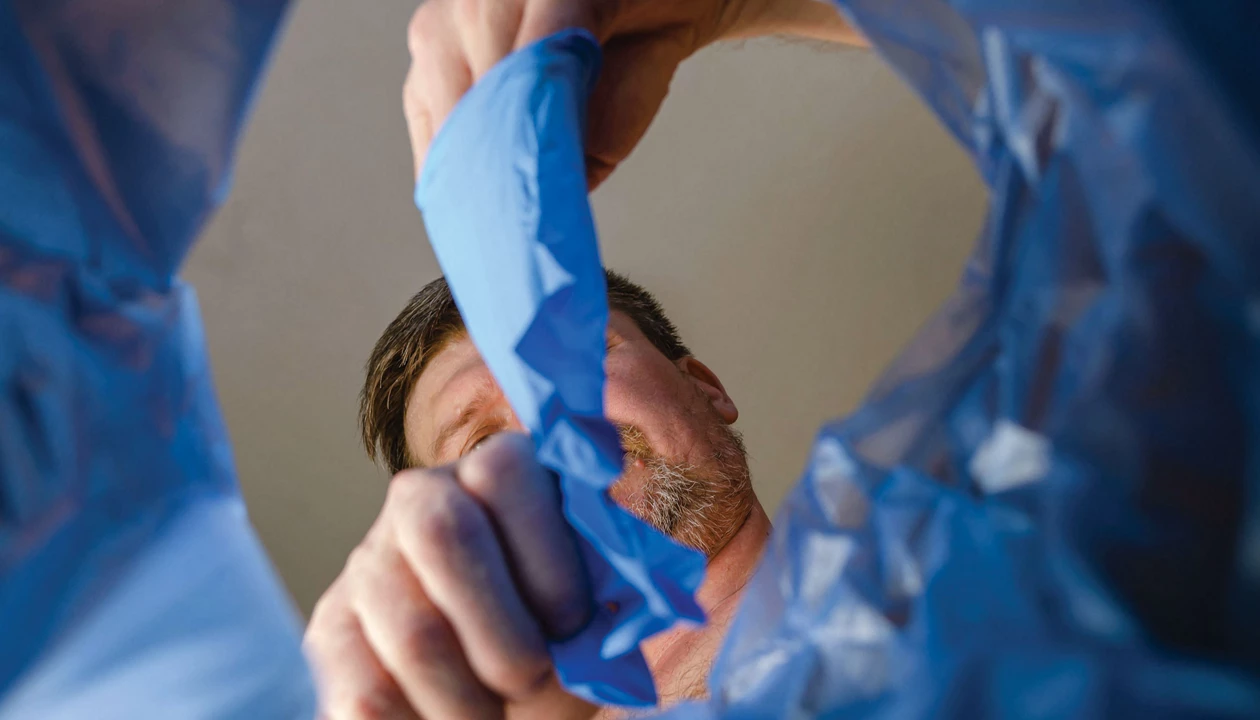
Skrydstrup and his team recently debuted their efforts to turn nitrile rubber, of the kind used in laboratory and medical gloves, into polyamine membranes that sequester carbon dioxide (Chem 2026, DOI: 10.1016/j.chempr.2025.102918).
Many carbon capture systems rely on amines that nab CO2 molecules to form carbamates and bicarbonates. Nitrile rubber was an obvious starting point for upcycling, because nitrile groups can be turned into amines in a single hydrogenation reaction.
Postdoctoral fellow Simon Kildahl screened a variety of catalysts for their ability to hydrogenate nitrile-butadiene rubber. He ultimately landed on a commercially available ruthenium pincer complex as the most efficient for converting the cross-linked rubber found in lab gloves.
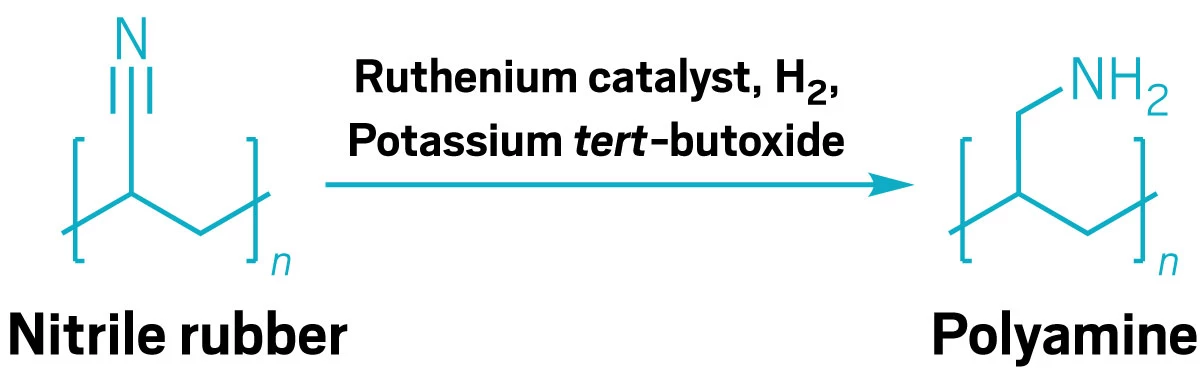
A reaction scheme showing nitrile rubber being converted to a polyamine by hydrogenating the nitrile groups using a ruthenium catalyst.
Nitrile rubber can be converted to a polyamine by hydrogenating the nitrile groups.
Kildahl also investigated procedures for installing additional nitrile groups through hydrocyanation on the polymer’s carbon-carbon double bonds before the hydrogenation step. Hydrocyanation also opened the possibility of starting with styrene butadiene-styrene rubber, found in a variety of products, including shoe soles.
The real test, Kildahl says, was whether the glove-derived polyamines would function well as carbon capture materials. He was pleasantly surprised, he says, that “they can actually capture quite a bit of CO2, even though they’re nonporous.”
When exposed to conditions typical of industrial flue gas—90 °C and 10% CO2—the upcycled polyamines showed capacities between 0.50 and 1.25 mmol/g, close to the reported capacity of a metal-organic framework (MOF) called CALF-20 under the same conditions. The MOF showed overall better performance under most conditions, but the recycled membrane shows promise at high temperatures, Kildahl says.
Kildahl and Skrydstrup’s hypothesis is that at temperatures above approximately 80 °C, CO2 molecules easily hop between the amine groups and end up migrating into the bulk of the polymer, boosting its capacity. They say they plan to continue refining their upcycled carbon capture materials; that includes trying to identify more efficient and less expensive catalysts and to improve the polyamines’ oxidative stability.
Régis Gauvin of the Paris Institute of Chemistry Research, who studies sustainable polymer chemistry and catalysis, says that as a proof-of-concept study “the work is very nicely done.” The relatively large amount of precious metal catalyst required would be an obstacle for scaling the process, though that’s a common issue with academic upcycling research, he says. “It’s good for advancing the scientific knowledge of mankind. But we hope to go beyond that.”
Enrico Andreoli, a chemical engineer at Swansea University who works with polyamines for carbon capture, says the work presents a creative solution to some very complex challenges. He has investigated similar polyamines for direct air capture, and it’s “very good news” that it could become possible to make them from plastic waste, he says. “I think that the way forward is to work more and more in upcycling.”

Chemical & Engineering News
ISSN 0009-2347
Copyright ©
2026 American Chemical Society