
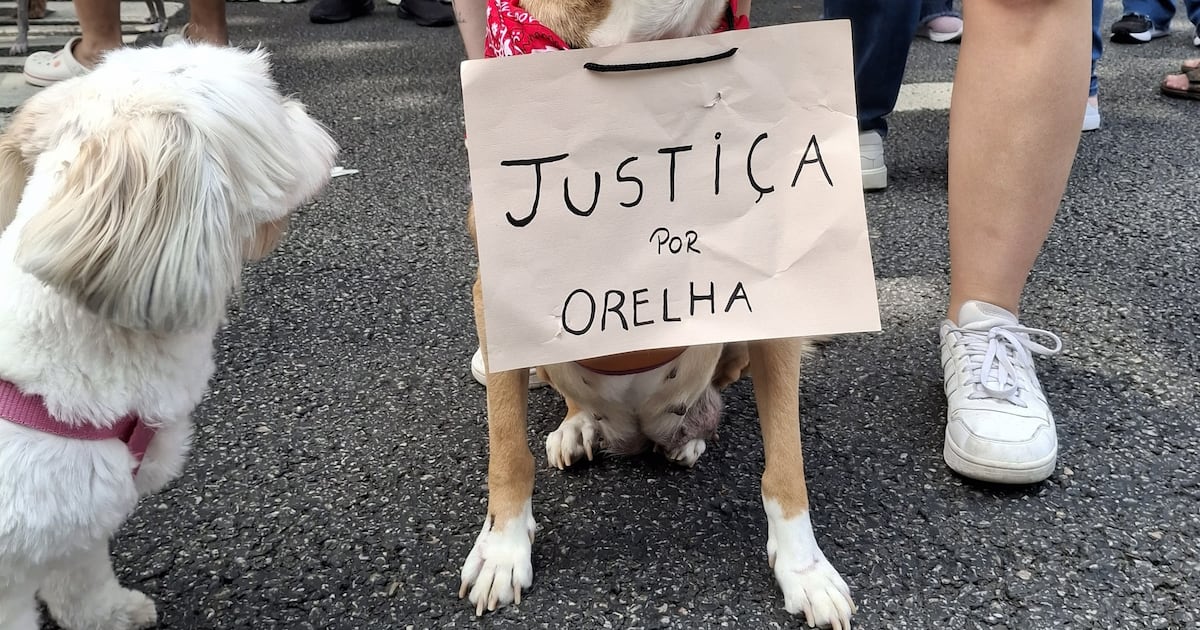
As street dogs go, Orelha was one of the lucky ones. Though he had no owner, this gentle mongrel was well loved and looked after by the local community of Praia Brava, a tiny beachside neighbourhood in the southern Brazilian city of Florianópolis.
But then early last month poor Orelha’s luck ran out. After the alarm had been raised about his disappearance it was one of his local carers who found the 10-year old mutt hidden under a parked car, the victim of an assault. He had suffered serious wounds to his head and was rushed to a vet. But so grave was the trauma, the decision was taken to put him out of his suffering.
Since then, grim details of the case have come to light; video evidence from security cameras in particular. This appears to show a group of adolescents trying to drown one of Orelha’s canine street buddies the night he disappeared. And a witness was later intimidated by relatives of the gang which had a reputation for trouble.
Orelha’s terrible fate has convulsed Brazil, mobilising street protests and petitions for stronger legal protections for animals. In a country where so much violence has left the population inured to often shocking atrocities, some with much higher human death tolls, the question is why has Orelha’s fate cut through this resignation?
In part, it is the contrast between photos of Orelha’s big friendly smile and the violence of his end. Globally, Brazil’s pet dog population is second only to the one in the US. In recent years, there has been a huge movement to stimulate the adoption of vulnerable street dogs like Orelha. Millions of homes across Brazil saw his photo and looked at their own four-pawed loved ones and felt this case viscerally.
Also, his widely reported trusting nature and how this left him vulnerable to those who would do him harm seems to have resonated widely with Brazilians, proud of their reputation for friendliness but exasperated by their society’s endemic violence which has made so many of them its victims.
And then there are the reports about the suspects and their families. The adolescents identified by police are apparently from well-off, well-connected backgrounds. Police had to wait until two of them returned from a trip to Disney before seizing their phones and summoning them for questioning.
There is already much speculation, claims and counterclaims, circulating about the alleged perpetrators and the role of adults in the aftermath of the attack on Orelha. But three relatives of the suspects have been charged with obstruction of justice after an alleged attempt to intimidate a witness. Worse, the judge initially in charge of the case made a series of decisions that appeared designed to impede an investigation already subject to questions about its handling before recusing herself, citing her close friendship with the family of one of the suspects.
This apparent effort to thwart justice infuriated many Brazilians, beyond fed-up with seeing evidence of wrongdoing proving incapable of holding wealthy, well-connected people to account.
[ Lula’s last lap: Brazil enters a fraught election yearOpens in new window ]
The danger in Brazil is this strengthens the appeal of bad ideas. In the case of Orelha, many are calling for a lowering of the age of criminal responsibility, long a demand of the hard right. Vigilantism is also in the air. The young suspects have not been named by the police but identities and photos were all over social media, only for it to turn out that one of them had no involvement. These postings have been accompanied by violent threats.
It would be a tragedy if understandable anger at the killing of Orelha boosted those calling for the lowering of the age of criminal responsibility. On its own, this is not going to reduce Brazil’s high levels of violence and would likely become another weapon in the country’s long war on its own poor, who have few of the resources to play the system to escape justice for wrongdoing.
And in Brazil, vigilantism, devoid as it is of due process, inevitably devolves into the most vicious method by which the country’s strong prey on the weak.
Better for Orelha’s case to be investigated and prosecuted promptly and rigorously. And among some of the more sensible suggestions for punishing those responsible is that they be forced to work in dog shelters until they properly comprehend the terrible consequences of their actions.
[ Brazil offers lesson in winning in Trump’s economic ‘Taco’ trade styleOpens in new window ]
As important is that the adults accused of wrongdoing in the case also be fully held to account. The charges against them mean many Brazilians are in no doubt that a foul deed has been compounded by a display of parenting that reveals the deep origins of the crime on Praia Brava.
Dismantling this sense of impunity among Brazil’s privileged would seem to be the country’s best shot at a future where everyone, even the most vulnerable, even a street dog, can live and die with dignity.
But in reality few think any of this is likely to happen.