
A chief executive of an Australian think tank has warned younger men are dating less, marrying later, and struggling more with their mental health amid a housing crisis.
Page Research Centre CEO Gerard Holland spoke at the Aspire Conference in Sydney this week to talk about Australia’s biggest politcal, economic, and social issues.
“Young people want to build their lives on a firm foundation, not on the uncertainty of a volatile rental market and a one-bedder apartment in Zetland or Strathfield,” he said during his speech.
He added there is such little hope to achieving the Australian dream upon which our social contract between generations has been built.
“It any wonder that more and more young people are identifying as depressed and pessimistic about the future?”
Mr Holland told Sky News host Steve Price that Generation Z men are struggling to find identity, purpose and aspiration in modern Australia, while being told from educational and cultural messaging how to view themselves.
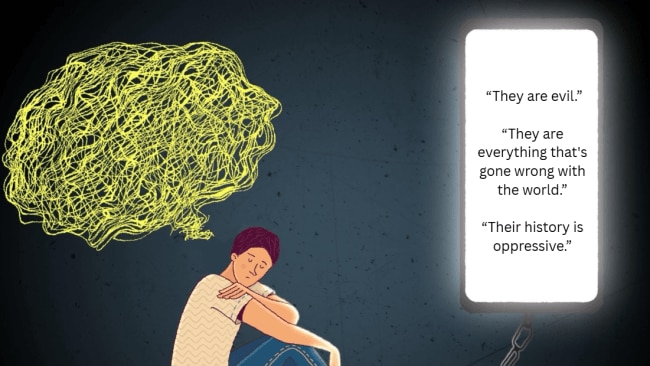
“What has happened is young boys, and particularly young white boys, have been told that they are the baddies. They are evil. They are everything that’s gone wrong with the world. Their history is oppressive,” he claimed on Friday.
“I think a lot of young men are feeling, well, what place do I have? Where do I find an identity? What is my story?
“How can I be aspirational in this country when increasingly from every I’m being told that I’m the problem.”
Generation Z – broadly defined as those born between the late 1990s and early 2010s – now spans teenagers through to adults nearing the age of 30.
Mr Holland pointed to worsening mental health outcomes among young men, arguing the issue extends beyond the challenges faced by earlier generations.
He said around a third of young Australian men identify as having a serious mental health disorder, about 10 per cent experience substance abuse issues, and suicide has overtaken car accidents and disease as a leading cause of death among young males.
Australia is also an outlier internationally, with young men taking their lives at roughly three times the rate of young women – higher than the global average gap.
“I think undoubtedly a lot of young men are retreating and be that to video games, pornography,” Mr Holland claimed, adding that data shows increasing social withdrawal.
“They’re not getting married, they’re not having kids, they’re not going on dates, they’re not having sex. This is increasingly the ‘sexless generation’ compared to their forebears.”

Economic pressures were identified as a major contributing factor, particularly housing affordability and declining rates of home ownership among younger Australians, which he said historically provided a sense of stability and long-term aspiration.
“I think there’s a lot can be done. I mean, housing affordability is a big one. I mean under 35’s had the lowest home ownership on record. So it’s just under a third in the eighties. It was around 60 per cent. So there’s been that collapse. And that of course has, you know, delays other life milestones and so getting the housing crisis under wraps I think would be some immediate relief,” Mr Holland said.
A Westpac report found that more than one in three (35 per cent) of Gen Z Australians plan to buy their first home within five years, up by five percentage points since January 2025.
According to the Home Ownership Report, younger Aussies have been doubling down on their bid to own a home, with 37 per cent fuelled by a desire for independence, and 34 per cent of buyers motivated by financial security.
Rent also contributed to 32 per cent of Gen Z buyers’ reasons for wanting to buy a home, with many daunted by the idea of renting forever.
The CEO of Page Research Centre also argued education systems and public institutions should place greater emphasis on national history and positive identity formation.
“They aren’t guilty by association…they too can have an incredible part to play in our Australian story, and we need to believe in them, tell them that they’re needed, that they’re wanted and that they’re loved,” he said.
“That kind of focus in our education, that kind of language from government, that kind of story from our media institutions, I think will go a long way to giving boys a place and really giving them encouragement.”