
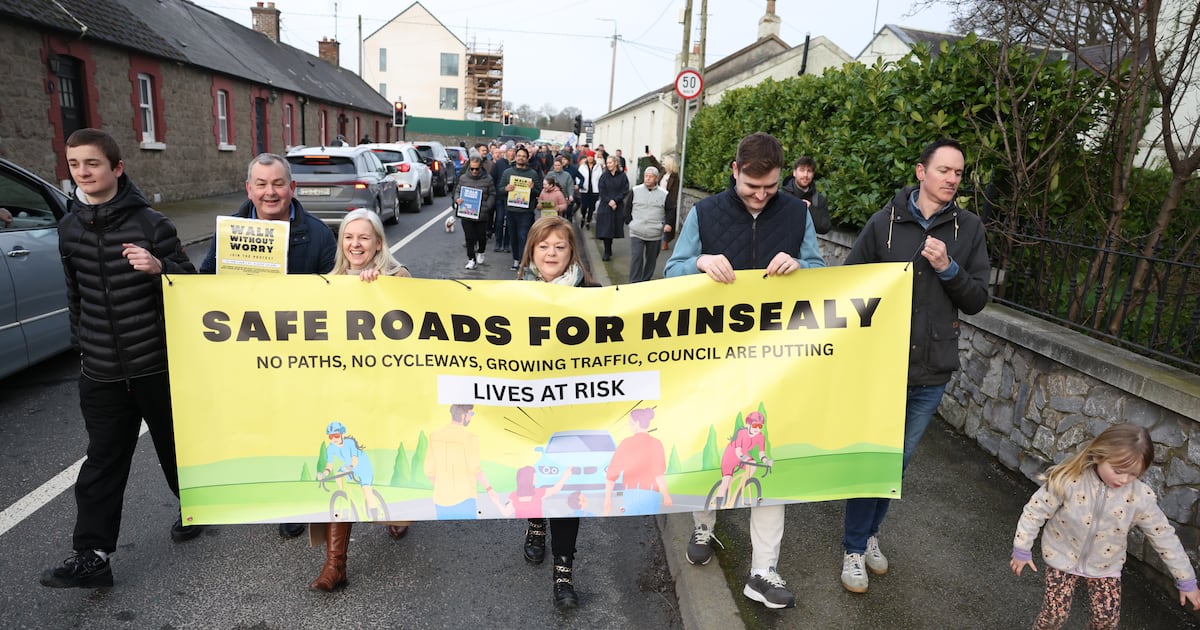
Over 100 people marched along a dangerous local road in north Dublin on Friday morning, slowing down traffic in protest over a lack of transport infrastructure for pedestrians and cyclists.
Residents of Kinsealy, a Fingal suburb, have been asking for basic pathways and cycle lanes along a route that is essential for children going to school and commuters heading to work. They are also calling on Fingal County Council to deliver a greenway from an estate in Kinsealy to Portmarnock train station.
Sharon Finn moved to Kinsealy four years ago, having previously lived in Germany. She has two boys, and as well as wanting to be closer to family, access to the local school was a big factor in her decision to come back to Ireland.
“We researched the local area development plan and talked to different people in the area about the facilities,” Finn says. “Everything had been promised.”
Unfortunately, very quickly after arriving in the area, Finn says, the “full extent of the reality of the lack of infrastructure hit home”.
“My older son was nearly knocked down in front of me by a car about three days after we moved in,” she says. “At the time, there were no traffic calming measures on Chapel Road, and there was a car coming at about 80km/h in front of me. He barely got in on to the path, and that’s what started this for me.”
The march began near St Olave’s Square in Kinsealy and continued over the 2km to Portmarnock train station, passing through a particularly treacherous junction at the intersection of Chapel Road, Malahide Road and Baskin Lane.
If the greenway were created leading from the Newpark estate to the train station, that journey would be reduced to less than a kilometre and would become safe for cyclists and pedestrians.
“You get to the Baskin Lane junction and there’s no pedestrian crossing,” Finn says. “You have to put your hand out to stop three different ways of traffic, just to get my child to a school that is absolutely within walking distance. This is what spurred us.”
Kinsealy is a growing area with a host of young families. A new housing development, Haley’s Hill, is in the process of opening, and there are proposals to rezone more land in the area for residential property. Those protesting on Friday understand the need for more houses, but believe infrastructure is failing to keep up with the increase.
“All of these families will be accessing school here, they’ll be accessing bus routes and they’ll be getting into their cars to drive to Portmarnock train station,” Finn says.
She says a young boy was knocked off his bike on Chapel Road, and a lady knocked down at a nearby junction, within the past few months. “I’m personally worried that somebody is going to get killed,” Finn says.
Social Democrats Councillor Joan Hopkins has been a member of Fingal County Council for five years. She says she has been raising the issue of transport infrastructure in Kinsealy throughout that time.
“Anybody living here can’t get to the school without going on the road,” she says. “Can’t get to the creche, and I’m talking about a creche that could be 200 metres from your house but you have to go out on to the road.”
Hopkins says that when Fingal County Council gave developers permission to build Haley’s Hill, they had “conditioned them to upgrade the junction into Baskin Lane”, but An Bord Pleanála ruled there was no obligation for developers to fund the improvements to infrastructure.
“There’s no legislative framework in the country to obligate either a developer or the local authority to make a provision for footpaths to local amenities,” Hopkins says. “We’re building islands of homes that are totally disconnected.
“So, this is where we’re at. Eventually, these upgrades will happen, but the taxpayer will pay for it rather than the developer. People keep saying to me, and I can’t argue with it, that when you’re building estates you need to build infrastructure along with them.”
Ann Graves, a Sinn Féin TD for Fingal East, also believes developers should have to contribute to local infrastructure as part of the planning process for projects in areas lacking appropriate transport facilities.
“Infrastructure for kids trying to get to school is an easy fix, I would think,” she says. “There’s planning permission [granted] for new estates, and they’re not looking at the infrastructure that’s needed long-term. Right around Fingal east, this is a problem.
“Nobody is saying no to houses – we need them desperately and we know that. But when they’re doing it, they need to be putting the infrastructure in place.”
Protesters lay the immediate blame at Fingal County Council’s door, and have asked them to commit to a two-year delivery period for crucial infrastructure from now.