
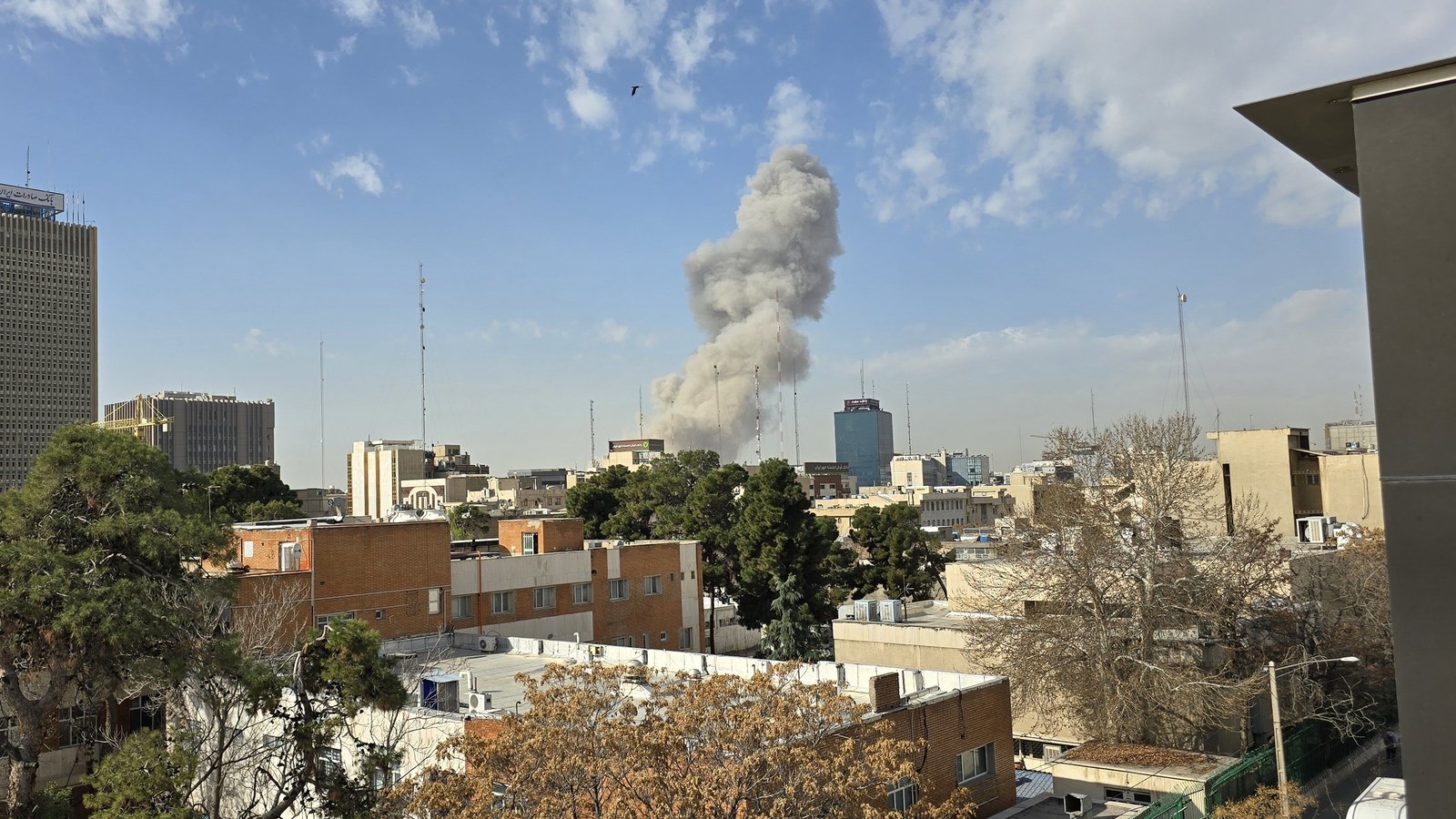
Israel’s defence ministry has announced it has launched a “pre-emptive strike” on Iran as sirens sounded in Jerusalem and people across the country received phone alerts about an “extremely serious” threat.
“The State of Israel has launched a pre-emptive strike against Iran. Defence Minister Israel Katz has declared a special and immediate state of emergency throughout the country,” read a statement from his ministry.
Tehran is preparing for retaliation after the attack, with the response set to be crushing, an Iranian official told Reuters.
An Israeli defence official has said that the operation was co-ordinated with the US and the operation was planned for months and was decided a week ago.
The New York Times, citing a US official, reported that US strikes on Iran were under way.
CNN, citing an official, said the US strikes on Iran are focused on military targets.
A source told Reuters that Iran’s supreme leader, Ayatollah Ali Khamenei, was not in Tehran and had been transferred to a secure location.
The attack, coming after Israel and Iran engaged in a 12-day air war in June, follows repeated US-Israeli warnings that they would strike again if Iran pressed ahead with its nuclear and ballistic missile programmes.
Two loud blasts were heard in Tehran this morning by AFP journalists, and two plumes of thick smoke were seen over the centre and east of the Iranian capital.
“The type of explosions suggests that this is a missile attack,” the Fars news agency reported, without immediately providing further details.
Iran has closed its airspace until further notice, following multiple blasts in the capital Tehran and elsewhere, the civil aviation agency said.
“The airspace of the entire country is cosed until further notice,” announced the spokesman of Iran’s Civil Aviation Organisation, quoted by Tasnim news agency.
The Jerusalem municipality ordered schools and workplaces to close on Saturday after Israel launched strikes on arch-foe Iran, saying the closure would be in effect until 6pm Irish time on Monday.
“In accordance with the assessment of the situation by the Home Front Command and the launch of a preemptive strike against Iran, it has been decided to change the guidelines and transition from full activity to essential activity throughout the country,” it said in a statement.
“There will be no educational activities, no gatherings, and no going to work, except for workers defined as essential. This policy is in effect from Saturday (2/28) at 8:00 am (0600 GMT) until Monday (3/2) at 8:00 pm (1800 GMT)”.
US designates Iran ‘state sponsor of wrongful detention’
Meanwhile, the US designated Iran a “state sponsor of wrongful detention,” its first such move under a new blacklist that could eventually result in a travel ban.
The step comes as the United States builds up its military near Iran and threatened to strike over concerns led by its disputed nuclear programme.
“The Iranian regime must stop taking hostages and release all Americans unjustly detained in Iran, steps that could end this designation and associated actions,” US Secretary of State Marco Rubio said in a statement.
If Iran makes no progress, Mr Rubio said that the United States could eventually decide that US passports are invalid for travel to Iran.
The United States only forbids its nationals from traveling to one country – North Korea – and many Iranian-Americans routinely travel to Iran, ruled since 1979 by clerics after the overthrow of the pro-US shah.
US President Donald Trump in September signed an executive order that created the blacklist on wrongful detention, similar to designations by the United States on terrorism.
Iran becomes the first country to be placed on the blacklist. It has detained a number of Americans in recent years, usually dual nationals whom the government considers Iranian citizens.
“No American should travel to Iran for any reason. We reiterate our call for Americans who are currently in Iran to leave immediately,” Mr Rubio said.
Meanwhile, Mr Trump said he did not want Iran to have any uranium enrichment at all, even for civilian purposes, a day after the US and Iran held talks on nuclear and other issues.
“I say no enrichment,” Mr Trump told reporters ahead of an event in the Texas port city of Corpus Christi.
“Not 20%, 30%, they always want 20%, 30%, they want it for civilians. I think it’s uncivil,” he added.
President Trump also reiterated that he was “not happy with the negotiation.”
It comes as Oman said that Iran agreed during the talks to never stockpile enriched uranium, in what was called a breakthrough that would hopefully prevent war.
“This is something completely new. It really makes the enrichment argument less relevant, because now we are talking about zero stockpiling,” Omani Foreign Minister Badr Albusaidi told CBS News programme ‘Face the Nation.’
The Trump administration has repeatedly accused Iran of intending to build a nuclear weapon.
But “if you cannot stockpile material that is enriched then there is no way you can actually create a bomb,” Mr Albusaidi told CBS.