
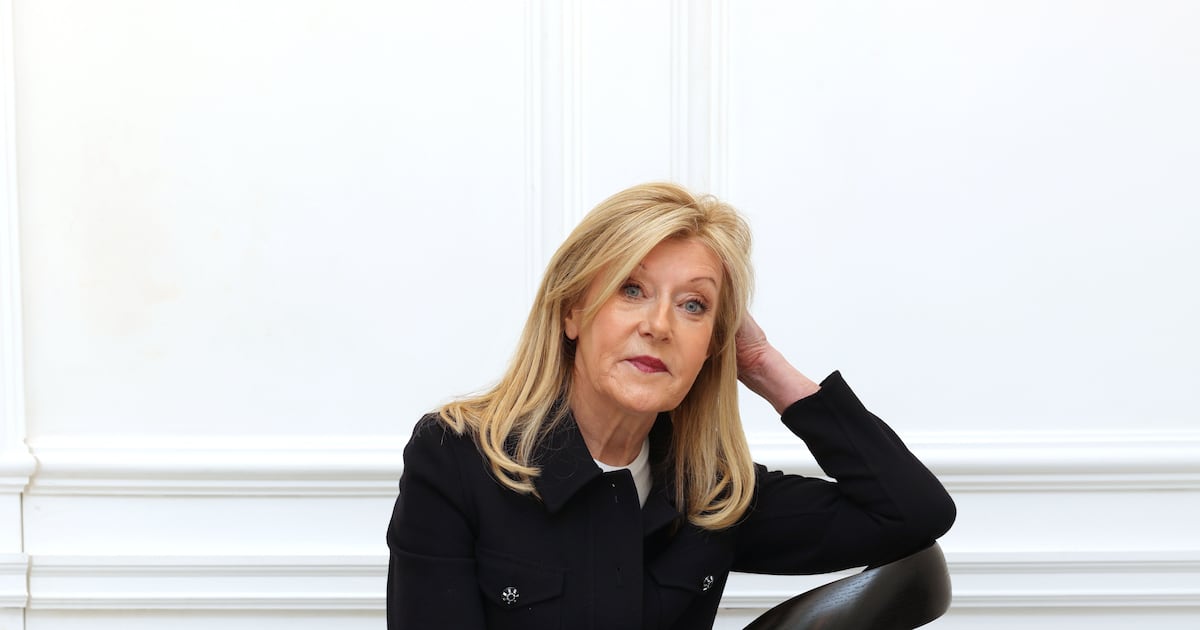
Sunburst-motif mirrors welcome customers ringing the bell of Louise Kennedy’s four-storey Georgian Dublin townhouse. Inside, the ground floor gifting rooms are spotted with art deco-inspired bottle-stoppers and crystal-adorned ceramic egg candles. Purples and pinks pop out from the rails of the first-floor fashion rooms, where later I spot the black lurex tweed biker jacket Kennedy is wearing for our interview.
There’s sadly no sign of the star of her Instagram page, Paddy Paws, the 11-year-old miniature Schnauzer who has “two mummies”: the designer and her younger sister, public relations guru Caroline Kennedy.
“He’s beloved in the office. I think every office needs a dog – well, I would say a schnauzer because of their intelligence and chutzpah. We have clients who literally will say, ‘What are you doing with [the likeness of] Paddy this season?’ He’s been on a sweater, he’s been bejewelled, he’s been woven into a little mini-skirt. I’m not obsessed.”
She apologises for all the steps as she leads me up the staircase and we leave the grandeur of her luxury brand’s elegant Merrion Square store, open since 1998, for the comfort of her home, where I feel abruptly cautious about letting my pen anywhere near the sofa.
When Kennedy is in town she lives above the shop, on the top two floors of the restored building, though she is “always on a plane”, spending half her life in London, close to the Belgravia store she opened in 2000. She is often in Italy, where her clothes and handbags are made, and in New Delhi, where the hand-beading and embroidery is completed and where she could “easily spend 70 nights a year”.
In January she was in Milan for the “especially busy” Milano Unica, a high-end textile and accessories fair showcasing fabrics for spring-summer 2027.
With this year’s spring-summer collection arriving in and work on 2027’s clothes now under way, Kennedy and her design team have also been busy tweaking the autumn-winter 2026 collection, placing their final fabric orders so it can be stocked in London before the summer.
“We’re very fortunate that our flagship store in London is extremely busy from May or June onwards, when a small segment of our Middle Eastern clients come to get away from the heat of the Gulf. So we like to have our major hero pieces for autumn-winter in early,” she explains.
This is not how she tends to shop herself.
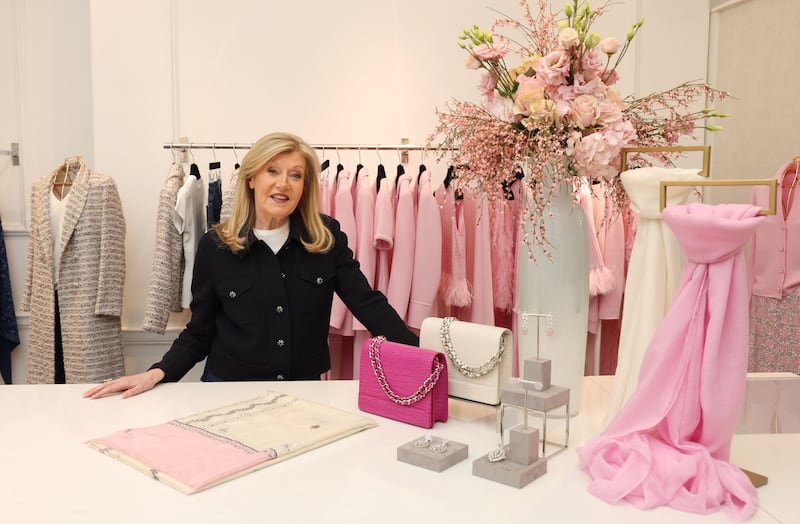 Fashion designer Louise Kennedy at her Merrion Square premises. Photograph: Alan Betson
“I like to try to stay on season. If you’re going on holiday in September and decide to buy some nice beachwear, there’s nothing worse than walking into a department store in August and finding it’s all cashmere coats and rollneck sweaters.”
But fashion is about evolving to meet the wants of your clients – it’s “dialogue”. It’s also about looking to the future, which she is now doing in more ways than one.
When asked what she is most proud of, she cites the continuity of having remained in business since 1983, the year her graduate collection was picked up by Brown Thomas, where her clothes are sold to this day.
“I would hope to think I can stay involved,” she says of her wholly owned company. “We’ve had many offers for buy-ins and at some stage we will do a buy-in, but I hope it’s somebody that will bring not just finance, but expertise.”
To sell her business, or part of it, she would need to receive “the right offer”, she says, not one that risks compromising her place in the market or jeopardising her long-term relationships with mills across Europe.
“I’ve seen other brands sell, and if it’s a VC [venture capital firm], they tend to look at how to drive profitability, and they touch the quality. The one thing I always say to people – the thing that has taken us through recessions, pandemics, times when cashflow was tight – is never touch the product,” she says.
“If you in any way diminish your quality and what it stands for, it’s very difficult to bring it back.”
She has seen VCs buy into brands only to tell them “no, you can’t invest that amount per metre” and “you’re not spending that on a button”.
I learn a lot from Kennedy during the two hours I spend with her, and some of it is about buttons.
“Buttons are a major factor in what we do and we often have clients who will say, ‘Oh my god, I just love your buttons.’ We work with a third-generation Milanese company that makes jewellery as buttons, and it’s terrifying, the cost of a button, but it looks it,” she says.
Craftmanship and embellishments, and the price tags that follow, are part of the exclusivity of the brand – they’re what her clients both appreciate and expect from her.
“We do work with the best cashmere mills and best weavers in Italy and that obviously denotes where we sit price-wise. A lot of our garments are pure silk-lined, and our buttons can be a couple of hundred euros each, but they’re also what makes what we do distinctive,” she says.
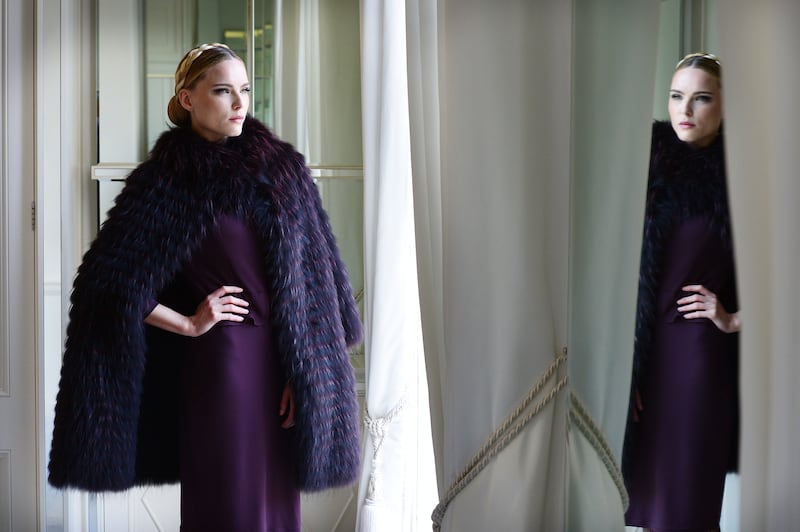 Louise Kennedy designs from 2019. Photograph: Alan Betson
“If it’s a fabric with three hues, then we’ll have fun pulling those hues from a Swarovski card to enable the stones to sit in harmony with the fabric.”
Later she emails to say the brand, which has sold an eponymous eau de parfum since 2013, will this year add a limited-edition pure perfume, “a highly concentrated composition that will of course retail at a high price point”.
Kennedy describes her brand as niche with a global audience, and her team works to secure the repeat custom of clients, who range from women executives to elite American travellers to figures in the bloodstock industry. “It’s not come in, shop, goodbye,” she says.
Referrals are important for attracting new clients – as is location.
“The windows of London are our pages of Vogue,” she says of the Belgravia store, which is surrounded by the luxury hotels and residences of SW1. “We do want to look at possibly a second store in London.”
This year she plans to host a series of “trunk shows” – events where fashion brands connect directly with customers – in the US, while the company is also “actively looking” at the Middle East.
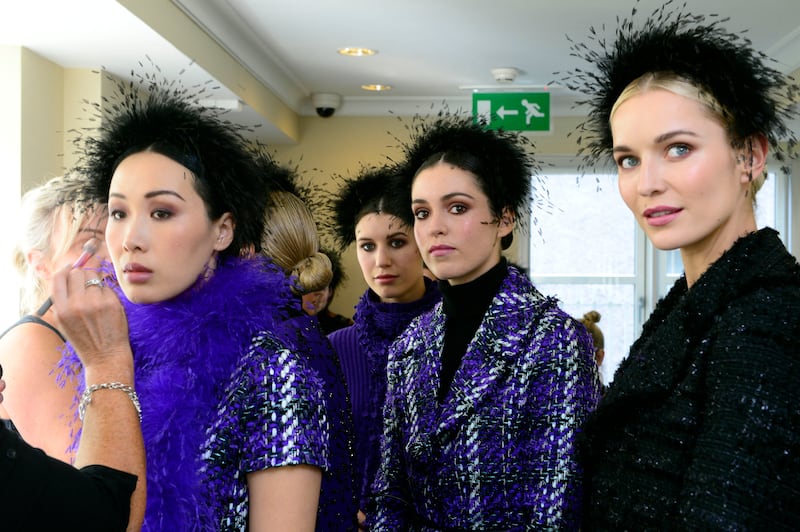 Models at the launch of the Louise Kennedy’s 2018 collection. Photograph: Cyril Byrne
“Instead of us waiting for them to come to us, we are looking into the licences needed and how we might go about Qatar in particular. We would have a lot of the sovereign family shopping with us. Kuwait is also a good market for us, and Abu Dhabi.”
Sales through her online platform are growing, meanwhile, and her outlet at Kildare Village helps bring in younger customers.
Financially, the company – which employs a young team of about 40 people – is “very comfortable” targeting “small growth” each year, and has bounced back from the pandemic, with revenues at her London and Dublin stores increasing in 2025 despite a decline in US visitors to Europe.
“But we have plans in place, because in 2026 we do want to see a stronger lift.”
Later she mentions her decision to do a “complete pivot” away from her wholesale business when she lost overseas clients during the 2008 recession. Was that the most disorienting year?
“Oh my goodness. Yes, absolutely, because that crash happened when a lot of stock had already been shipped. Not everybody reneged on paying, but we definitely lost some very big accounts.”
Fashion can be a testing industry, but it is also a fabulous one, says 65-year-old Kennedy. “No day is the same, every week is different, and it happens to suit me.”
She was born in 1960 to the late Jimmy and Rita Kennedy, who lived in Puckane, Co Tipperary. Her father, a retired hurler, worked for Minch Norton Maltings, which brought the family to Kilkenny, then Cork. When she was 10, they returned to Tipperary to live in Thurles, where her mother had been left a 50 per cent stake in her family’s drapery business, JK Moloney.
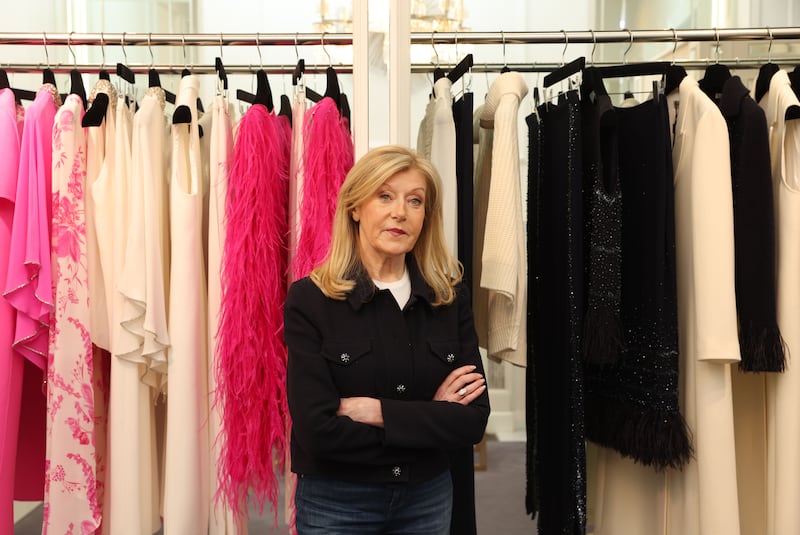 Fashion designer Louise Kennedy at her Merrion Square premises. Photograph: Alan Betson
“I think of all the five kids, I would be the one who loved to be on the shop floor. I thought it was Harrods my parents had bought.”
She wasn’t thinking about fashion design as a career, but she loved colour, loved texture, and after her time boarding at the Brigidine Convent in Abbeyleix, she studied art as part of a year-long course in Dublin – “I won’t say it was a finishing school” – and adored it. She started in the College of Marketing and Design, thinking interiors would be her focus, but when she ended up moving to the Grafton Academy of Fashion Design, her calling became clear.
After graduating, she was poised to move to New York to gain experience when her clothes featured in an International Wool Secretariat showcase organised by Eddie Shanahan, now a retail consultant. When a Brown Thomas buyer, Marie McCarthy, asked to see her graduate collection, Kennedy brought a clothes rail to their Westbury Hotel meeting and asked a friend from home to model some of the pieces.
“Marie turned round and said she had never done this before, but she was going to give me an order. And I had six months to find somebody to make it for me.”
It all feels as real to her now as it did then, she says.
In September 1983, her designs were displayed in two windows of the old Brown Thomas store on Grafton Street, where Marks & Spencer now stands. Winning the designer of the year accolade at the Late Late Show fashion awards in 1989 was another step forward. By the end of the decade, she had well and truly arrived.
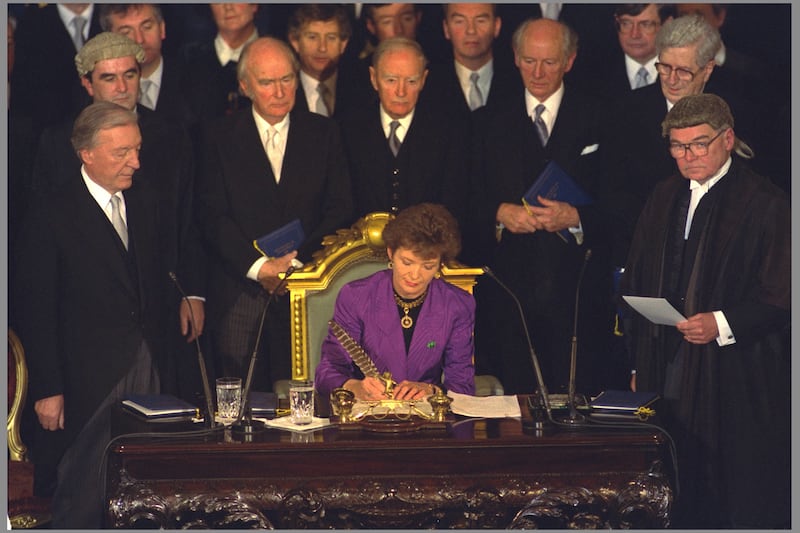 Mary Robinson chose a Louise Kennedy two-piece suit in purple silk moire for her inauguration in 1990
Then came “the Mary Robinson moment”. In 1990 Kennedy was asked to design the inauguration outfit for Ireland’s first woman president. It was “the ultimate compliment”, she says of being invited to Robinson’s home to discuss what became a two-piece suit in purple silk moire – a signature blast of Kennedy colour amid the sea of greys and blacks at Dublin Castle.
“We were only six years in the marketplace, so it was a big responsibility and a tremendous honour, and it was global news,” Kennedy says.
She has also dressed Mary McAleese, while President Catherine Connolly wore her Maya coat, Orelia blouse and Julie trousers for her inauguration last November. Kennedy says it was Michelle Curtin, head of personal shopping for womenswear in Brown Thomas, who was “very involved in pulling the look together” for Connolly, and when I say it was striking that, though the style differed, the colour echoed Robinson’s suit, she says this was by chance.
“We happened to have a purple collection. It’s part of the main line collection – it’s on our website.”
Purple does have special resonance for women, she notes. “It’s an empowering colour, a strong colour, and it has great associations for women in power thanks to the suffragette movement.”
The Instagram feedback to Connolly’s look was also “warm and effusive”, she says. “Yeah, it was really lovely.”
I mention that not everyone appreciated the inclusion of fashion details in reports on Connolly’s inauguration, believing it sexist despite the fact that her male predecessor’s wardrobe was often remarked upon. Does she think there is more sensitivity around the discussion of fashion when it concerns women, almost as if there is that residual fear of not being taken seriously?
“There is more interest [in women’s fashion], I suppose. But I don’t think it’s belittling the fact that it’s a female in the office.”
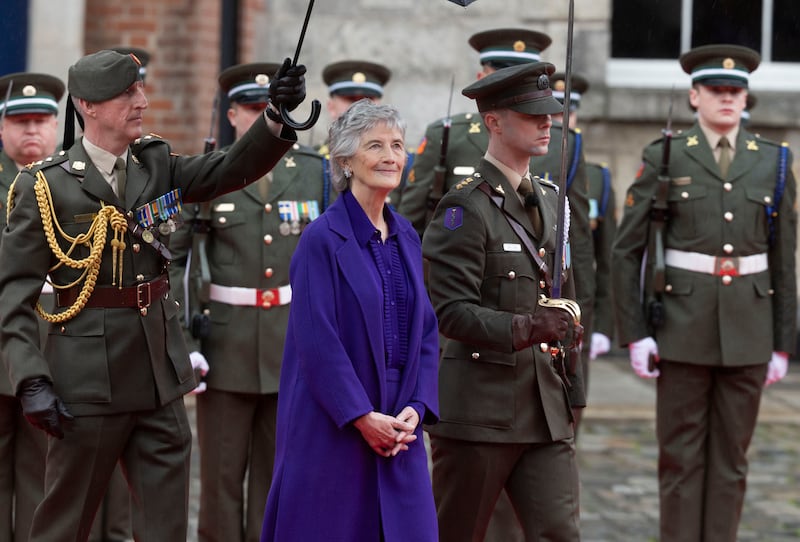 President Catherine Connolly, wearing Louise Kennedy’s Maya coat, Orelia blouse and Julie trousers, inspects the Guard of Honour at Dublin Castle after her inauguration. Photograph: Sam Boal/Collins Photos
She has a wishlist of high-profile women she would love to dress, though she’s not rushing to divulge names. “It’s not about how they look, it’s what they stand for and what they represent. That interests me maybe more.”
She has loved dressing professional women ever since US designer Donna Karan popularised her “seven easy pieces” – what would now be called a “capsule wardrobe” – in 1985.
“I just loved that concept, I thought it was so clever. And that’s why I’ve always loved looking after female executives and women who travel. It’s, like, how do you design a collection that can take you from desk to dinner?”
Each collection starts with a whiteboard and a set of “tried and classic shapes” (though they also evolve), with newness incorporated through updates to fabrics and colours, and the union of textures and prints.
[ Irish heritage meets Danish flair in Kerry designer’s debut collectionOpens in new window ]
“We’re always learning, every season,” she says.
Women aren’t slaves to fashion to the extent they were in previous eras – which is fine, as her brand caters to “investment dressers” – while women professionals are no longer obliged to stick to obvious derivations of the male template.
“She can embrace print, she can embrace colour. When I was graduating, a lot of women dressed almost in men’s tailoring. When I look back on our Eighties’ imagery, I go, ‘Oh my God, the size of the shoulder pads.’ Now there are trends that drive that big, oversized boxy shape, but at the time it wasn’t a trend, it was how they were constructed.”
We also talk about how there isn’t an event-specific “wedding look” for guests any more.
“If people are investing in clothes that cost a lot of money, they don’t want it to scream that it’s a wedding outfit. They want to know that a feathered skirt could be worn with a little white tee somewhere else,” she says, alluding to what’s known as high-low dressing.
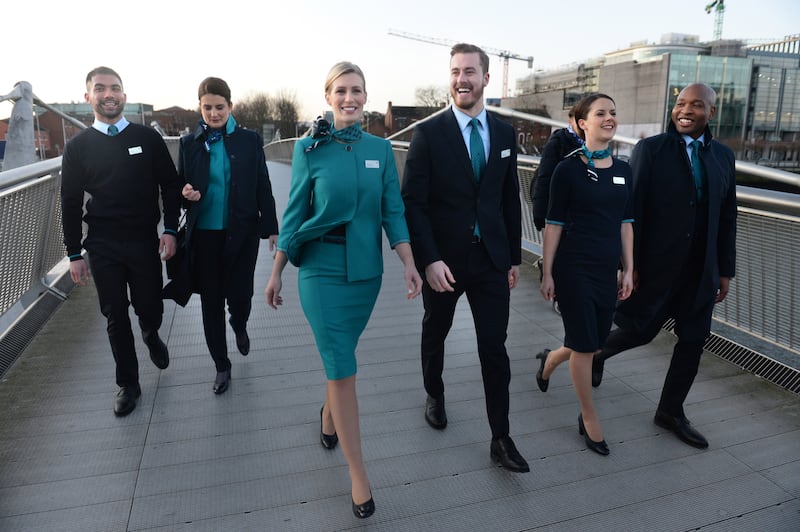 Are Lingus cabin crew members Oisin Leong, Aoife Costelloe, Victoria Elmore, David Rodgers, Eszter Dornfeld and Byron Kumbula in the uniform designed by Louise Kennedy.
Photograph: Dara Mac Dónaill
Kennedy has had the distinction of twice receiving the contract to update the uniforms of her “preferred airline”, Aer Lingus, in designs unveiled in 1998 and 2020. The second time around – in what were the first Aer Lingus uniforms to give women cabin crew the option of trousers – she refreshed its green shade, while also receiving the go-ahead to bring in “midnight navy” as a complementary colour.
“I think [the navy] is very flattering, but there was no way management would have wanted all midnight navies, because then you’re up against Air France, you’re up against British Airways.”
Along her journey through fashion there have been many other proud moments, from her commission to design robes for Supreme Court judges to her collaborations with Irish brands such as Tipperary Crystal. “Any opportunity to move outside your own domain is fascinating,” she says.
When I ask who her influences were, the first people she mentions are her parents.
“My father was a role model. He instilled the importance of honesty and integrity in any business relationship, and he was so straight. My mum, I think, despite her illness [rheumatoid arthritis], had an absolute passion for what she did, and encouraged all of us to go out, create our own careers and be independent.”
[ Stylist Corina Gaffey: A fashion app changed the way I dressOpens in new window ]
Her brother Christopher works with the company, while sister Rosemary lives in the US. Susan Kennedy, their eldest sister, died unexpectedly last July.
“That was a big, big shock for us. We were five, we are now four, and it’s really devastating.”
When I ask if there is anyone in particular in her life at the moment, she laughs and says, “I never go there, Laura,” adding that there’s no one she’s missing out. She is “extremely close” to Caroline, who is younger by four years – “there is no one like her for sage advice” – with their bond dating back to their boarding school years.
“Would I say it was our finest hour when we shared during college? Maybe not. Because I’d have saved up for that particular pair of boots and I’d see her skedaddle out wearing them.”
Kennedy’s love for fashion and hard work seems undimmed. “There’s no such thing as a day off. Try as you might,” she says. But this relentlessness has its reward. “When I go to any of the mills and watch the collection being woven, it’s fabulous. Absolutely fabulous.”