
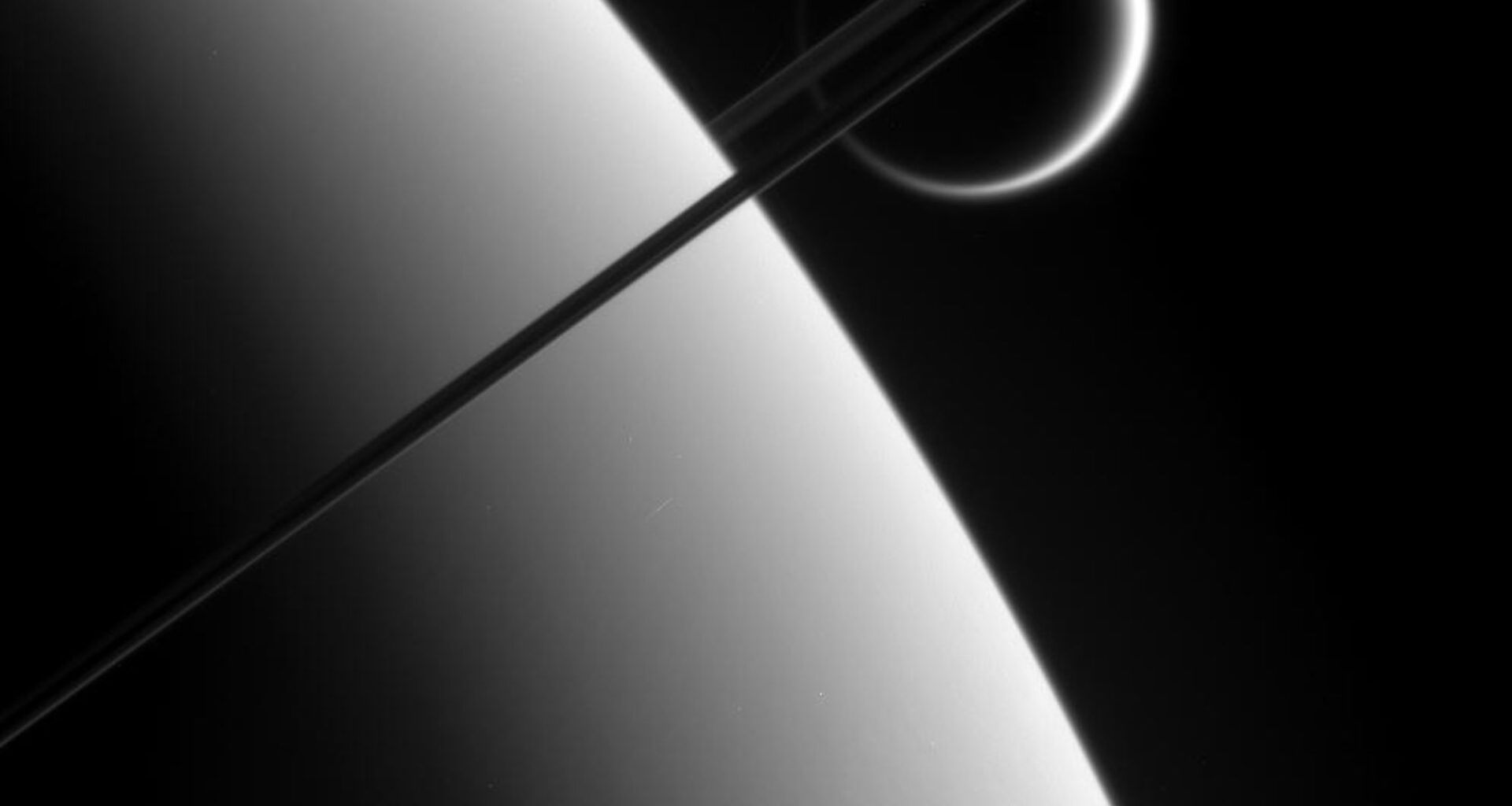
For centuries, Saturn’s shimmering rings have captivated astronomers and stargazers alike. Yet their ages and the histories of Saturn’s moons have remained among planetary science’s most tantalizing mysteries.
Saturn’s system is mainly shaped by Titan, its largest moon, which is moving outward rapidly due to tidal forces within Saturn.
A new study led by SETI Institute scientist Matija Ćuk suggests that Saturn’s moons and rings may be linked, with Titan possibly formed from a merger of two moons.
Near the end of its mission, Cassini measured Saturn’s internal mass distribution, which governs the planet’s spin-axis wobble (precession). Scientists had long believed Saturn’s precession matched Neptune’s, allowing gravitational interactions to tilt Saturn and reveal its rings. But Cassini showed Saturn’s mass is more concentrated at its center, breaking that resonance.
Scientists Detected Unexpected Behavior on Saturn’s Moon Titan
To explain this, researchers at MIT and UC Berkeley proposed that Saturn once had an extra moon, which was destabilized and either ejected or destroyed. Ćuk’s team took this idea further.
Computer simulations suggest the extra moon likely collided with Titan. This merger would have erased Titan’s craters, disturbed its orbit, and left behind debris. Saturn’s small, chaotic moon Hyperion, locked in resonance with Titan, may itself be a remnant of this upheaval.
SETI Institute scientist Matija Ćuk, who led the study, said, “In simulations where the extra moon became unstable, Hyperion was often lost and survived only in rare cases. We recognized that the Titan-Hyperion lock is relatively young, only a few hundred million years old.”
“Perhaps Hyperion did not survive this upheaval but resulted from it. If the extra moon merged with Titan, it would likely produce fragments near Titan’s orbit. That is exactly where Hyperion would have formed.”
The simulations also suggest that Saturn’s largest moon, Titan, resulted from the merger of two earlier moons: a “Proto-Titan,” nearly as large as Titan itself, and a smaller “Proto-Hyperion.” This merger would have erased Titan’s craters, disturbed its orbit, and left behind debris.
Titan’s orbit is still settling down, which hints at a recent collision with a smaller moon, Proto‑Hyperion. Before the merger, Proto‑Titan may have looked like Jupiter’s Callisto, cratered and without an atmosphere. The study also found that Proto‑Hyperion tilted the orbit of Saturn’s distant moon Iapetus before it disappeared, solving another mystery.
If a moon‑moon merger created Titan, then Saturn’s rings likely came from a different event. Researchers suggest the rings formed from collisions between medium‑sized moons closer to Saturn.
Computer simulations supported the idea- showing that most of the debris from these crashes would clump back into new moons, but some fragments would drift inward and spread out to form Saturn’s bright rings.
Mars once had a ring billions of years ago
For a long time, scientists thought Saturn’s inner moons collided because of the Sun’s influence. But new research shows the real trigger was Titan’s earlier merger. After that event, Titan’s orbit became stretched (eccentric), and this can throw smaller moons off balance when their orbits line up with Titan’s in a pattern called orbital resonance.
When this happens, the smaller moons’ paths become unstable, stretching out until they crash into each other. These collisions made debris. Some of it re-formed into moons, while the rest drifted inward to form Saturn’s rings. We do not know exactly when this second cataclysm happened, but it took place after Titan merged. This timing fits with the idea that Saturn’s rings are about 100 million years old.
Journal Reference:
Matija Ćuk, Maryame El Moutamid, Jim Fuller, Valéry Lainey. Origin of Hyperion and Saturn’s Rings in A Two-Stage Saturnian System Instability. Planetary Science Journal. DOI: abs/2602.09281