
The artist’s energised impasto — predominantly red, yellow and blue, punctuated by elements of pink and white — creates a depth of field.
Shiraga made his name in the Gutai group, the avant-garde movement that flourished in post-war Japan, producing works in a signature fashion that blended performance art and painting. Created in 1989, Yagenko dates from a mature period in his career. He had been initiated as a lay monk in the esoteric Tendai Buddhist sect the previous decade, and he now chanted a sutra before starting work on each painting, deeming it integral to his artistic process. One might say that the genesis of Yagenko was spiritual, while its execution was utterly dynamic.
Richter is another artist renowned for a radical painting technique: in his case, applying layers of wet paint to a canvas and then dragging a squeegee across its surface. He began using the method in the early 1980s, and it is associated with his abstract works (he has also painted figuratively).
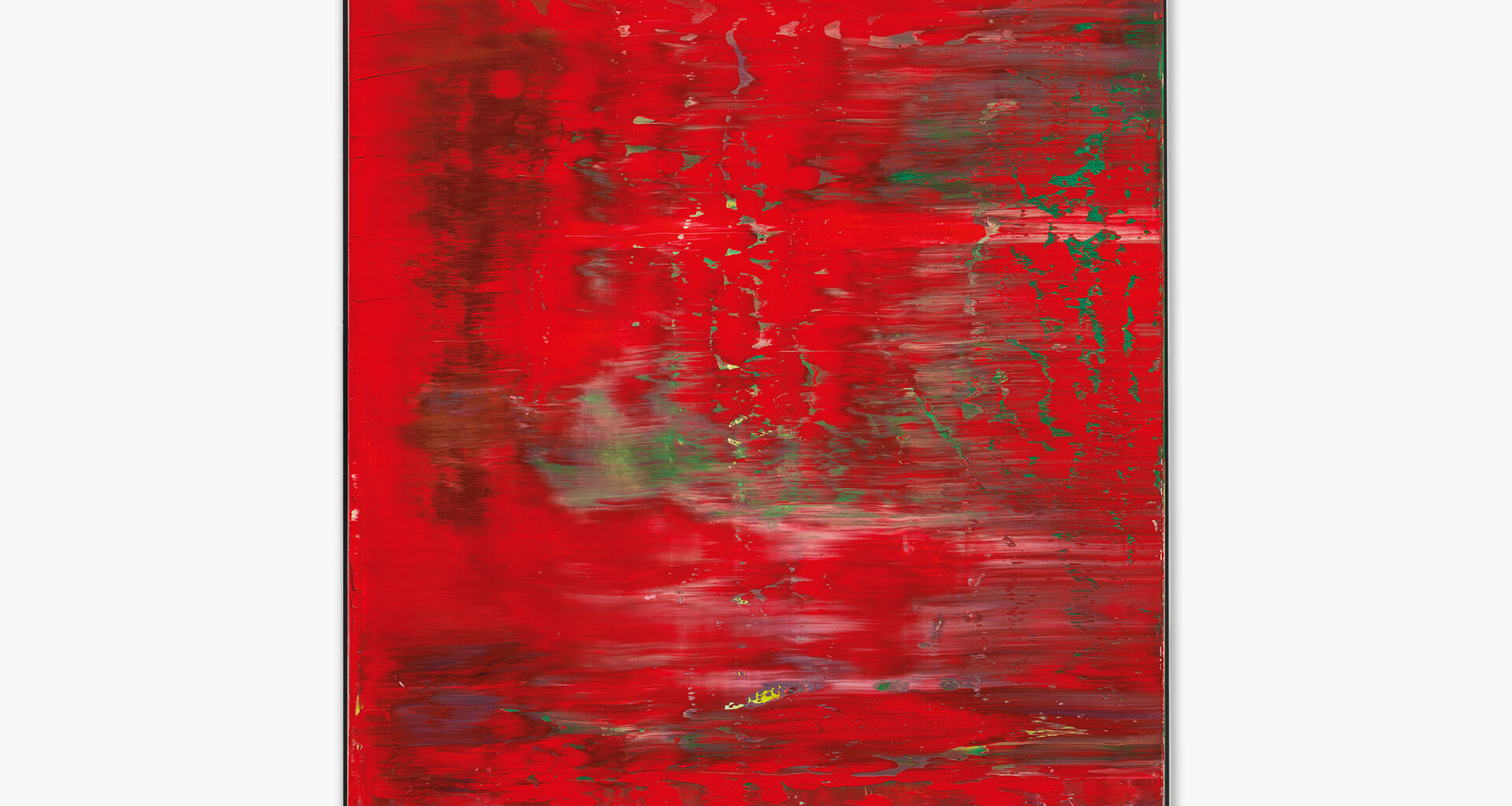
Abstraktes Bild is an excellent example. Its surface is blazing red — red, that is, in a broad spectrum of shades, from cherry, rose and brick, to burgundy and carmine. Other colours glimmer through the surface like jewels, as if the squeegee has veiled our view of a tantalising world beyond.
Richter enjoyed the element of chance that his tool introduced. The squeegee, he said, ‘is a good technique for switching off thinking. Consciously, I can’t calculate the result. But subconsciously, I can sense it.’